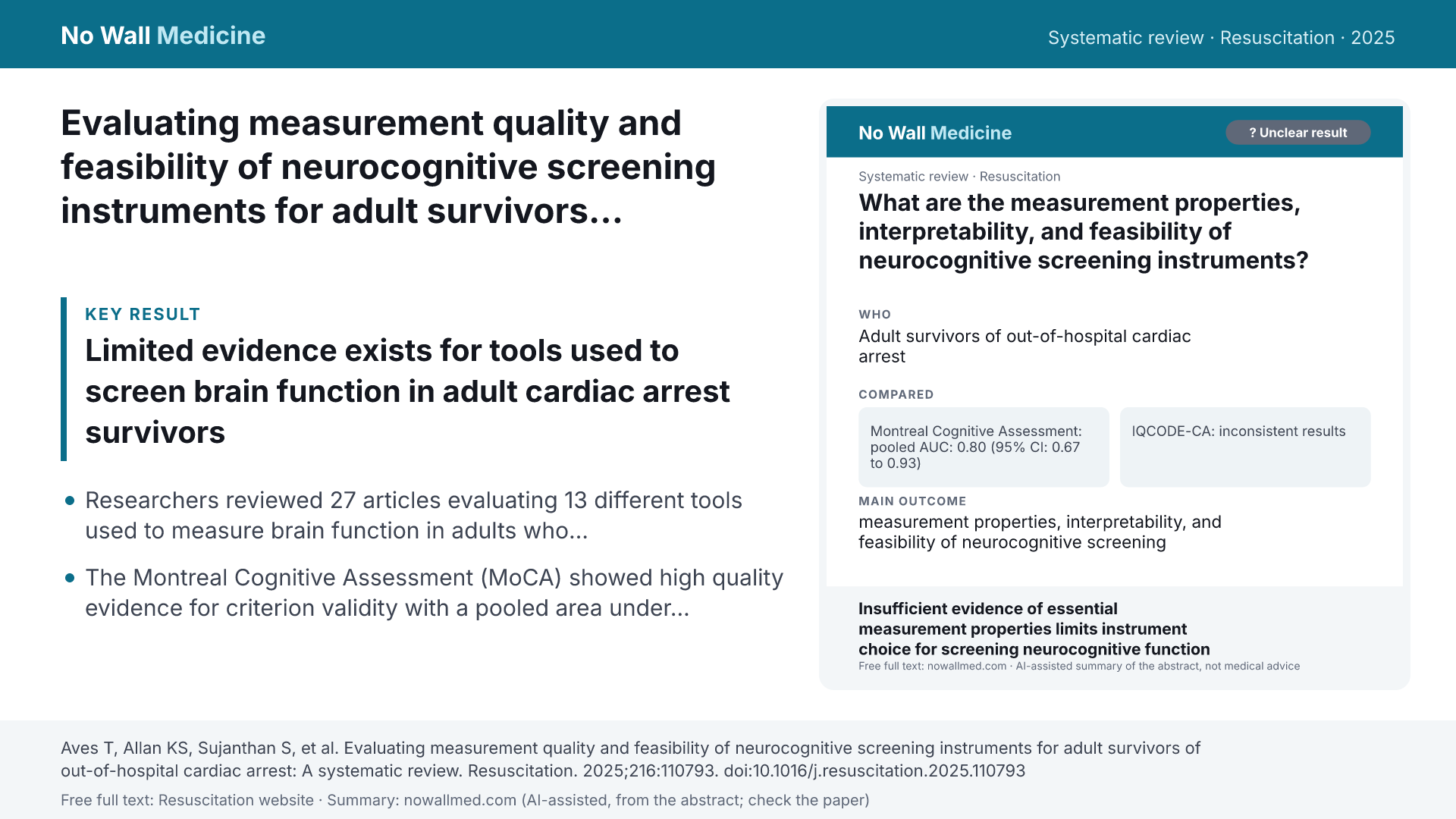
Limited evidence exists for tools used to screen brain function in adult cardiac arrest survivors
Evaluating measurement quality and feasibility of neurocognitive screening instruments for adult survivors of out-of-hospital cardiac arrest: A systematic review
Systematic reviewUnclear result
What are the measurement properties, interpretability, and feasibility of neurocognitive screening instruments?
Who
Adult survivors of out-of-hospital cardiac arrest
Compared
Montreal Cognitive Assessment: pooled AUC: 0.80 (95% CI: 0.67 to 0.93)
IQCODE-CA: inconsistent results
Main outcome
measurement properties, interpretability, and feasibility of neurocognitive screening instruments
Result: pooled AUC: 0.80 (95% CI: 0.67 to 0.93)
Bottom line: Insufficient evidence of essential measurement properties limits instrument choice for screening neurocognitive function in cardiac arrest survivors.
Limitation: Insufficient evidence of essential measurement properties and limited evidence of score interpretability and feasibility.
Resuscitation · 2025-08-30Download image
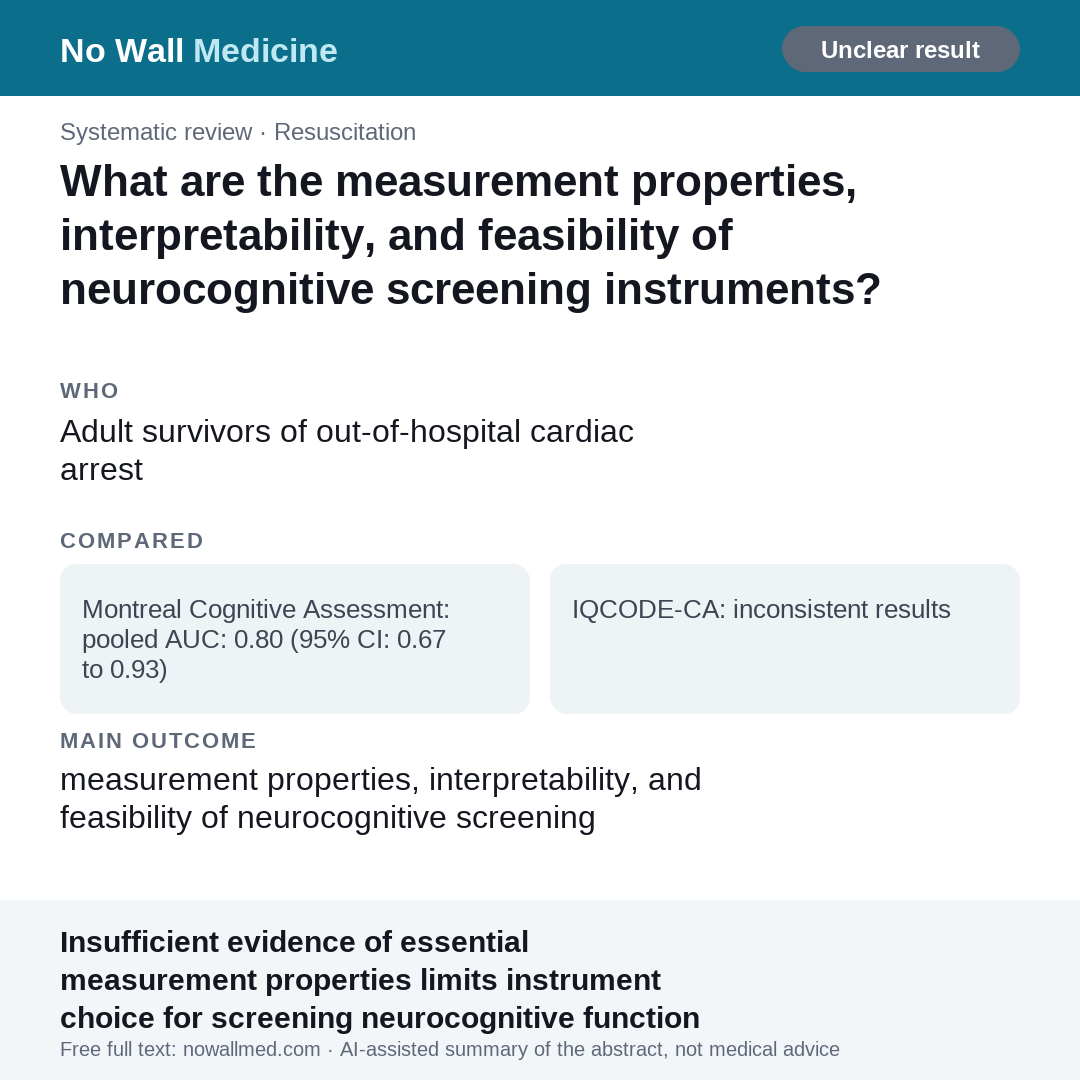
Clinical question: What are the measurement properties, interpretability, and feasibility of neurocognitive screening instruments?
Why it matters: Clinicians lack sufficient evidence regarding the measurement quality and feasibility of tools used to screen neurocognitive function in survivors of out-of-hospital cardiac arrest.
Key points
- Researchers reviewed 27 articles evaluating 13 different tools used to measure brain function in adults who survived out-of-hospital cardiac arrest.
- The Montreal Cognitive Assessment (MoCA) showed high quality evidence for criterion validity with a pooled area under the curve of 0.80 (95% CI: 0.67 to 0.93).
- There was limited evidence regarding how easy these tools are to use or how to interpret their scores across all 13 instruments.
Limitation the authors note: Insufficient evidence of essential measurement properties limits instrument choice.
Headline and key points written with AI from the paper’s abstract, with every number checked against it. Read the paper before relying on them.
Was this summary helpful?
Subject terms
Cite this article
Aves T, Allan KS, Sujanthan S, Henderson-Lee Wah D, Rahimi M, Shalca S. Evaluating measurement quality and feasibility of neurocognitive screening instruments for adult survivors of out-of-hospital cardiac arrest: A systematic review. Resuscitation. 2025. doi:10.1016/j.resuscitation.2025.110793
Spotted a mistake? Suggest a correction