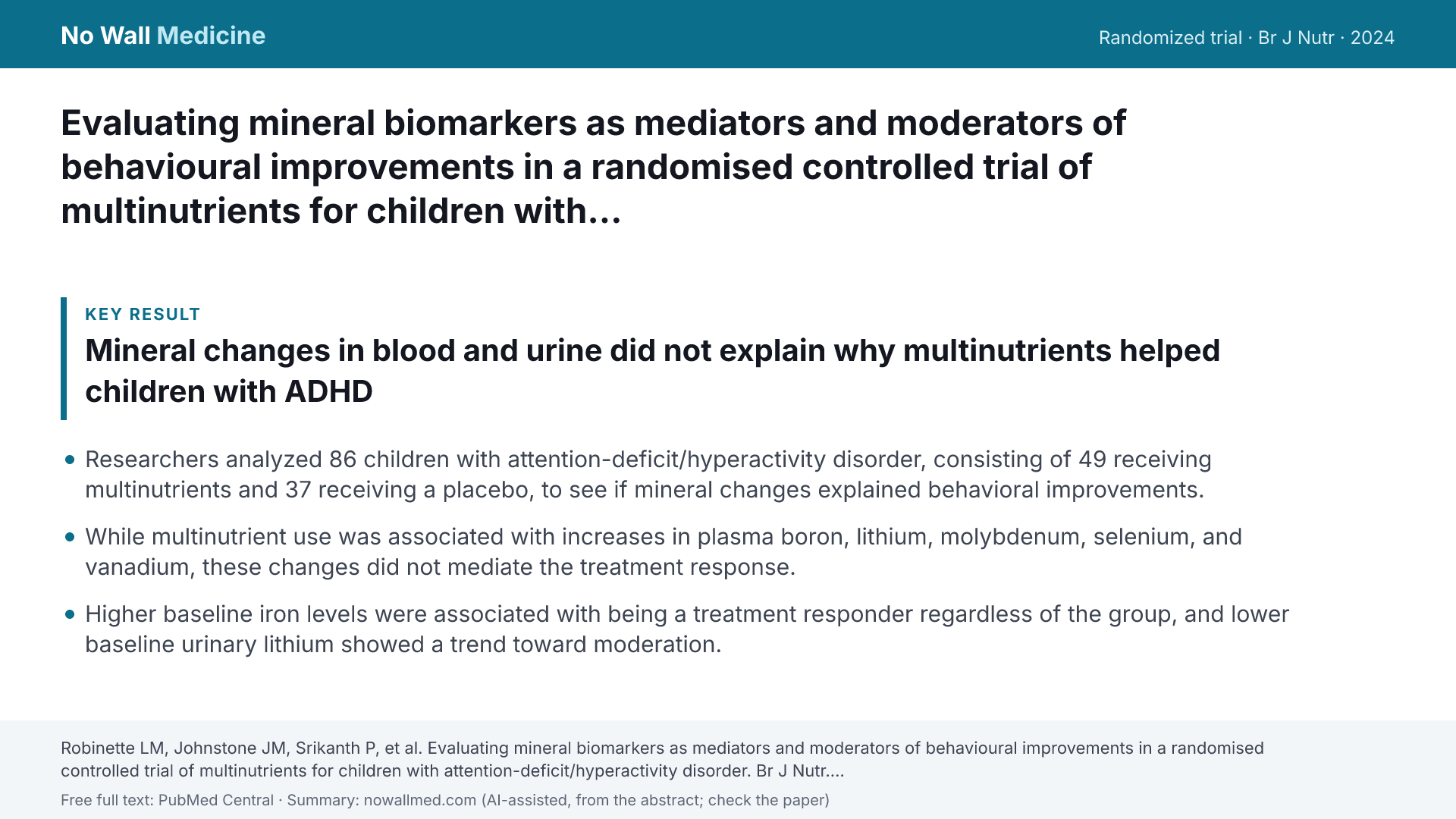
Mineral changes in blood and urine did not explain why multinutrients helped children with ADHD
Evaluating mineral biomarkers as mediators and moderators of behavioural improvements in a randomised controlled trial of multinutrients for children with attention-deficit/hyperactivity disorder
Key points
- Researchers analyzed 86 children with attention-deficit/hyperactivity disorder, consisting of 49 receiving multinutrients and 37 receiving a placebo, to see if mineral changes explained behavioral improvements.
- While multinutrient use was associated with increases in plasma boron, lithium, molybdenum, selenium, and vanadium, these changes did not mediate the treatment response.
- Higher baseline iron levels were associated with being a treatment responder regardless of the group, and lower baseline urinary lithium showed a trend toward moderation.
Headline and key points written with AI from the paper’s abstract, with every number checked against it. Read the paper before relying on them.
Was this summary helpful?
Subject terms
Headline, design, result, key points, caveat and citation as plain text.
Cite this article
Robinette LM, Johnstone JM, Srikanth P, et al. Evaluating mineral biomarkers as mediators and moderators of behavioural improvements in a randomised controlled trial of multinutrients for children with attention-deficit/hyperactivity disorder. Br J Nutr. 2024;132(3):315-329. doi:10.1017/S0007114524001132
Spotted a mistake? Suggest a correction