Evaluating SinergiAPS, an intervention based on patient feedback to improve patient safety in primary care: a cluster randomized trial
Cluster randomized controlled trialNo clear difference
Does the SinergiAPS intervention improve patient safety in primary healthcare centres?
Who
1053
Primary healthcare professionals and centres in Spain · Multicentre, Spain
Compared
3.60SinergiAPS intervention (95% CI 3.55 to 3.64)
3.64Usual care (95% CI 3.60 to 3.68)
Main outcome
Patient safety culture
Bottom line: The SinergiAPS intervention did not improve patient safety culture in Spanish primary healthcare centres.
Limitation: The COVID-19 pandemic limited the capacity to develop and implement safety improvement action plans.
BMC Med · 2025-04-07Download image
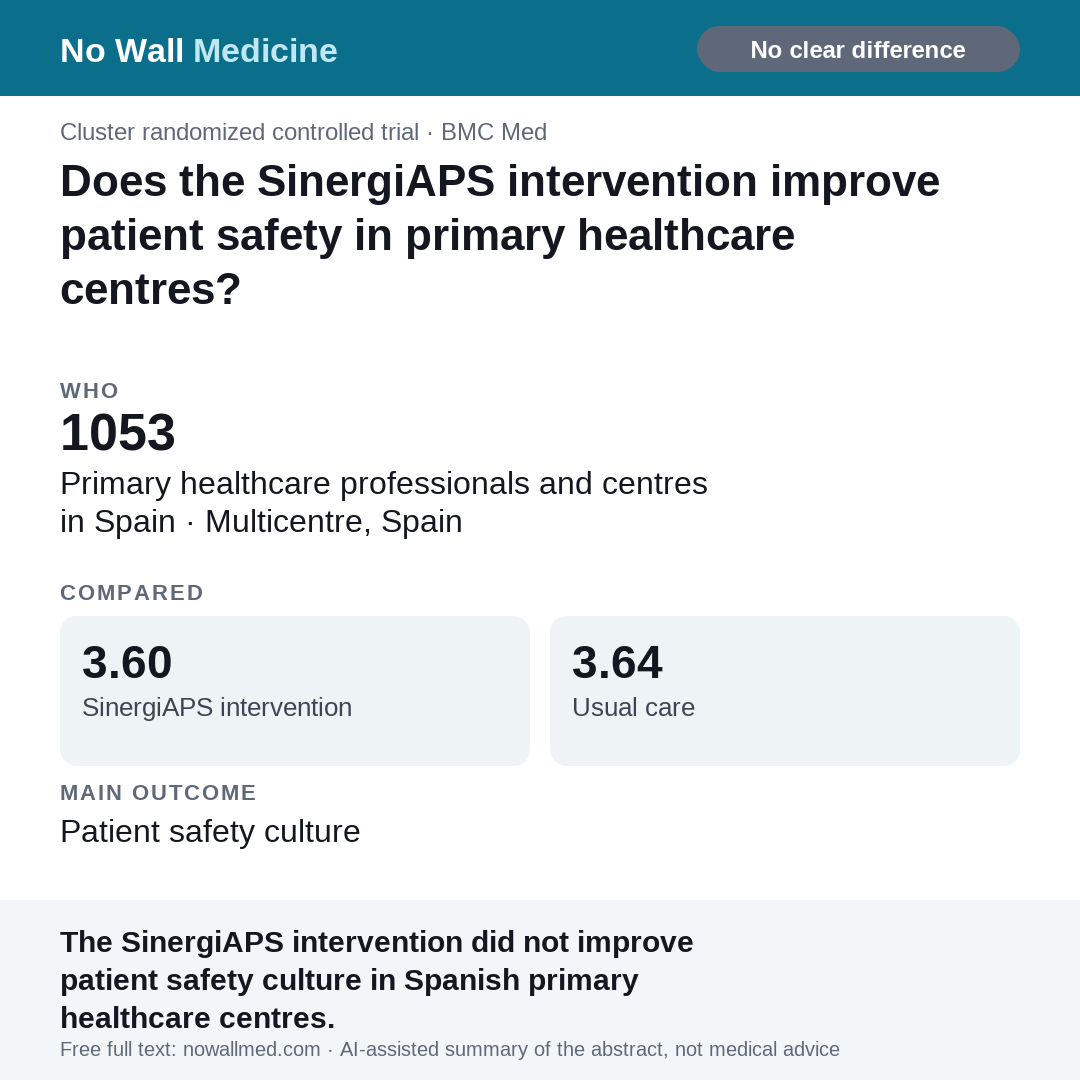
Clinical question: Does the SinergiAPS intervention improve patient safety in primary healthcare centres?
Abstract
Background
Patient safety, defined by the WHO as the absence of preventable harm, is a critical component of healthcare quality and poses a significant challenge globally. This study aimed to evaluate the effectiveness of SinergiAPS, a patient-centred audit and feedback intervention, in improving patient safety in primary healthcare (PHC) centres. Methods
We conducted a 12-month cluster randomized controlled, multicentre trial. Fifty-nine PHC centres (1053 PHC professionals) in Spain were recruited and randomly allocated (1:1) to usual care or SinergiAPS intervention. The SinergiAPS intervention comprised: a bespoke feedback report with results from audits of patient safety based on the Patient Reported Experiences and Outcomes of Safety in Primary Care (PREOS-PC) questionnaire, administered to 75 patients/centre; a set of educational materials, and a structured template to record safety improvement plans. The primary outcome (at the PHC professional level) was patient safety culture (Medical Office Survey on Patient Safety Culture (MOSPSC) questionnaire). Secondary outcomes (at the centre level) were patient-reported safety (six PREOS-PC scales), and rate of avoidable hospital admissions. After a 12-month follow-up, we conducted 15 semi-structured interviews with PHC professionals to explore their perceptions of the intervention. Results
During the 12-month follow-up, 10 of the 30 centres in the intervention group held action plan team meetings and eight registered 57 safety improvement action plans. The plans aimed to improve patient activation, address treatment-related incidents, enhance communication between patients and providers, and strengthen patient safety culture. At 12 months, no significant differences were observed in MOSPSC mean score (intervention: 3.60 [95% CI 3.55 to 3.64] vs. control: 3.64 [3.60 to 3.68]). Similarly, no differences were observed in the secondary outcomes, with both groups experiencing a decline in patient-reported safety and avoidable hospital admissions. The qualitative interviews evidenced that the onset of the COVID-19 pandemic 6-9 weeks after initiating the follow-up period severely limited PHC's capacity of developing and implementing safety improvement action plans, despite high levels of acceptability and perceived utility of the SinergiAPS intervention. Conclusions
In the context of the health emergency caused by the COVID-19 pandemic, SinergiAPS did not improve patient safety in Spanish PHC centres. Trial registration
ClinicalTrials.gov (NCT03837912).
Subject terms
Cite this article
Fiol-deRoque MA, Valderas JM, Serrano-Ripoll MJ, Gens-Barbarà M, Martín-Luján F, Sánchez-Freire E. Evaluating SinergiAPS, an intervention based on patient feedback to improve patient safety in primary care: a cluster randomized trial. BMC Med. 2025. doi:10.1186/s12916-025-04029-7
Spotted a mistake? Suggest a correction
Top studies every Monday
The week’s key trials and guidelines in your specialties, plus any topics you follow. By email, free.
Get the weekly digest