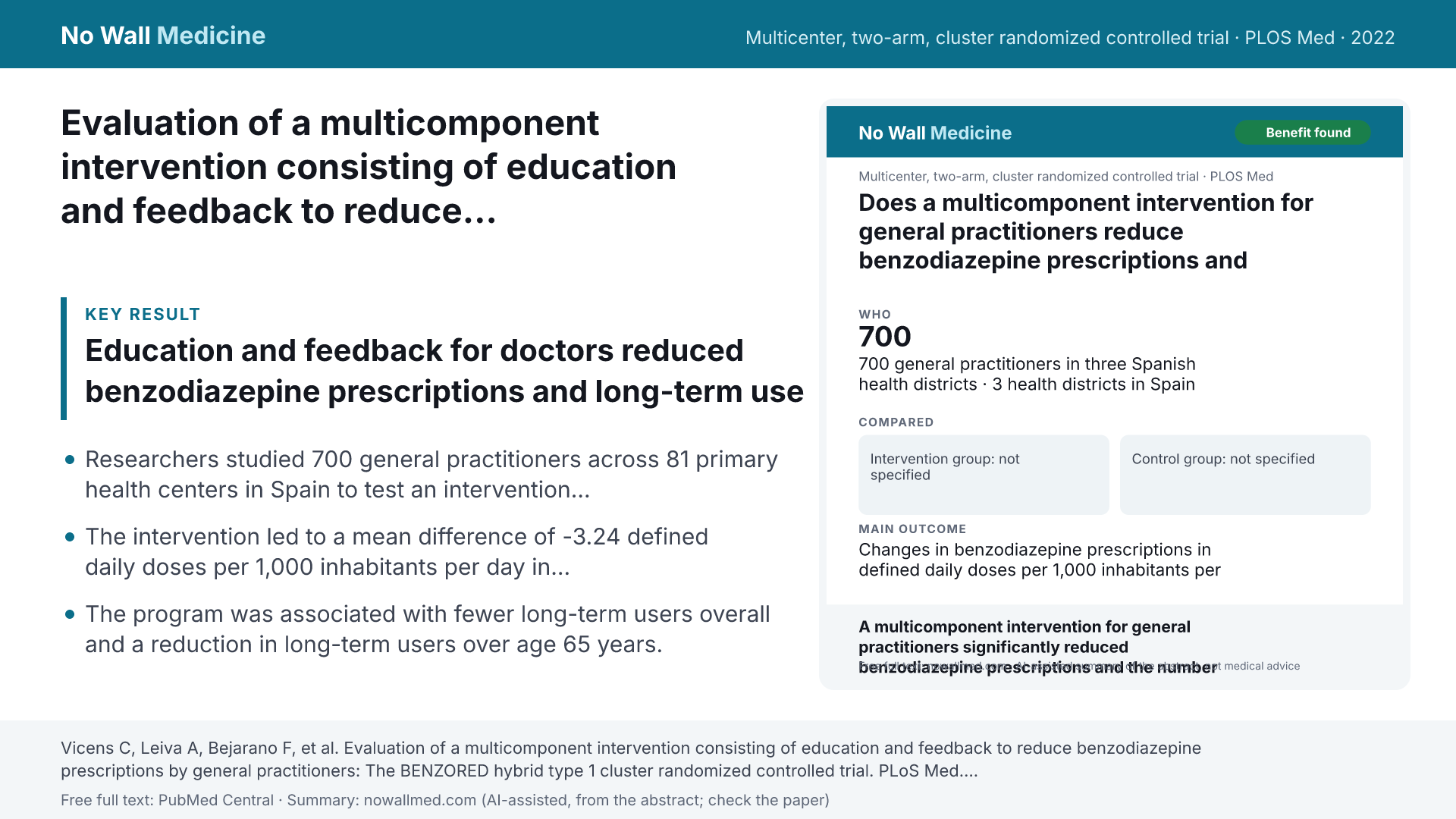
Education and feedback for doctors reduced benzodiazepine prescriptions and long-term use
Evaluation of a multicomponent intervention consisting of education and feedback to reduce benzodiazepine prescriptions by general practitioners: The BENZORED hybrid type 1 cluster randomized controlled trial
Multicenter, two-arm, cluster randomized controlled trialBenefit found
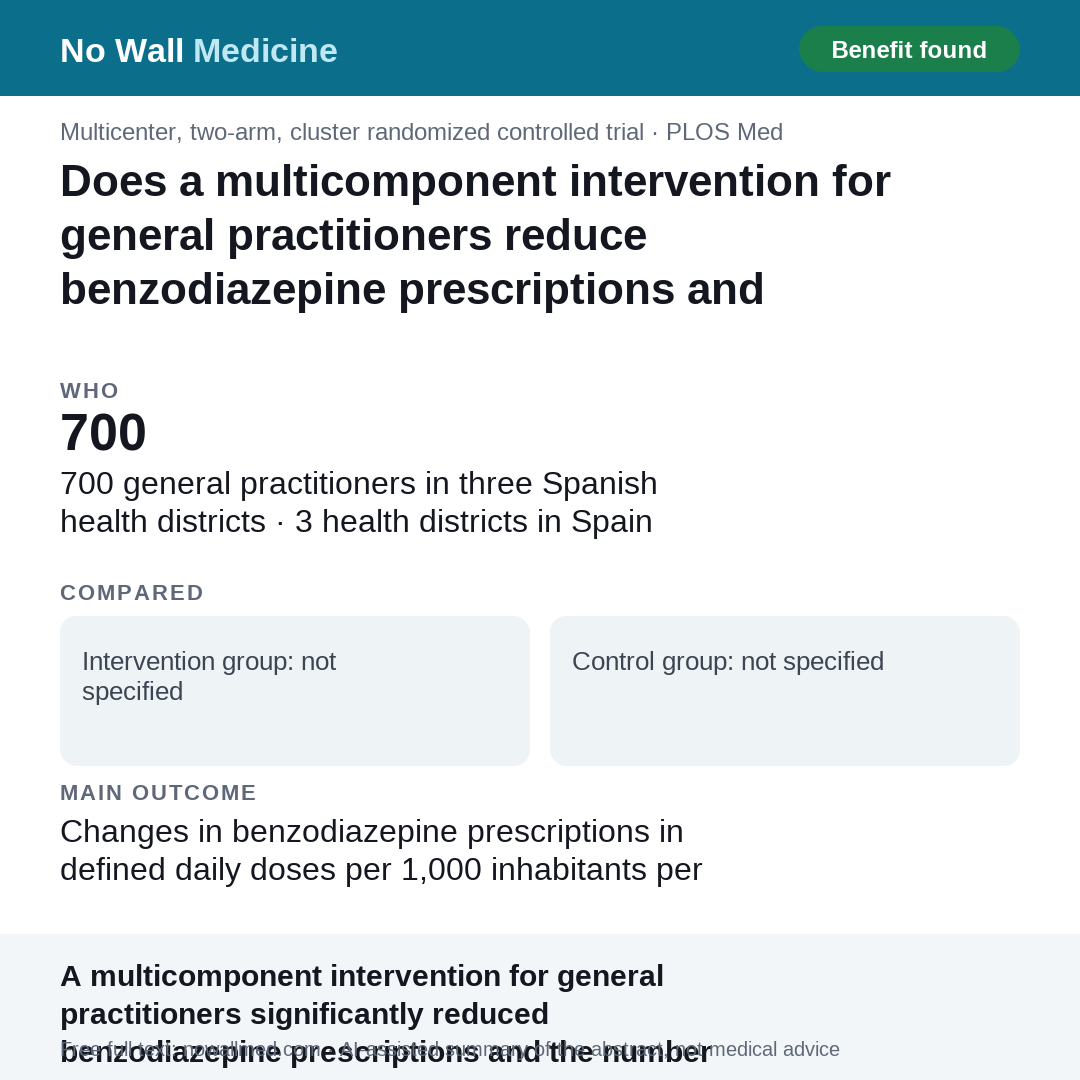
Does a multicomponent intervention for general practitioners reduce benzodiazepine prescriptions and long-term use?
Who
700
700 general practitioners in three Spanish health districts · 3 health districts in Spain
Compared
Intervention group: not specified
Control group: not specified
Main outcome
Changes in benzodiazepine prescriptions in defined daily doses per 1,000 inhabitants per day
Result: mean difference: -3.24 DDDs per 1,000 inhabitants per day, 95% CI: -4.96, -1.53
Bottom line: A multicomponent intervention for general practitioners significantly reduced benzodiazepine prescriptions and the number of long-term users.
Limitation: Imbalance of some baseline characteristics between the groups.
PLOS Med · 2022-05-06Download image
Clinical question: Does a multicomponent intervention for general practitioners reduce benzodiazepine prescriptions and long-term use?
Why it matters: It is unknown if interventions delivered by general practitioners can effectively reduce the prescription and long-term use of benzodiazepines, which are linked to dependence and falls.
Key points
- Researchers studied 700 general practitioners across 81 primary health centers in Spain to test an intervention involving workshops, monthly prescription feedback, and a support website.
- The intervention led to a mean difference of -3.24 defined daily doses per 1,000 inhabitants per day in benzodiazepine prescriptions compared to the control group.
- The program was associated with fewer long-term users overall and a reduction in long-term users over age 65 years.
Limitation the authors note: The authors state that the cluster randomized design had an imbalance of some baseline characteristics, including higher baseline prescription rates in the control group.
Headline and key points written with AI from the paper’s abstract, with every number checked against it. Read the paper before relying on them.
Was this summary helpful?
Subject terms
Cite this article
Vicens C, Leiva A, Bejarano F, et al. Evaluation of a multicomponent intervention consisting of education and feedback to reduce benzodiazepine prescriptions by general practitioners: The BENZORED hybrid type 1 cluster randomized controlled trial. PLOS Med. 2022. doi:10.1371/journal.pmed.1003983
Spotted a mistake? Suggest a correction