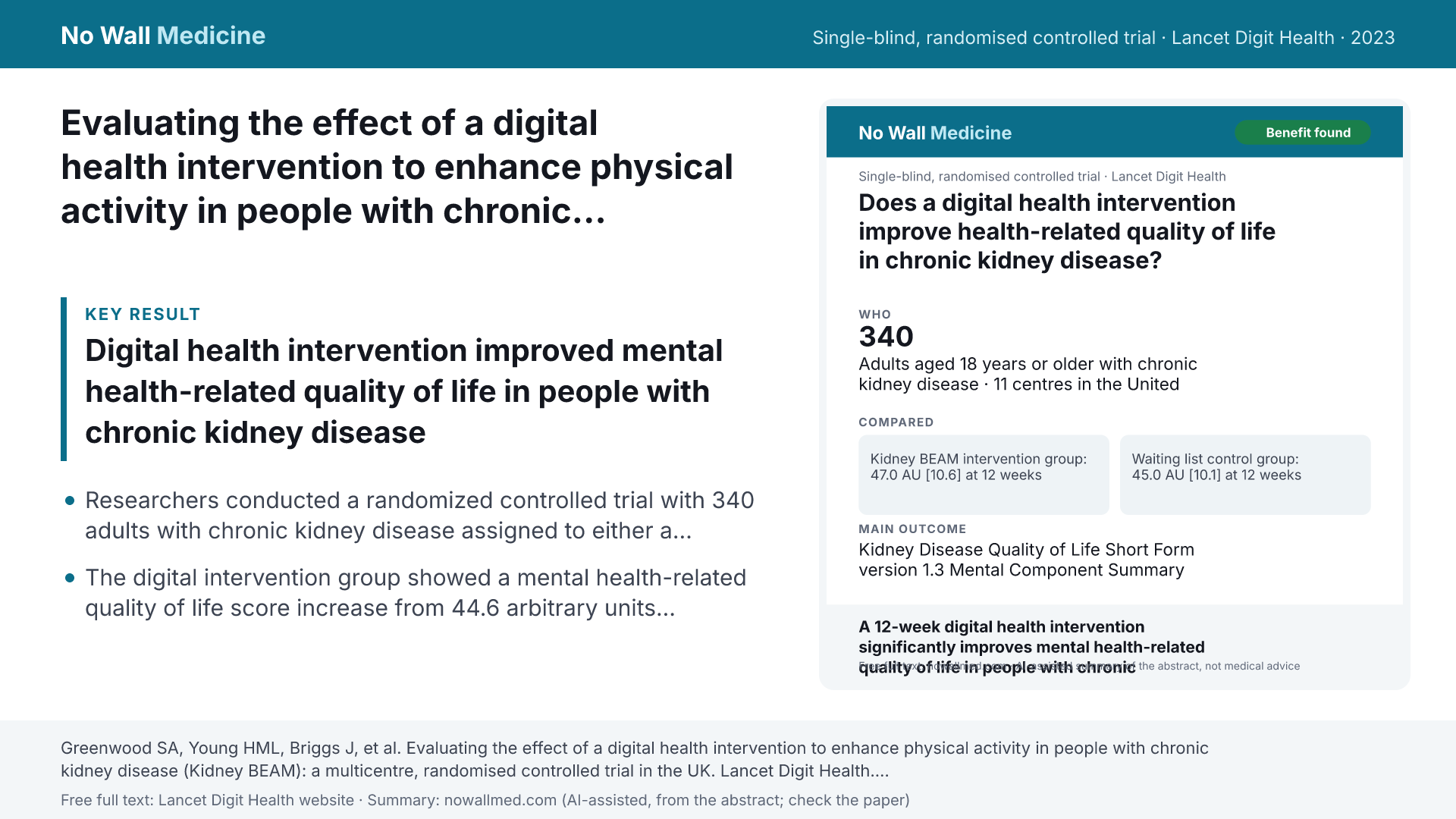
Digital health intervention improved mental health-related quality of life in people with chronic kidney disease
Evaluating the effect of a digital health intervention to enhance physical activity in people with chronic kidney disease (Kidney BEAM): a multicentre, randomised controlled trial in the UK
Single-blind, randomised controlled trialBenefit found
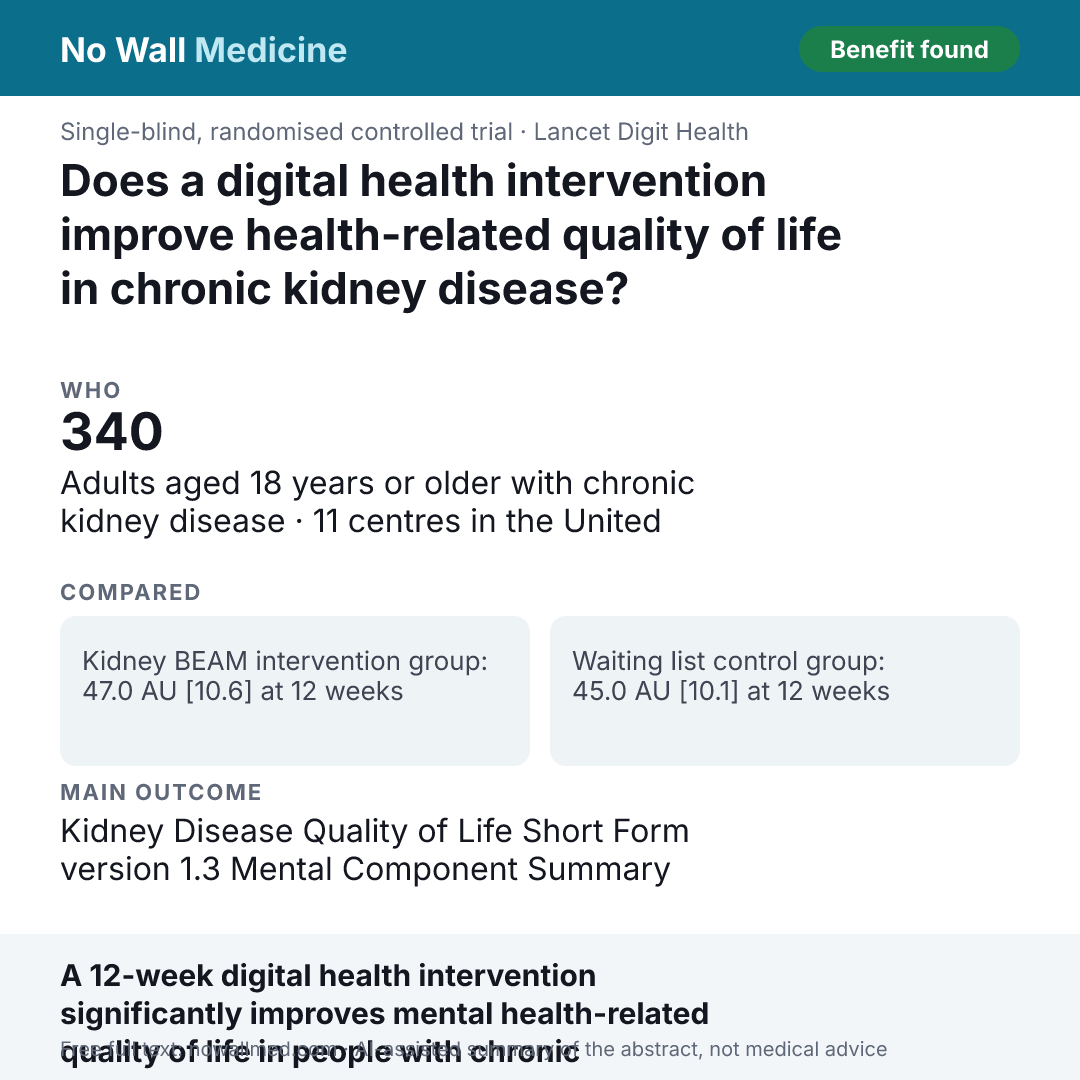
Does a digital health intervention improve health-related quality of life in chronic kidney disease?
Who
340
Adults aged 18 years or older with chronic kidney disease · 11 centres in the United Kingdom
Compared
Kidney BEAM intervention group: 47.0 AU [10.6] at 12 weeks
Waiting list control group: 45.0 AU [10.1] at 12 weeks
Main outcome
Kidney Disease Quality of Life Short Form version 1.3 Mental Component Summary
Result: between-group difference of 3.1 AU [95% CI 1.8-4.4]
Bottom line: A 12-week digital health intervention significantly improves mental health-related quality of life in people with chronic kidney disease.
Funded by: Kidney Research UK
Lancet Digit Health · 2023-11-14 · Save PNG
Clinical question: Does a digital health intervention improve health-related quality of life in chronic kidney disease?
Why it matters: High-quality evidence is needed to support the implementation of remote digital health interventions to improve sedentary behavior and quality of life in people with chronic kidney disease.
Key points
- Researchers conducted a randomized controlled trial with 340 adults with chronic kidney disease assigned to either a digital physical activity intervention or a waiting list.
- The digital intervention group showed a mental health-related quality of life score increase from 44.6 arbitrary units to 47.0 arbitrary units compared to 46.1 to 45.0 in the control group.
- The difference between the two groups at 12 weeks was 3.1 arbitrary units (95% CI 1.8-4.4; p<0.0001).
Headline and key points written with AI from the paper’s abstract, with every number checked against it. Read the paper before relying on them.
Was this summary helpful?
Abstract
Background
Remote digital health interventions to enhance physical activity provide a potential solution to improve the sedentary behaviour, physical inactivity, and poor health-related quality of life that are typical of chronic conditions, particularly for people with chronic kidney disease. However, there is a need for high-quality evidence to support implementation in clinical practice. The Kidney BEAM trial evaluated the clinical effect of a 12-week physical activity digital health intervention on health-related quality of life. Methods
In a single-blind, randomised controlled trial conducted at 11 centres in the UK, adult participants (aged ≥18 years) with chronic kidney disease were recruited and randomly assigned (1:1) to the Kidney BEAM physical activity digital health intervention or a waiting list control group. Randomisation was performed with a web-based system, in randomly permuted blocks of six. Outcome assessors were masked to treatment allocation. The primary outcome was the difference in the Kidney Disease Quality of Life Short Form version 1.3 Mental Component Summary (KDQoL-SF1.3 MCS) between baseline and 12 weeks. The trial was powered to detect a clinically meaningful difference of 3 arbitrary units (AU) in KDQoL-SF1.3 MCS. Outcomes were analysed by an intention-to-treat approach using an analysis of covariance model, with baseline measures and age as covariates. The trial was registered with ClinicalTrials.gov, NCT04872933. Findings
Between May 6, 2021, and Oct 30, 2022, 1102 individuals were assessed for eligibility, of whom 340 participants were enrolled and randomly assigned to the Kidney BEAM intervention group (n=173) or the waiting list control group (n=167). 268 participants completed the trial (112 in the Kidney BEAM group and 156 in the waiting list control group). All 340 randomly assigned participants were included in the intention-to treat population. At 12 weeks, there was a significant improvement in KDQoL-SF.13 MCS score in the Kidney BEAM group (from mean 44·6 AU [SD 10·8] at baseline to 47·0 AU [10·6] at 12 weeks) compared with the waiting list control group (from 46·1 AU [10·5] to 45·0 AU [10·1]; between-group difference of 3·1 AU [95% CI 1·8-4·4]; p<0·0001). Interpretation
The Kidney BEAM physical activity platform is an efficacious digital health intervention to improve mental health-related quality of life in patients with chronic kidney disease. These findings could facilitate the incorporation of remote digital health interventions into clinical practice and offer a potential intervention worthy of investigation in other chronic conditions. Funding
Kidney Research UK.
Abstract reproduced under the article’s CC BY licence.
Subject terms
Headline, design, result, key points, caveat and citation as plain text.
Cite this article
Greenwood SA, Young HML, Briggs J, et al. Evaluating the effect of a digital health intervention to enhance physical activity in people with chronic kidney disease (Kidney BEAM): a multicentre, randomised controlled trial in the UK. Lancet Digit Health. 2024;6(1):e23-e32. doi:10.1016/S2589-7500(23)00204-2
Spotted a mistake? Suggest a correction