Combining stent retrievers and aspiration with balloon guide catheters improves stroke treatment outcomes
Evaluating the effectiveness and safety of initial thrombectomy approaches for acute anterior large vessel occlusions: a comparative network analysis of techniques
Bayesian network meta-analysisBenefit found
Which initial thrombectomy approach is most effective and safe for acute anterior large vessel occlusion?
Who
19268
patients with acute anterior circulation large vessel occlusion strokes
Compared
Stent retriever and aspiration with balloon guide catheter: mTICI 2b-3 OR 2.87 (95% CI 1.64 to 5.20)
Contact aspiration with balloon guide catheter: functional independence OR 1.96 (95% CI 1.16 to 3.41)
Stent retriever and aspiration alone: 90-day mortality OR 1.74 (95% CI 1.06 to 2.66)
Main outcome
recanalization success, first-pass effect, functional independence, and safety
Bottom line: Thrombectomy strategies using balloon guide catheters, especially contact aspiration or combined approaches, show superior efficacy and safety.
J Neurointerv Surg · 2026-06-18Download image
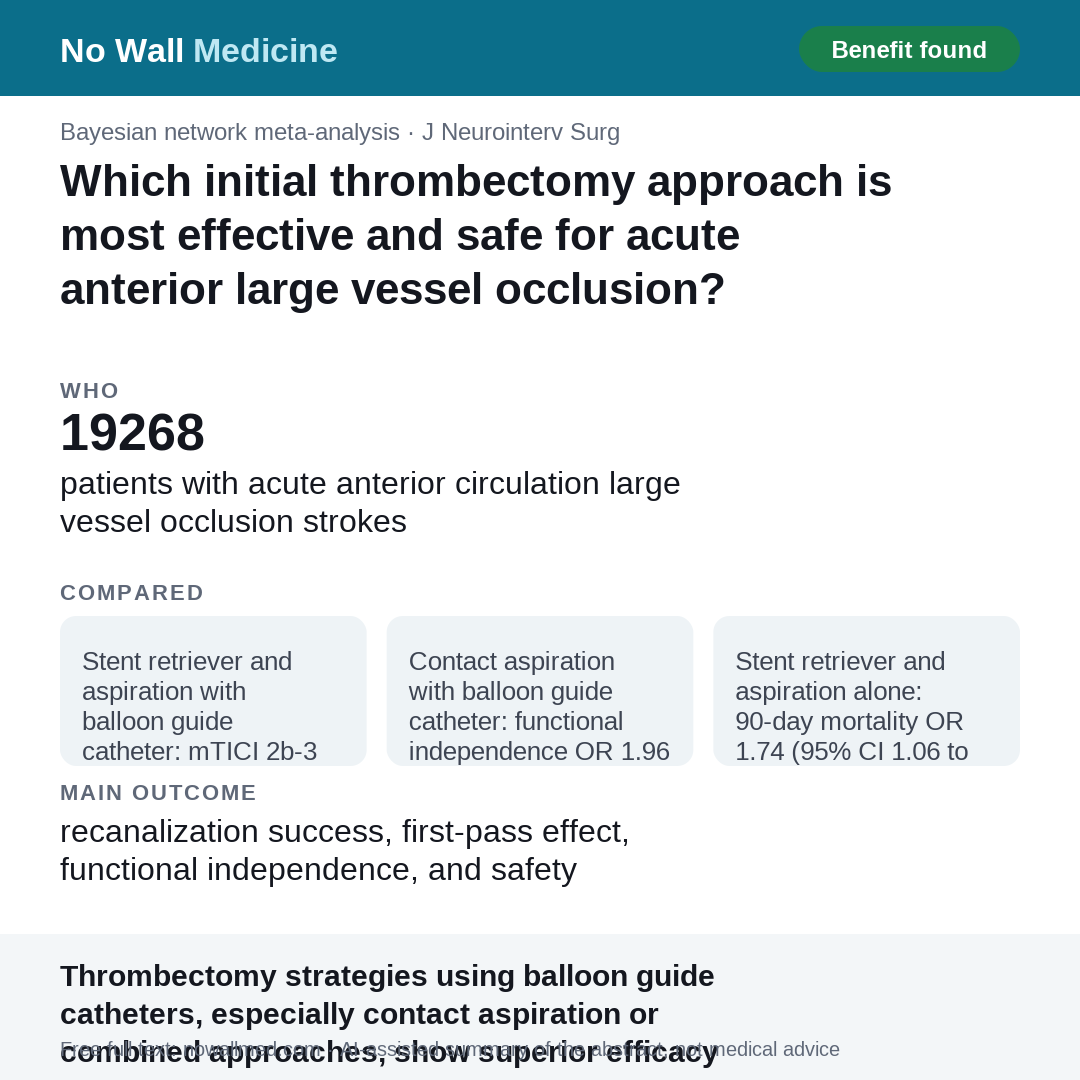
Clinical question: Which initial thrombectomy approach is most effective and safe for acute anterior large vessel occlusion?
Why it matters: Clinicians need to determine which specific mechanical clot removal techniques provide the best efficacy and safety for patients with acute large vessel occlusion strokes.
Key points
- Researchers analyzed 44 studies involving 19,268 participants to compare different mechanical clot removal techniques for large vessel occlusion strokes.
- Combining stent retrievers, aspiration, and balloon guide catheters was most effective for successful blood vessel reopening and first-pass effect.
- Using aspiration and balloon guide catheters was associated with the highest odds of functional independence and the lowest 90-day mortality.
Headline and key points written with AI from the paper’s abstract, with every number checked against it. Read the paper before relying on them.
Abstract
Background
Acute anterior circulation large vessel occlusion (ACLVO) strokes represent a critical challenge in stroke management. Advancements in thrombectomy strategies, including contact aspiration (CA), stent retrievers (SR), and their combination (SRA), particularly with the addition of balloon guide catheters (BGC), aim to enhance outcomes. This systematic review and Bayesian network meta-analysis evaluates the efficacy and safety of these first-line thrombectomy strategies. Methods
A systematic search was performed across nine databases up to March 15, 2025, yielding 44 studies with 19 268 participants. The risk of bias was assessed using RoB 2.0 for randomized controlled trials and ROBINS-I for observational studies. Bayesian random-effects network meta-analysis was conducted, presenting odds ratios (OR) with 95% CIs and ranking interventions via surface under the cumulative ranking curve (SUCRA). Outcomes included recanalization success (modified Thrombolysis in Cerebral Infarction (mTICI) 2b-3), first-pass effect (FPE), functional independence (modified Rankin Scale ≤2 at 90 days), symptomatic intracranial hemorrhage (sICH), and 90-day mortality. Results
SRA+BGC was most effective for achieving mTICI 2b-3 (OR 2.87, 95% CI 1.64 to 5.20, SUCRA 90.1) and FPE (OR 7.33, 95% CI 1.71 to 39.71, SUCRA 91.0). CA+BGC yielded the highest odds of functional independence at 90 days (OR 1.96, 95% CI 1.16 to 3.41, SUCRA 88.1) and the lowest 90-day mortality (OR 0.42, 95% CI 0.20 to 0.95). Safety outcomes favored SR+BGC and SRA+BGC for reducing sICH (OR 0.59, 95% CI 0.37 to 0.91, SUCRA 85.3). CA alone was associated with significant improvements over SR in functional outcomes (OR 1.41, 95% CI 1.09 to 1.83, SUCRA 78.5), but SRA alone was linked to higher mortality (OR 1.74, 95% CI 1.06 to 2.66). Conclusion
Thrombectomy strategies incorporating BGC, particularly CA+BGC and SRA+BGC, achieve superior efficacy and safety outcomes in patients with acute ACLVO stroke.
Abstract reproduced under the article’s CC BY NC licence.
Topics
Cite this article
Wiyarta E, Kurniawan M, Hidayat R, Permana AP, Sinaga GHP, Budiman RA. Evaluating the effectiveness and safety of initial thrombectomy approaches for acute anterior large vessel occlusions: a comparative network analysis of techniques. J Neurointerv Surg. 2026. doi:10.1136/jnis-2025-023769
Spotted a mistake? Suggest a correction