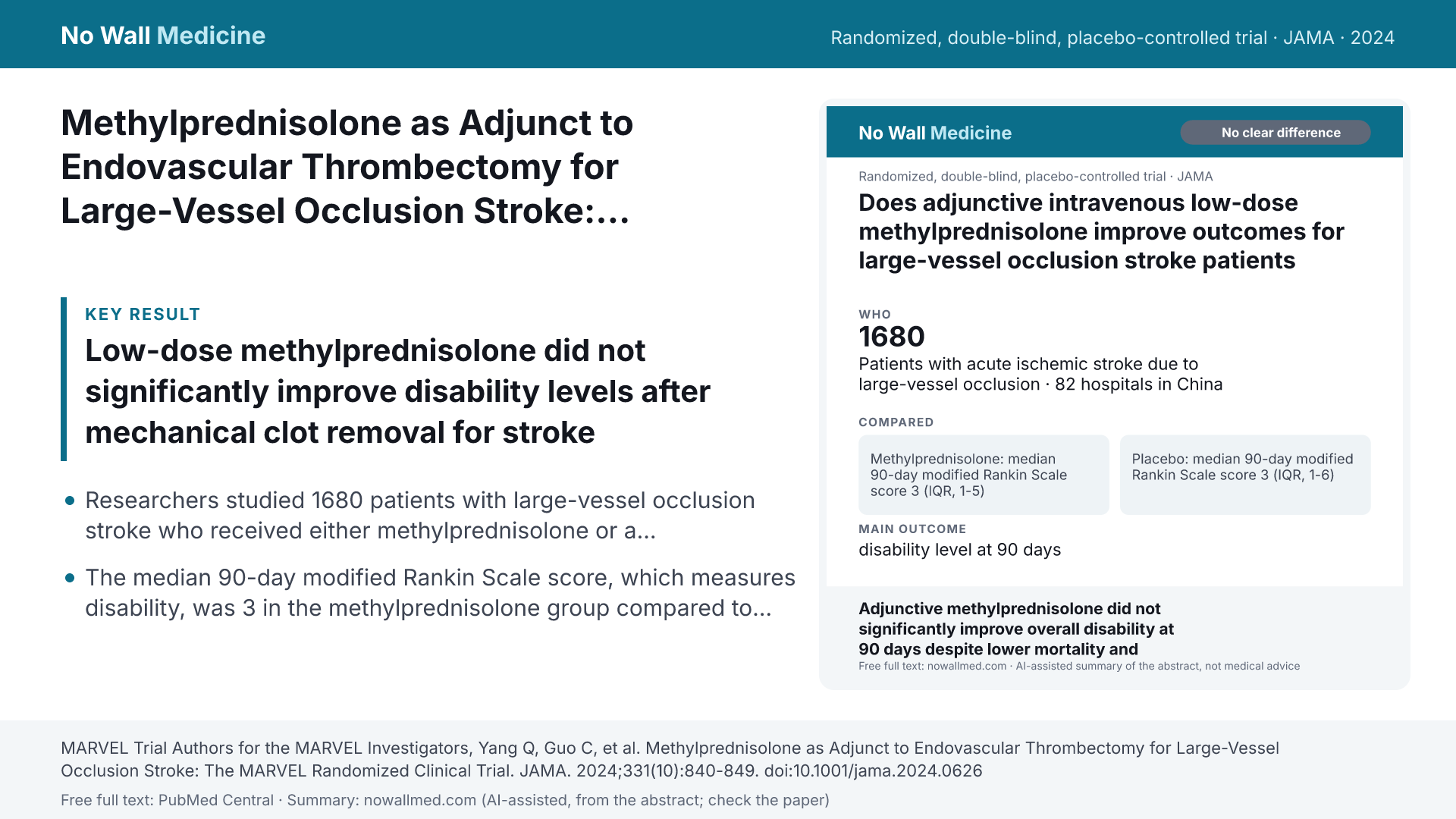
Low-dose methylprednisolone did not significantly improve disability levels after mechanical clot removal for stroke
Methylprednisolone as Adjunct to Endovascular Thrombectomy for Large-Vessel Occlusion Stroke: The MARVEL Randomized Clinical Trial
Randomized, double-blind, placebo-controlled trialNo clear difference
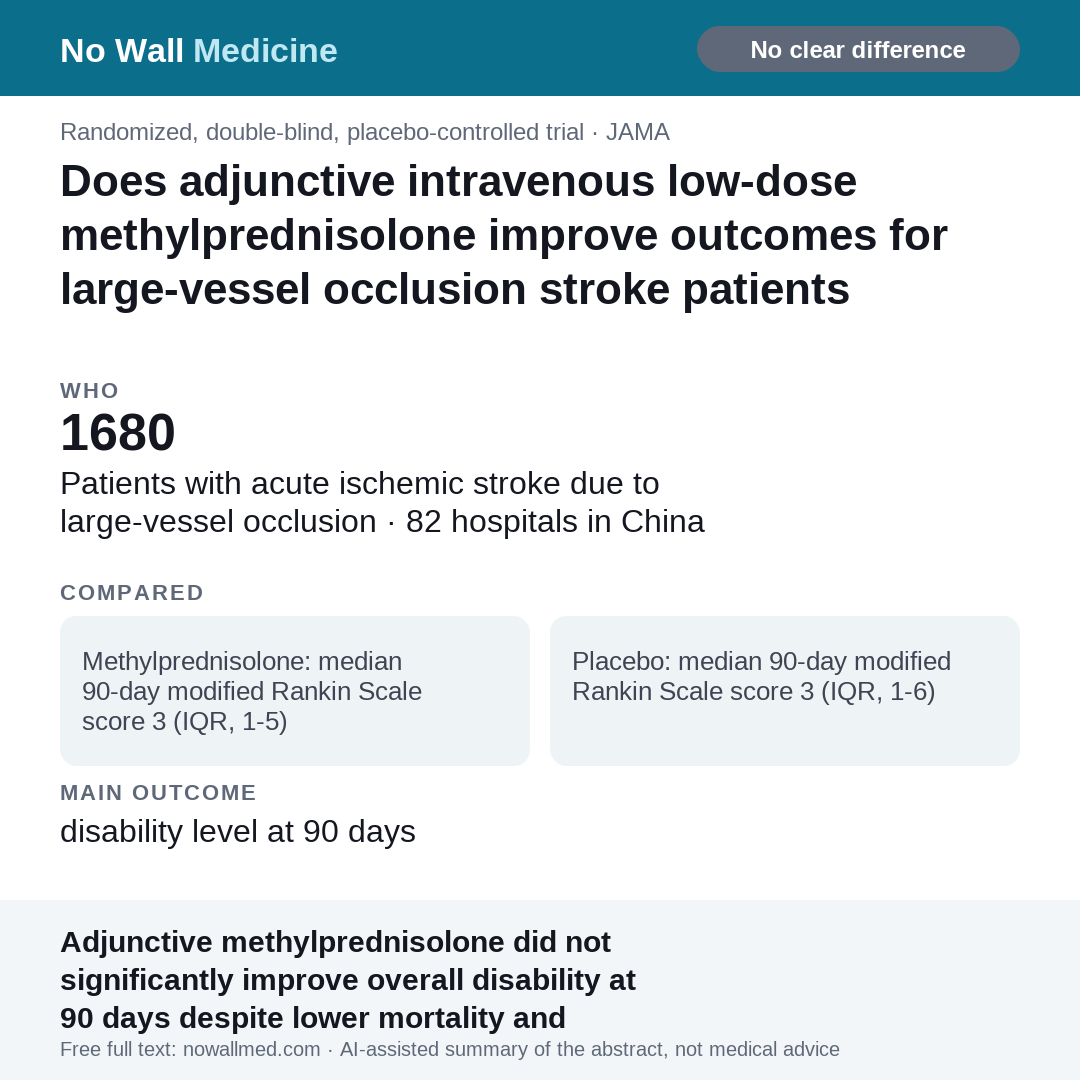
Does adjunctive intravenous low-dose methylprednisolone improve outcomes for large-vessel occlusion stroke patients undergoing endovascular thrombectomy?
Who
1680
Patients with acute ischemic stroke due to large-vessel occlusion · 82 hospitals in China
Compared
Methylprednisolone: median 90-day modified Rankin Scale score 3 (IQR, 1-5)
Placebo: median 90-day modified Rankin Scale score 3 (IQR, 1-6)
Main outcome
disability level at 90 days
Result: adjusted generalized odds ratio 1.10 (95% CI, 0.96-1.25)
Bottom line: Adjunctive methylprednisolone did not significantly improve overall disability at 90 days despite lower mortality and hemorrhage rates.
JAMA · 2024-02-08Download image
Clinical question: Does adjunctive intravenous low-dose methylprednisolone improve outcomes for large-vessel occlusion stroke patients undergoing endovascular thrombectomy?
Why it matters: It is uncertain whether adding intravenous methylprednisolone to mechanical clot removal improves outcomes for patients with acute ischemic stroke caused by large-vessel occlusion.
Key points
- Researchers studied 1680 patients with large-vessel occlusion stroke who received either methylprednisolone or a placebo alongside endovascular thrombectomy, a procedure to remove blood clots.
- The median 90-day modified Rankin Scale score, which measures disability, was 3 in the methylprednisolone group compared to 3 in the placebo group.
- Methylprednisolone was associated with a lower mortality rate of 23.2% versus 28.5% and a lower rate of symptomatic intracranial hemorrhage of 8.6% versus 11.7%.
Headline and key points written with AI from the paper’s abstract, with every number checked against it. Read the paper before relying on them.
Was this summary helpful?
Subject terms
Cite this article
MARVEL Trial Authors for the MARVEL Investigators, Yang Q, Guo C, et al. Methylprednisolone as Adjunct to Endovascular Thrombectomy for Large-Vessel Occlusion Stroke: The MARVEL Randomized Clinical Trial. JAMA. 2024. doi:10.1001/jama.2024.0626
Spotted a mistake? Suggest a correction