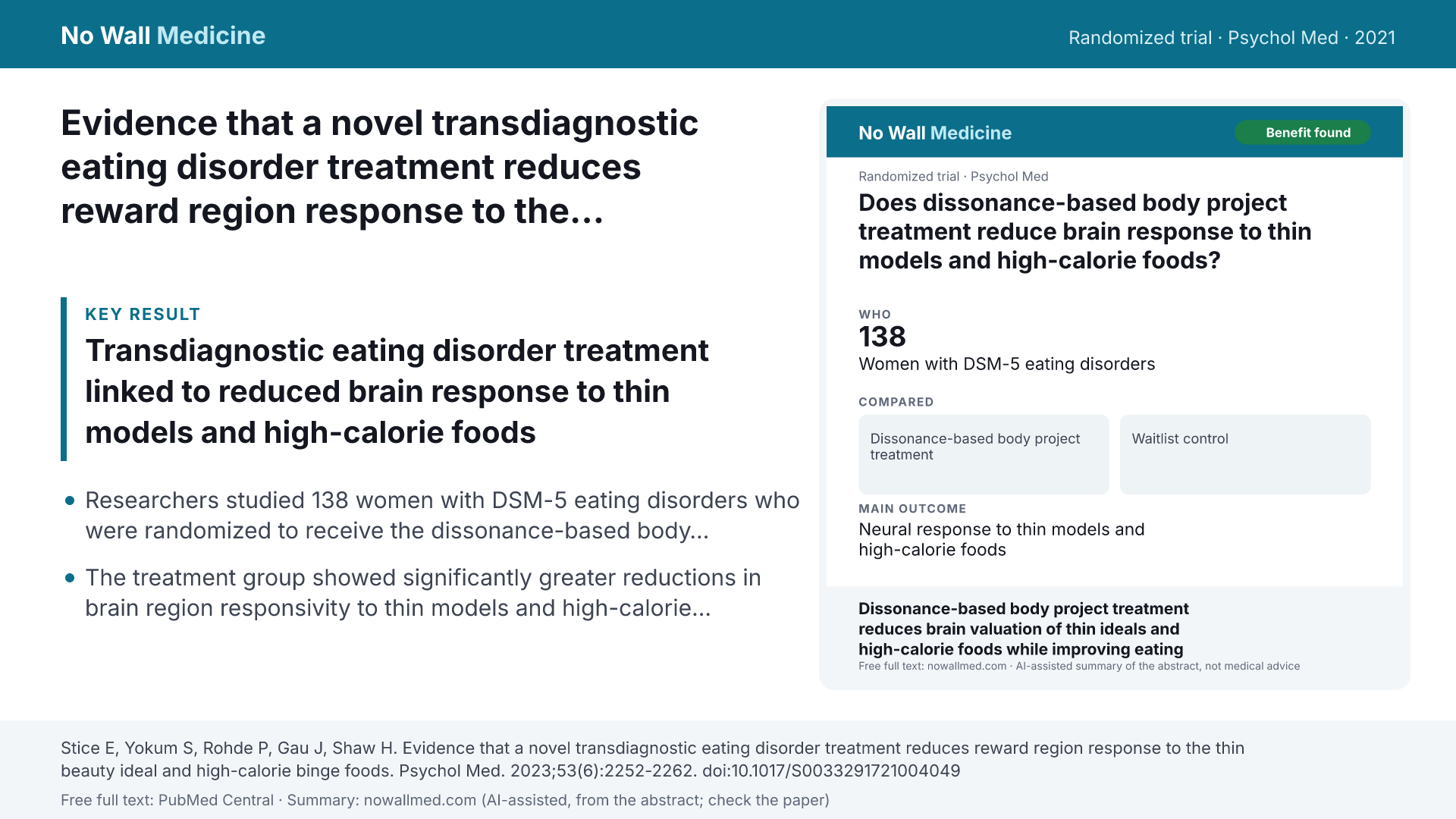
Transdiagnostic eating disorder treatment linked to reduced brain response to thin models and high-calorie foods
Evidence that a novel transdiagnostic eating disorder treatment reduces reward region response to the thin beauty ideal and high-calorie binge foods
Randomized trialBenefit found
Does dissonance-based body project treatment reduce brain response to thin models and high-calorie foods?
Who
138
Women with DSM-5 eating disorders
Compared
Dissonance-based body project treatment
Waitlist control
Main outcome
Neural response to thin models and high-calorie foods
Bottom line: Dissonance-based body project treatment reduces brain valuation of thin ideals and high-calorie foods while improving eating pathology.
Psychol Med · 2021-10-12 · Save PNG
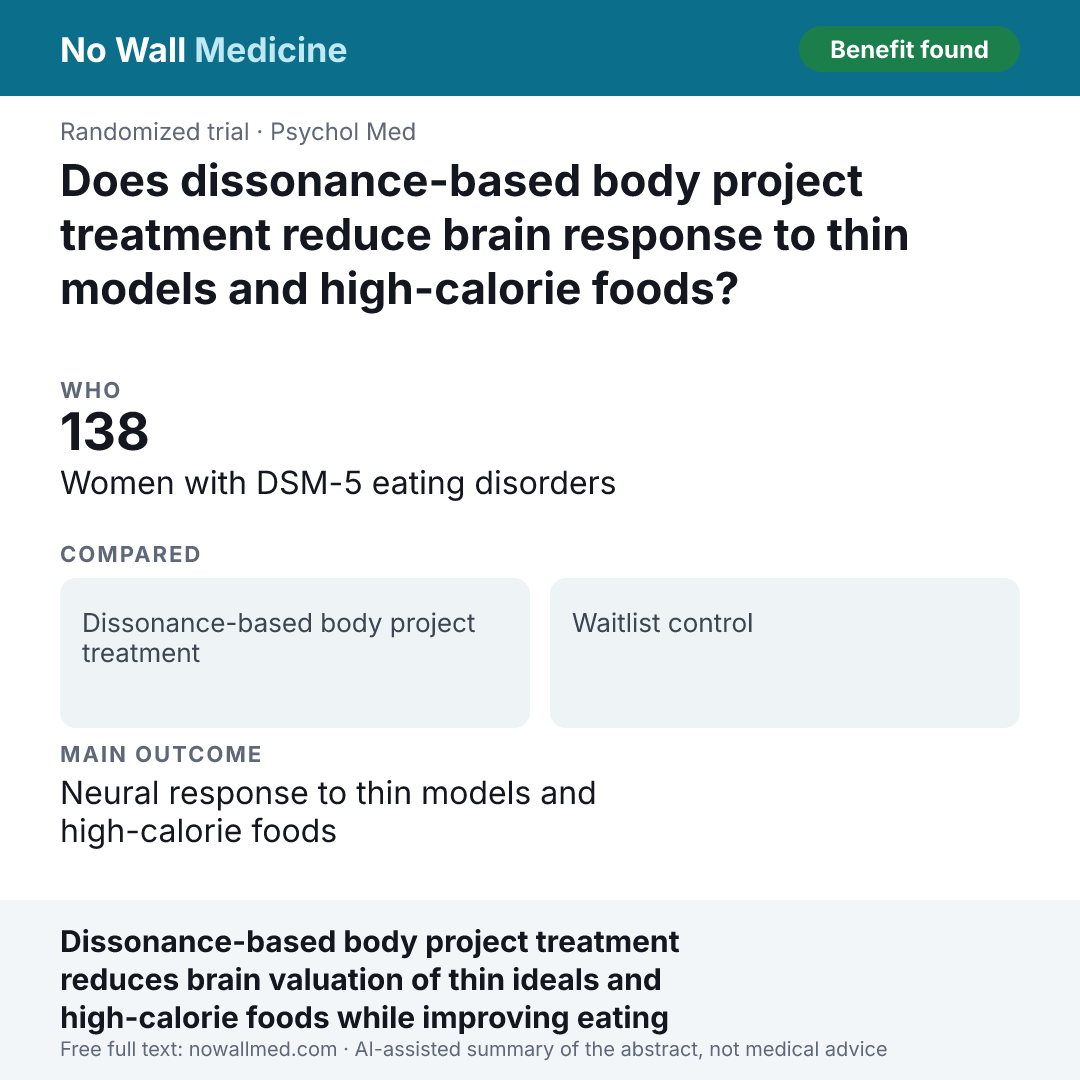
Clinical question: Does dissonance-based body project treatment reduce brain response to thin models and high-calorie foods?
Key points
- Researchers studied 138 women with DSM-5 eating disorders who were randomized to receive the dissonance-based body project treatment or a waitlist control.
- The treatment group showed significantly greater reductions in brain region responsivity to thin models and high-calorie binge foods compared to the control group.
- Participants receiving the treatment also showed greater reductions in eating disorder symptoms, binge eating, and purging behaviors.
Headline and key points written with AI from the paper’s abstract, with every number checked against it. Read the paper before relying on them.
Was this summary helpful?
Subject terms
Headline, design, result, key points, caveat and citation as plain text.
Cite this article
Stice E, Yokum S, Rohde P, Gau J, Shaw H. Evidence that a novel transdiagnostic eating disorder treatment reduces reward region response to the thin beauty ideal and high-calorie binge foods. Psychol Med. 2023;53(6):2252-2262. doi:10.1017/S0033291721004049
Spotted a mistake? Suggest a correction