Evolution of epitope-specific IgE and IgG4 antibodies in children enrolled in the LEAP trial
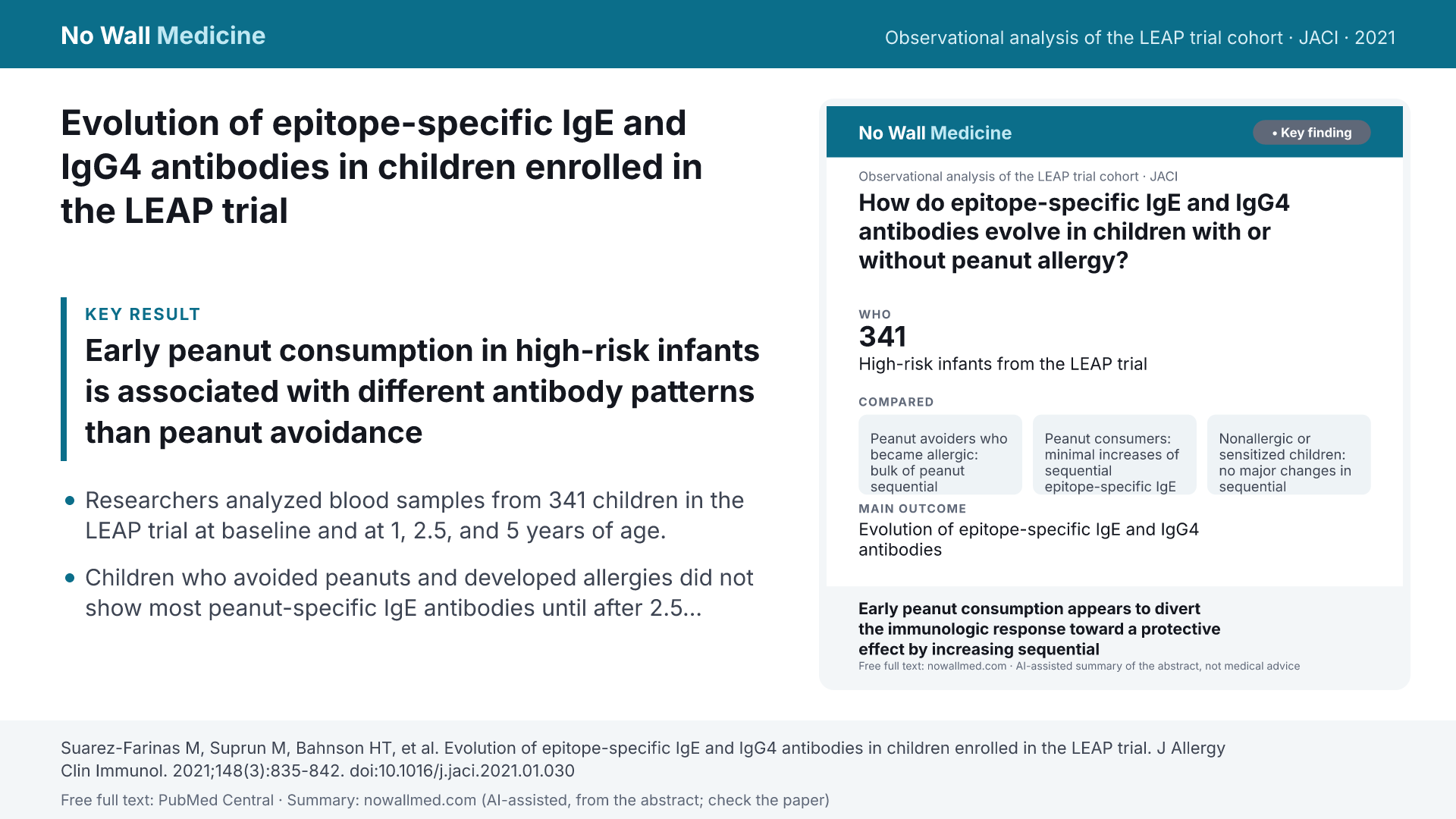
Key result: Early peanut consumption in high-risk infants is associated with different antibody patterns than peanut avoidance
Observational analysis of the LEAP trial cohortKey finding
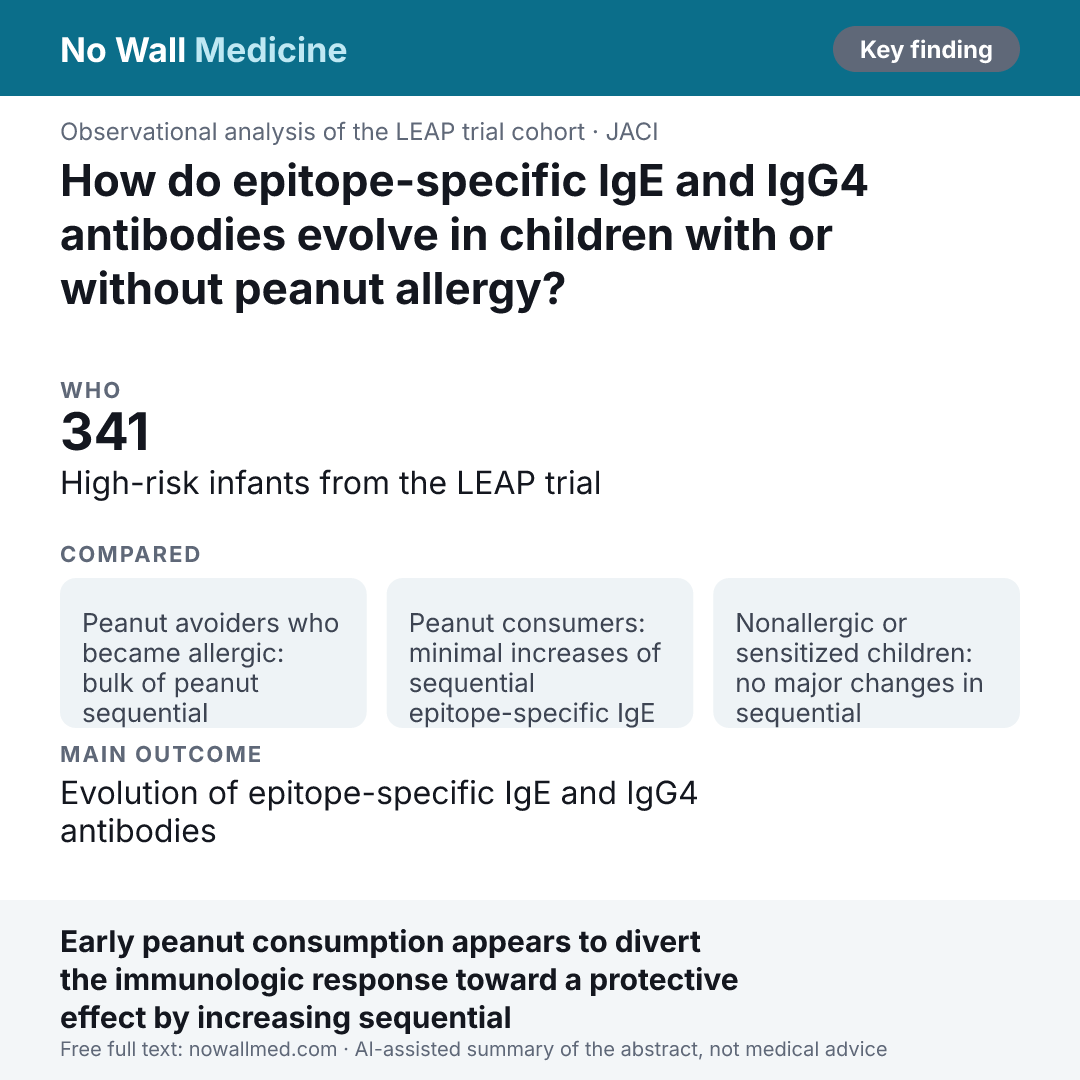
How do epitope-specific IgE and IgG4 antibodies evolve in children with or without peanut allergy?
Who
341
High-risk infants from the LEAP trial
Compared
Peanut avoiders who became allergic: bulk of peanut sequential epitope-specific IgE did not develop until after 2.5 years
Peanut consumers: minimal increases of sequential epitope-specific IgE occurred after 1 year
Nonallergic or sensitized children: no major changes in sequential epitope-specific IgE
Main outcome
Evolution of epitope-specific IgE and IgG4 antibodies
Bottom line: Early peanut consumption appears to divert the immunologic response toward a protective effect by increasing sequential epitope-specific IgG4.
JACI · 2021-02-13 · Save PNG
Key points
- Researchers analyzed blood samples from 341 children in the LEAP trial at baseline and at 1, 2.5, and 5 years of age.
- Children who avoided peanuts and developed allergies did not show most peanut-specific IgE antibodies until after 2.5 years of age.
- Peanut consumers tended to generate more peanut-specific IgG4 antibodies earlier than those who avoided peanuts, regardless of allergy status.
Discussion prompts
- Would these patients look like yours? Who was left out?
- Is the main outcome one that matters to patients?
- Is the difference large enough to change what you do?
Cite: Suarez-Farinas M, Suprun M, Bahnson HT, et al. Evolution of epitope-specific IgE and IgG4 antibodies in children enrolled in the LEAP trial. J Allergy Clin Immunol. 2021;148(3):835-842. doi:10.1016/j.jaci.2021.01.030
Free full text: PubMed Central · Summary and visual abstract: nowallmed.com/a/evolution-of-epitope-specific-ige-and-igg4-antibodies-in-children-e7n307/ (AI-assisted from the abstract; check the paper before relying on it).