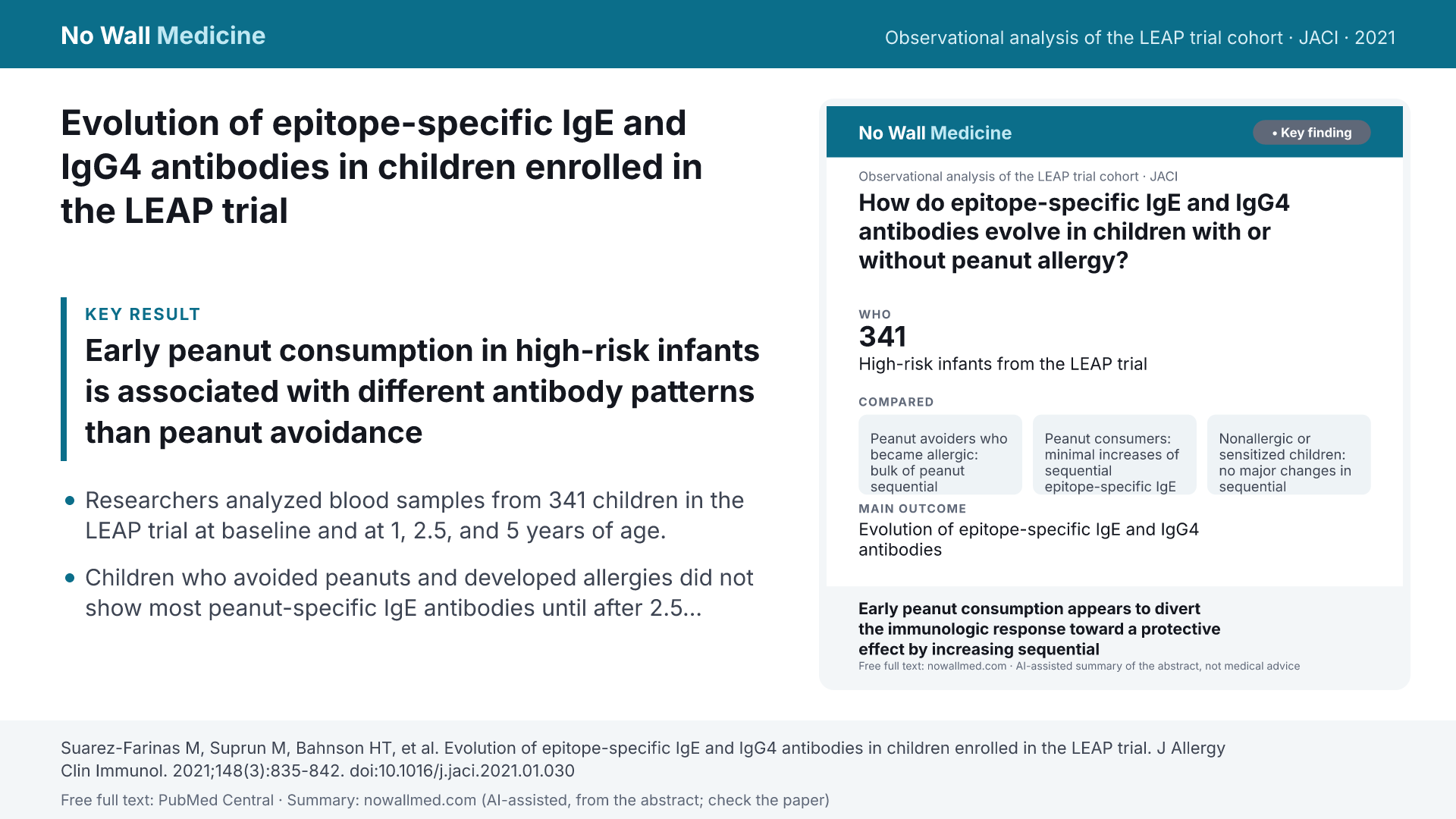
Early peanut consumption in high-risk infants is associated with different antibody patterns than peanut avoidance
Evolution of epitope-specific IgE and IgG4 antibodies in children enrolled in the LEAP trial
Observational analysis of the LEAP trial cohortBenefit found
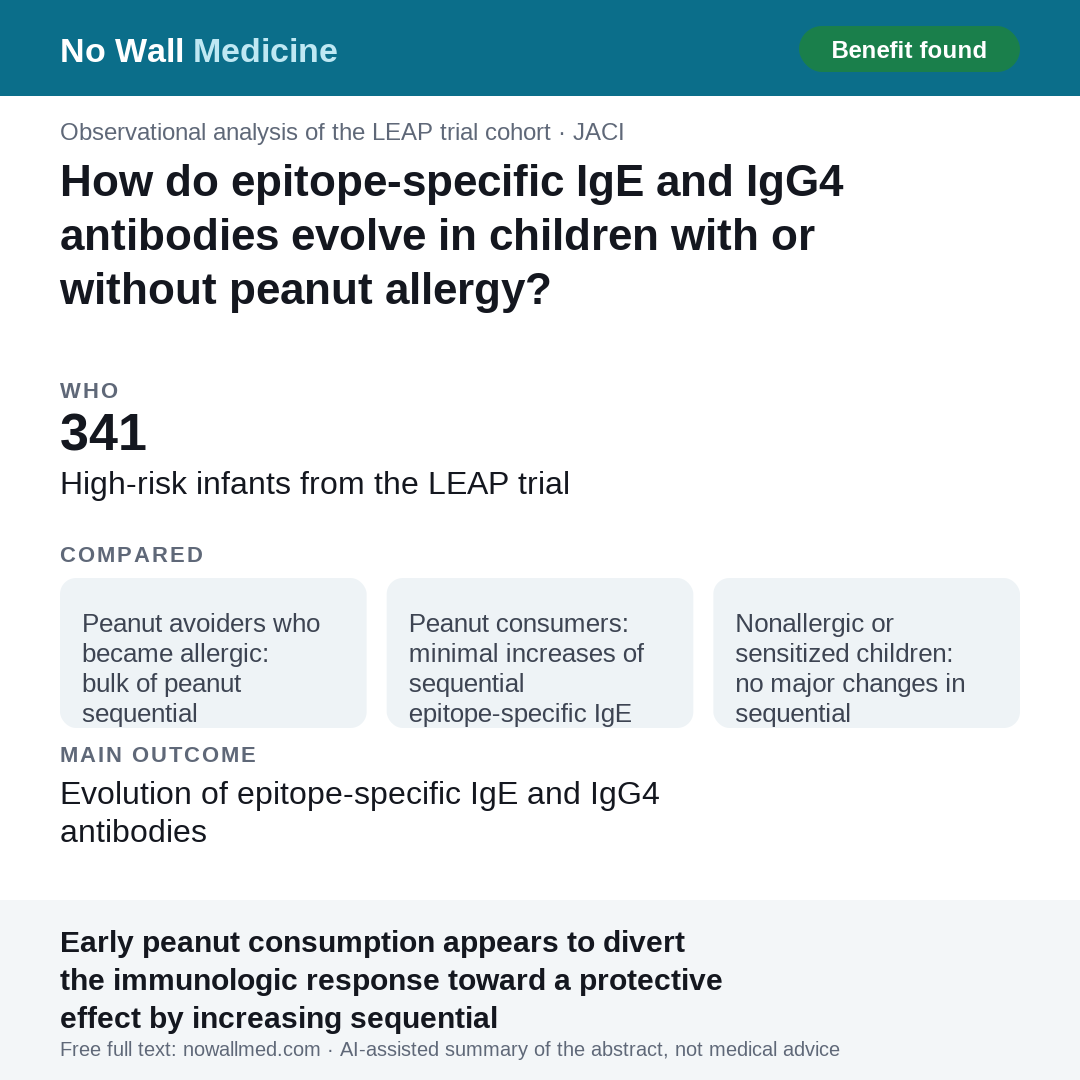
How do epitope-specific IgE and IgG4 antibodies evolve in children with or without peanut allergy?
Who
341
High-risk infants from the LEAP trial
Compared
Peanut avoiders who became allergic: bulk of peanut sequential epitope-specific IgE did not develop until after 2.5 years
Peanut consumers: minimal increases of sequential epitope-specific IgE occurred after 1 year
Nonallergic or sensitized children: no major changes in sequential epitope-specific IgE
Main outcome
Evolution of epitope-specific IgE and IgG4 antibodies
Bottom line: Early peanut consumption appears to divert the immunologic response toward a protective effect by increasing sequential epitope-specific IgG4.
JACI · 2021-02-13Download image
Clinical question: How do epitope-specific IgE and IgG4 antibodies evolve in children with or without peanut allergy?
Why it matters: It was unknown how specific antibody responses to peanut proteins evolve over time in high-risk infants who either consume or avoid peanuts.
Key points
- Researchers analyzed blood samples from 341 children in the LEAP trial at baseline and at 1, 2.5, and 5 years of age.
- Children who avoided peanuts and developed allergies did not show most peanut-specific IgE antibodies until after 2.5 years of age.
- Peanut consumers tended to generate more peanut-specific IgG4 antibodies earlier than those who avoided peanuts, regardless of allergy status.
Headline and key points written with AI from the paper’s abstract, with every number checked against it. Read the paper before relying on them.
Was this summary helpful?
Subject terms
Cite this article
Suarez-Farinas M, Suprun M, Bahnson HT, Raghunathan R, Getts R, duToit G. Evolution of epitope-specific IgE and IgG4 antibodies in children enrolled in the LEAP trial. JACI. 2021. doi:10.1016/j.jaci.2021.01.030
Spotted a mistake? Suggest a correction
Top studies every Monday
The week’s key trials and guidelines in your specialties, plus any topics you follow. By email, free.
Get the weekly digest