Examining associations, moderators and mediators between childhood maltreatment, social functioning, and social cognition in psychotic disorders: a systematic review and meta-analysis
Systematic review and meta-analysisMixed results
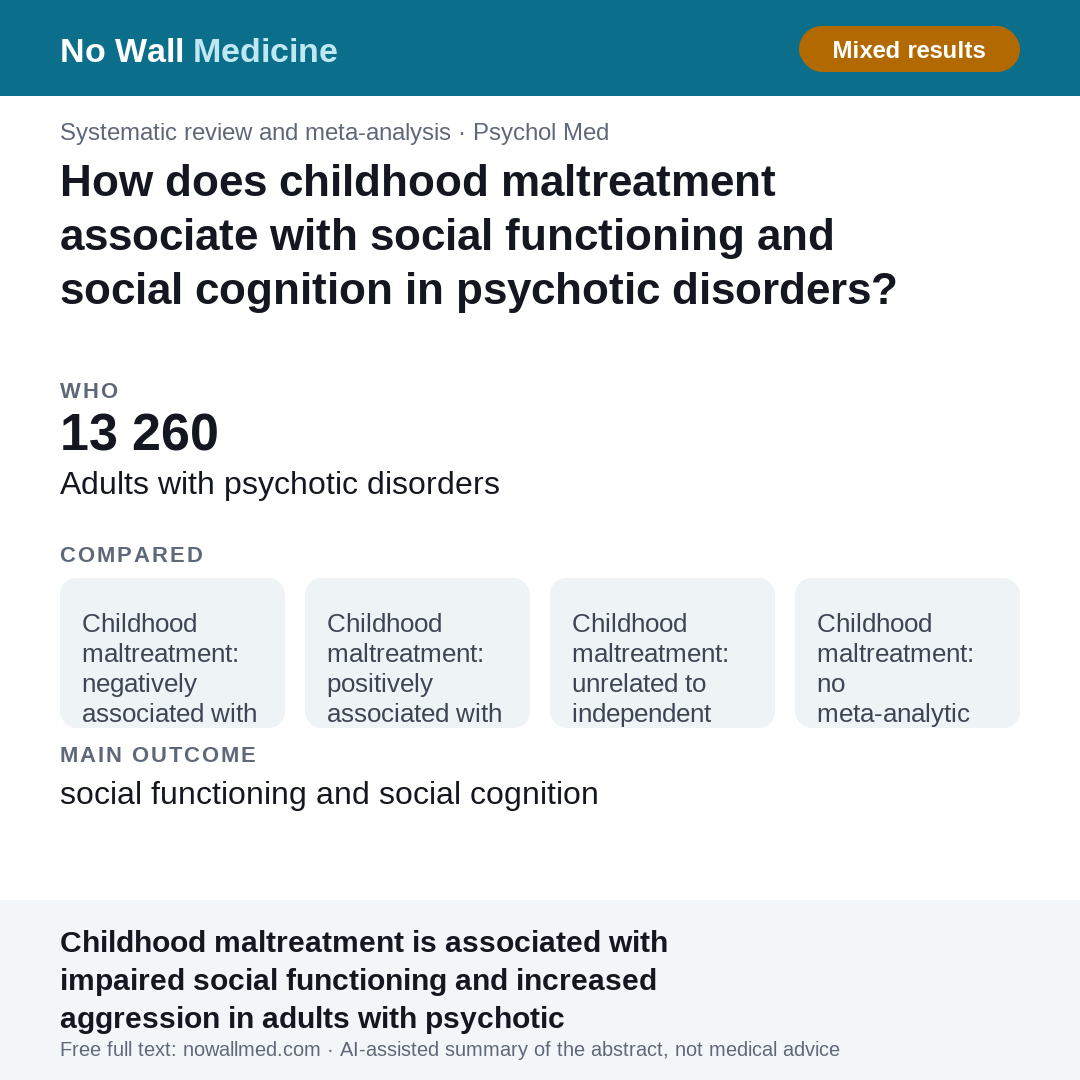
How does childhood maltreatment associate with social functioning and social cognition in psychotic disorders?
Who
13 260
Adults with psychotic disorders
Compared
Childhood maltreatment: negatively associated with global social functioning and interpersonal relations
Childhood maltreatment: positively associated with aggressive behaviour
Childhood maltreatment: unrelated to independent living or occupational functioning
Childhood maltreatment: no meta-analytic evidence of associations with social cognition
Main outcome
social functioning and social cognition
Bottom line: Childhood maltreatment is associated with impaired social functioning and increased aggression in adults with psychotic disorders.
Limitation: Associations were of small magnitude and few studies assessed subtypes and social cognition.
Psychol Med · 2023-07-17Download image
Clinical question: How does childhood maltreatment associate with social functioning and social cognition in psychotic disorders?
Abstract
Childhood maltreatment (CM) has been related to social functioning and social cognition impairment in people with psychotic disorders (PD); however, evidence across different CM subtypes and social domains remains less clear. We conducted a systematic review and meta-analysis to quantify associations between CM, overall and its different subtypes (physical/emotional/sexual abuse, physical/emotional neglect), and domains of social functioning and social cognition in adults with PD. We also examined moderators and mediators of these associations. A PRISMA-compliant systematic search was performed on 24 November 2022 (PROSPERO CRD42020175244). Fifty-three studies (N = 13 635 individuals with PD) were included in qualitative synthesis, of which 51 studies (N = 13 260) with 125 effects sizes were pooled in meta-analyses. We found that CM was negatively associated with global social functioning and interpersonal relations, and positively associated with aggressive behaviour, but unrelated to independent living or occupational functioning. There was no meta-analytic evidence of associations between CM and social cognition. Meta-regression analyses did not identify any consistent moderation pattern. Narrative synthesis identified sex and timing of CM as potential moderators, and depressive symptoms and maladaptive personality traits as possible mediators between CM and social outcomes. Associations were of small magnitude and limited number of studies assessing CM subtypes and social cognition are available. Nevertheless, adults with PD are at risk of social functioning problems after CM exposure, an effect observed across multiple CM subtypes, social domains, diagnoses and illness stages. Maltreated adults with PD may thus benefit from trauma-related and psychosocial interventions targeting social relationships and functioning.
Topics
Cite this article
Fares-Otero NE, Alameda L, Pfaltz MC, Martinez-Aran A, Schäfer I, Vieta E. Examining associations, moderators and mediators between childhood maltreatment, social functioning, and social cognition in psychotic disorders: a systematic review and meta-analysis. Psychol Med. 2023. doi:10.1017/S0033291723001678
Spotted a mistake? Suggest a correction
Top studies every Monday
The week’s key trials and guidelines in your specialties, plus any topics you follow. By email, free.
Get the weekly digest