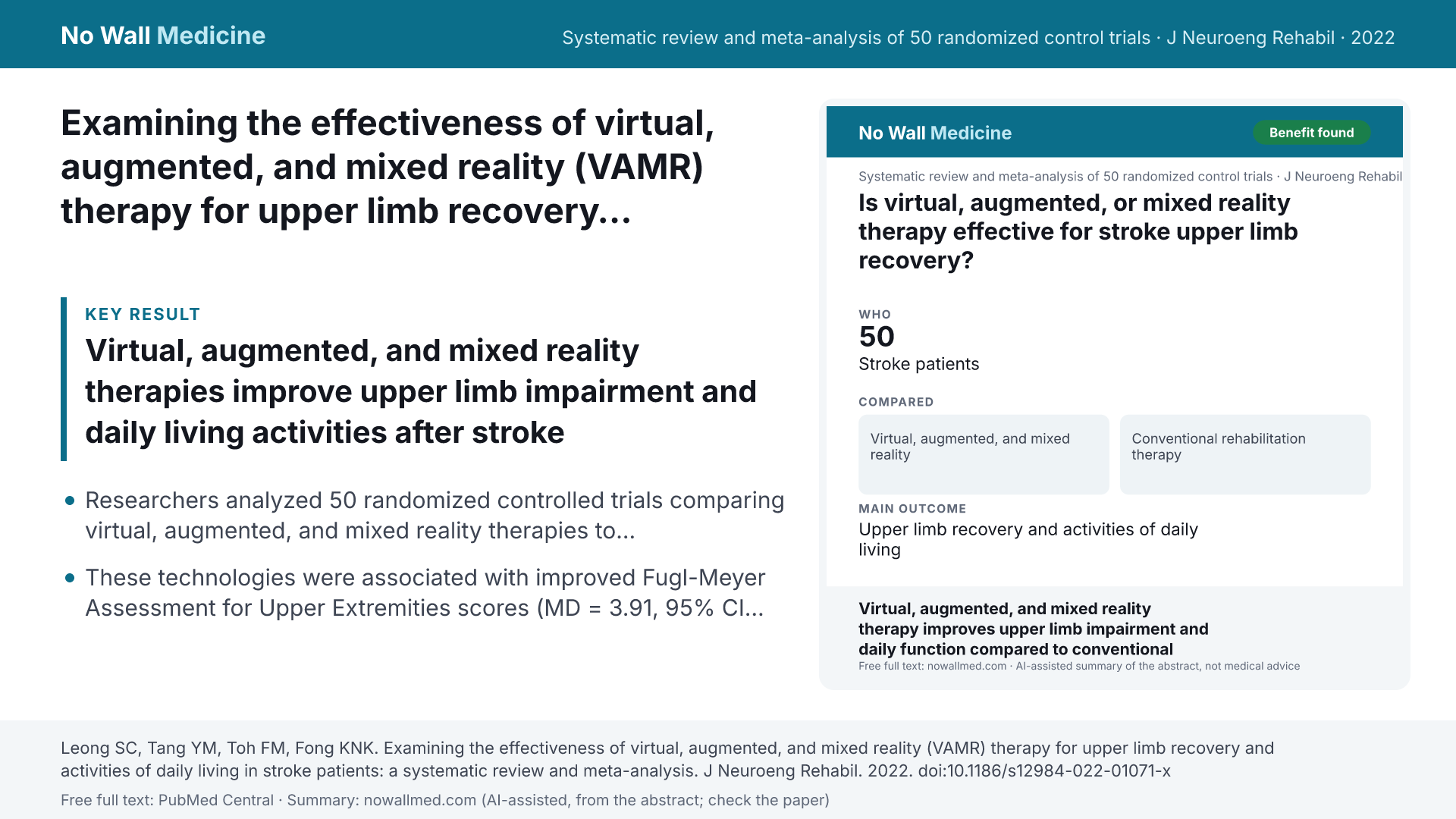
Examining the effectiveness of virtual, augmented, and mixed reality (VAMR) therapy for upper limb recovery and activities of daily living in stroke patients: a systematic review and meta-analysis
Key result: Virtual, augmented, and mixed reality therapies improve upper limb impairment and daily living activities after stroke
Key points
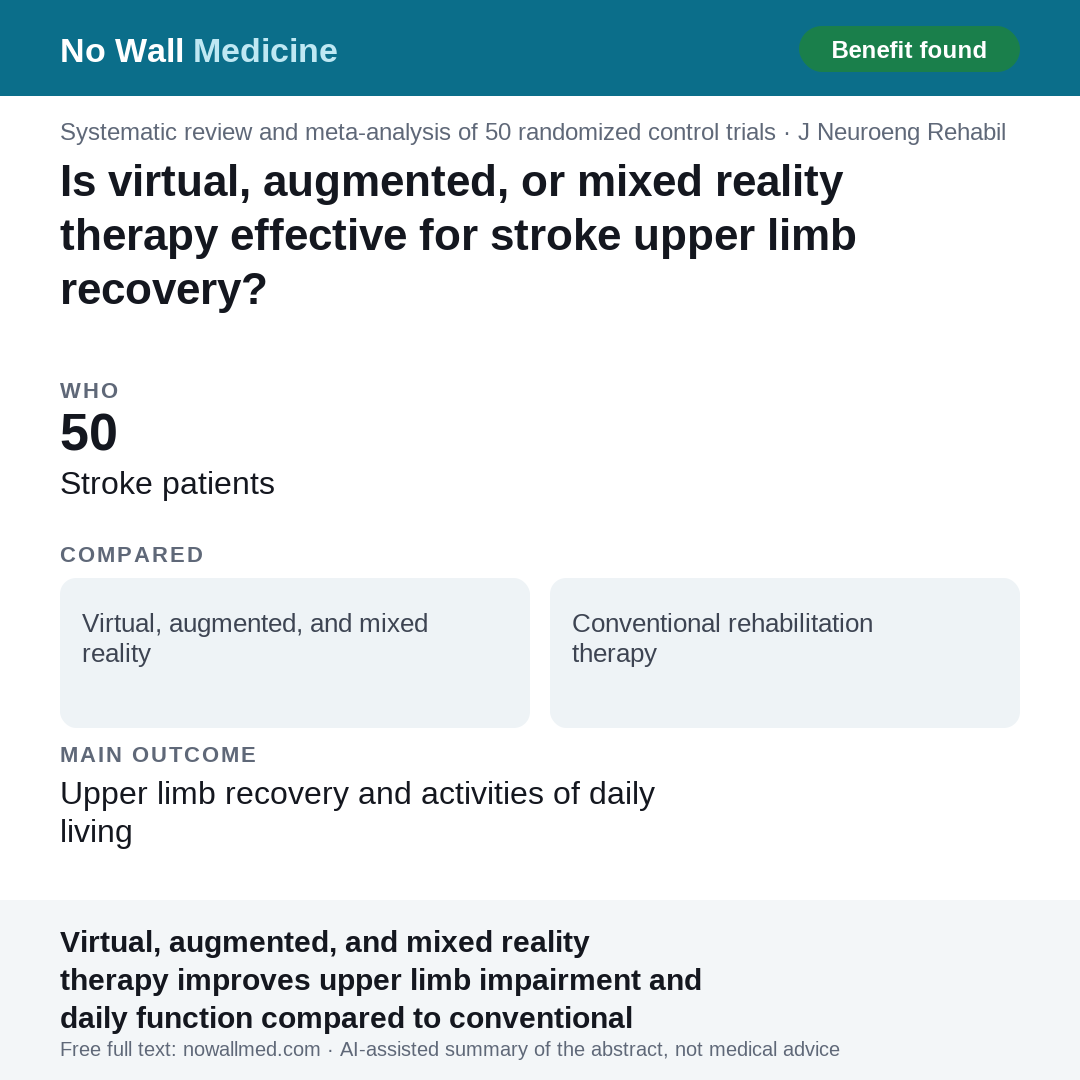
- Researchers analyzed 50 randomized controlled trials comparing virtual, augmented, and mixed reality therapies to standard rehabilitation for stroke patients.
- These technologies were associated with improved Fugl-Meyer Assessment for Upper Extremities scores (MD = 3.91, 95% CI = 1.70-6.12, P = 0.0005) and Functional Independence Measure scores (MD = 4.25, 95% CI = 1.47-7.03, P = 0.003).
- The therapies were not associated with significant changes in Box and Block Test or Wolf Motor Function Test scores (MD = 2.07, 95% CI = -0.58-4.72, P = 0.13).
Why it matters: It is unknown if virtual, augmented, or mixed reality technologies are more effective than conventional rehabilitation for improving upper limb recovery and daily living activities in stroke survivors.
Discussion prompts
- Would these patients look like yours? Who was left out?
- Is the main outcome one that matters to patients?
- Is the difference large enough to change what you do?
Cite: Leong SC, Tang YM, Toh FM, Fong KNK. Examining the effectiveness of virtual, augmented, and mixed reality (VAMR) therapy for upper limb recovery and activities of daily living in stroke patients: a systematic review and meta-analysis. J Neuroeng Rehabil. 2022. doi:10.1186/s12984-022-01071-x
Free full text: PubMed Central · Summary and visual abstract: nowallmed.com/a/examining-the-effectiveness-of-virtual-augmented-and-mixed-reality-12ldo4q/ (AI-assisted from the abstract; check the paper before relying on it).