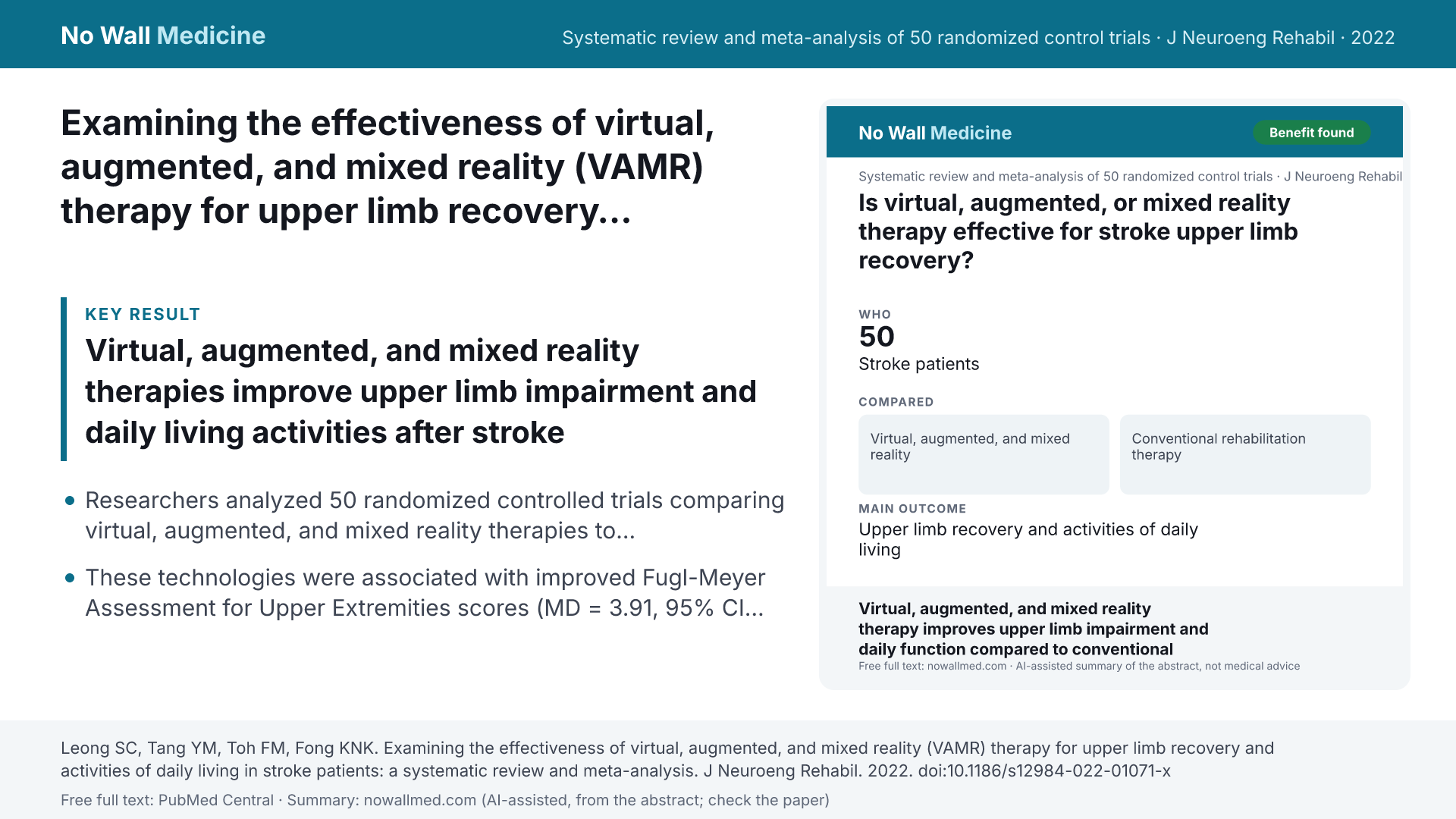
Virtual, augmented, and mixed reality therapies improve upper limb impairment and daily living activities after stroke
Examining the effectiveness of virtual, augmented, and mixed reality (VAMR) therapy for upper limb recovery and activities of daily living in stroke patients: a systematic review and meta-analysis
Systematic review and meta-analysis of 50 randomized control trialsBenefit found
Is virtual, augmented, or mixed reality therapy effective for stroke upper limb recovery?
Who
50
Stroke patients
Compared
Virtual, augmented, and mixed reality
Conventional rehabilitation therapy
Main outcome
Upper limb recovery and activities of daily living
Result: FMA-UE MD 3.91 (95 percent CI 1.70-6.12); FIM MD 4.25 (95 percent CI 1.47-7.03)
Bottom line: Virtual, augmented, and mixed reality therapy improves upper limb impairment and daily function compared to conventional treatment.
Limitation: Need for high-quality trials examining effects on upper limb function measures.
J Neuroeng Rehabil · 2022-08-24Download image
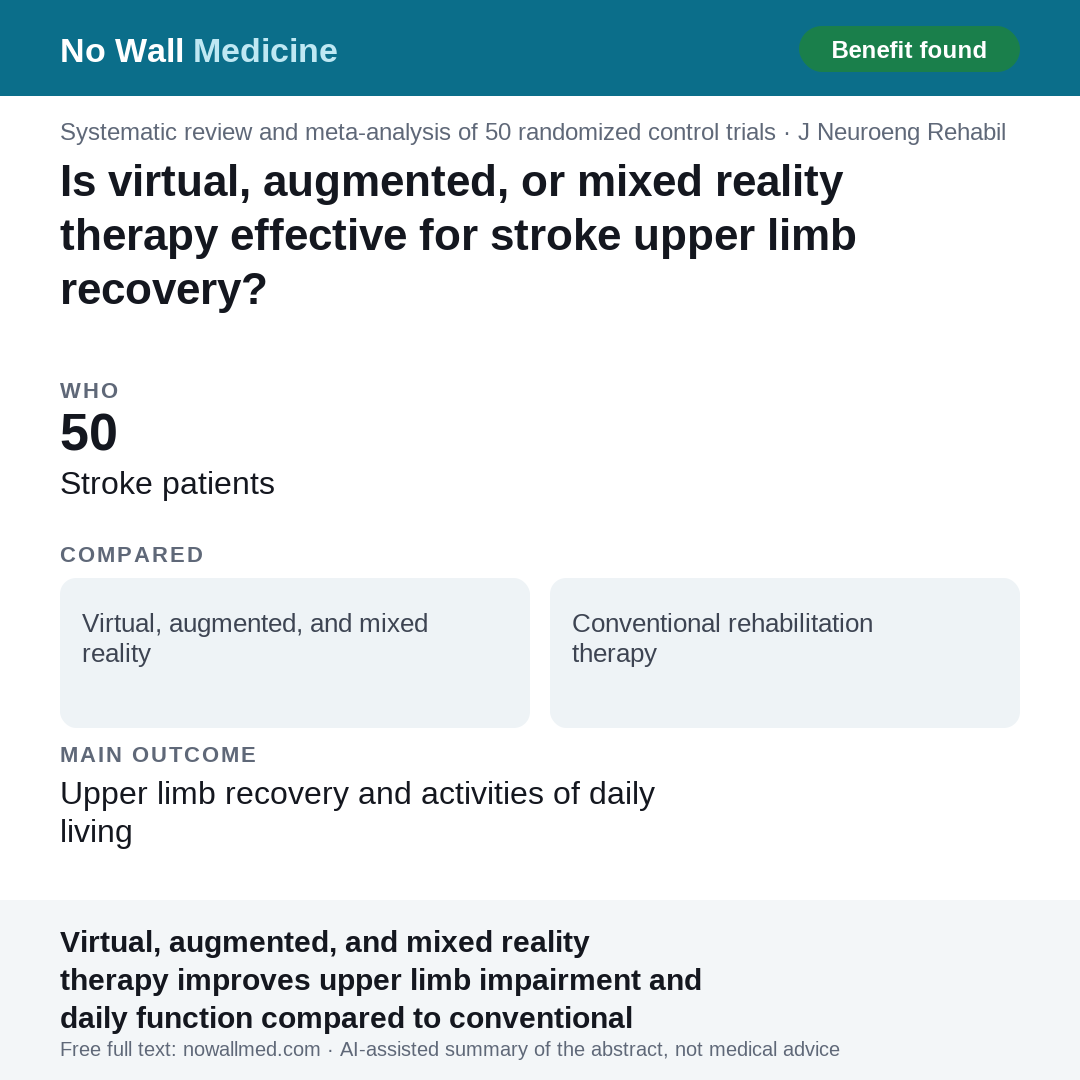
Clinical question: Is virtual, augmented, or mixed reality therapy effective for stroke upper limb recovery?
Why it matters: It is unknown if virtual, augmented, or mixed reality technologies are more effective than conventional rehabilitation for improving upper limb recovery and daily living activities in stroke survivors.
Key points
- Researchers analyzed 50 randomized controlled trials comparing virtual, augmented, and mixed reality therapies to standard rehabilitation for stroke patients.
- These technologies were associated with improved Fugl-Meyer Assessment for Upper Extremities scores (MD = 3.91, 95% CI = 1.70-6.12, P = 0.0005) and Functional Independence Measure scores (MD = 4.25, 95% CI = 1.47-7.03, P = 0.003).
- The therapies were not associated with significant changes in Box and Block Test or Wolf Motor Function Test scores (MD = 2.07, 95% CI = -0.58-4.72, P = 0.13).
Headline and key points written with AI from the paper’s abstract, with every number checked against it. Read the paper before relying on them.
Was this summary helpful?
Subject terms
Cite this article
Leong SC, Tang YM, Toh FM, Fong KNK. Examining the effectiveness of virtual, augmented, and mixed reality (VAMR) therapy for upper limb recovery and activities of daily living in stroke patients: a systematic review and meta-analysis. J Neuroeng Rehabil. 2022. doi:10.1186/s12984-022-01071-x
Spotted a mistake? Suggest a correction
Top studies every Monday
The week’s key trials and guidelines in your specialties, plus any topics you follow. By email, free.
Get the weekly digest