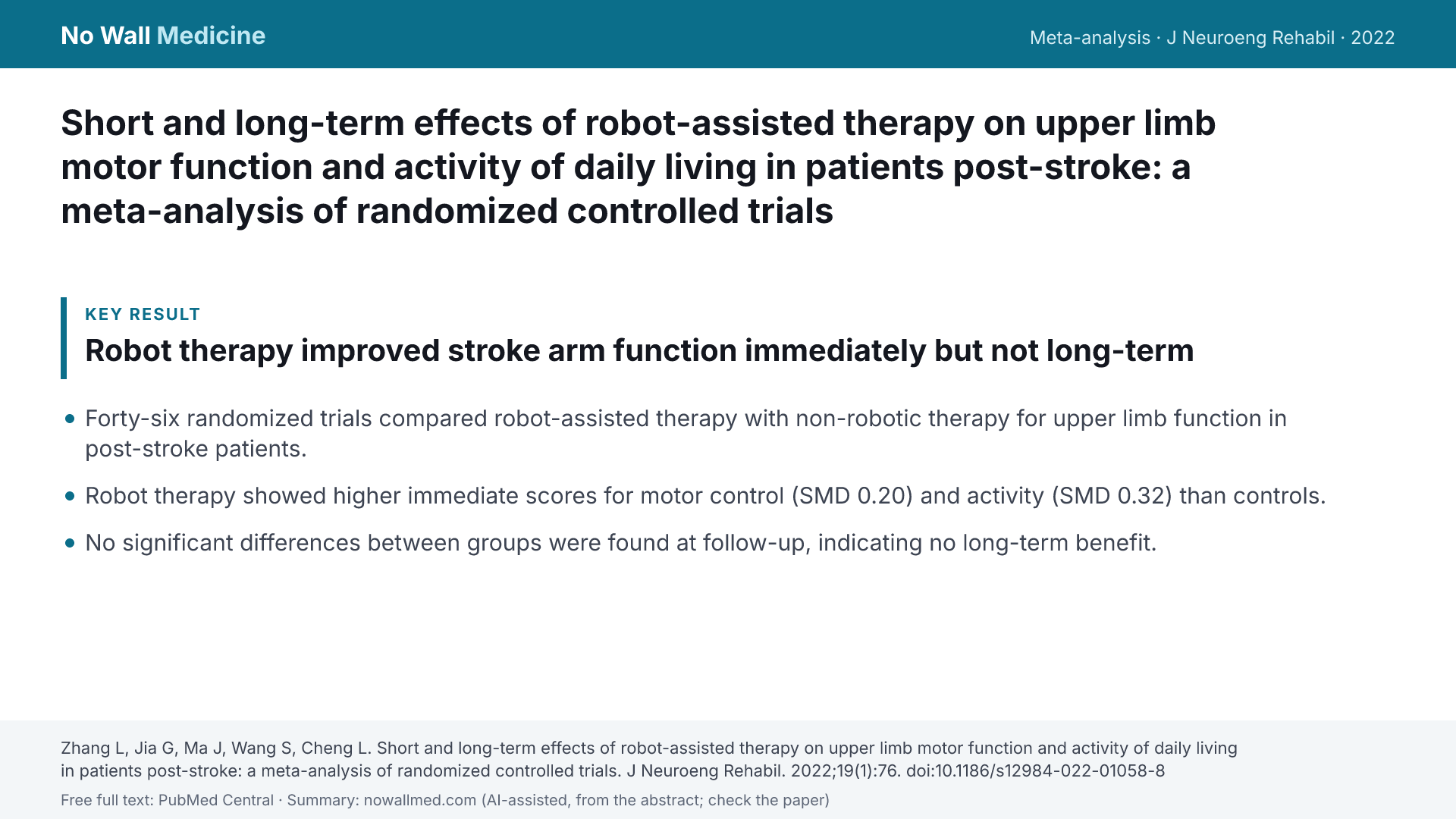
Robot-assisted therapy shows immediate benefits for upper limb function in stroke patients after treatment
Short and long-term effects of robot-assisted therapy on upper limb motor function and activity of daily living in patients post-stroke: a meta-analysis of randomized controlled trials
Why it matters: It is unknown if robot-assisted therapy provides superior motor control and activity function compared to non-robotic therapy in the long term.
Key points
- Researchers analyzed 46 randomized controlled trials comparing robot-assisted therapy to non-robotic therapy in adults after a stroke.
- Robot-assisted therapy was associated with higher Fugl-Meyer Upper Extremity assessment scores (SMD = 0.20, P = 0.001) and activity function (SMD = 0.32, P < 0.001) immediately after intervention.
- Significant differences in motor control and activity function were only observed when total training time exceeded 15 h.
Headline and key points written with AI from the paper’s abstract, with every number checked against it. Read the paper before relying on them.
Was this summary helpful?
Subject terms
Cite this article
Zhang L, Jia G, Ma J, Wang S, Cheng L. Short and long-term effects of robot-assisted therapy on upper limb motor function and activity of daily living in patients post-stroke: a meta-analysis of randomized controlled trials. J Neuroeng Rehabil. 2022. doi:10.1186/s12984-022-01058-8
Spotted a mistake? Suggest a correction