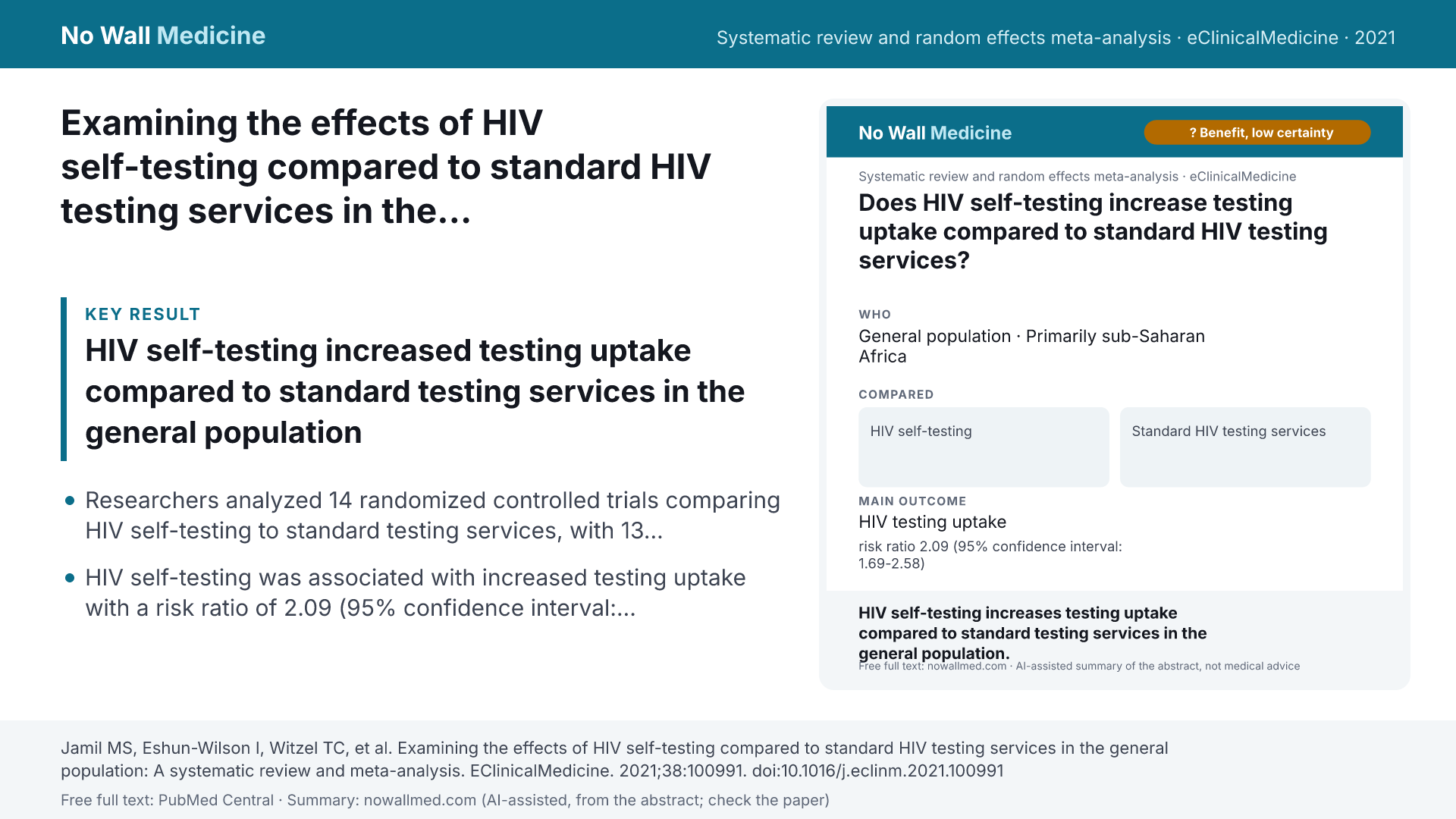
HIV self-testing increased testing uptake compared to standard testing services in the general population
Examining the effects of HIV self-testing compared to standard HIV testing services in the general population: A systematic review and meta-analysis
Systematic review and random effects meta-analysisBenefit found
Does HIV self-testing increase testing uptake compared to standard HIV testing services?
Who
General population · Primarily sub-Saharan Africa
Compared
HIV self-testing
Standard HIV testing services
Main outcome
HIV testing uptake
Result: risk ratio 2.09 (95% confidence interval: 1.69-2.58)
Bottom line: HIV self-testing increases testing uptake compared to standard testing services in the general population.
eClinicalMedicine · 2021-07-07Download image
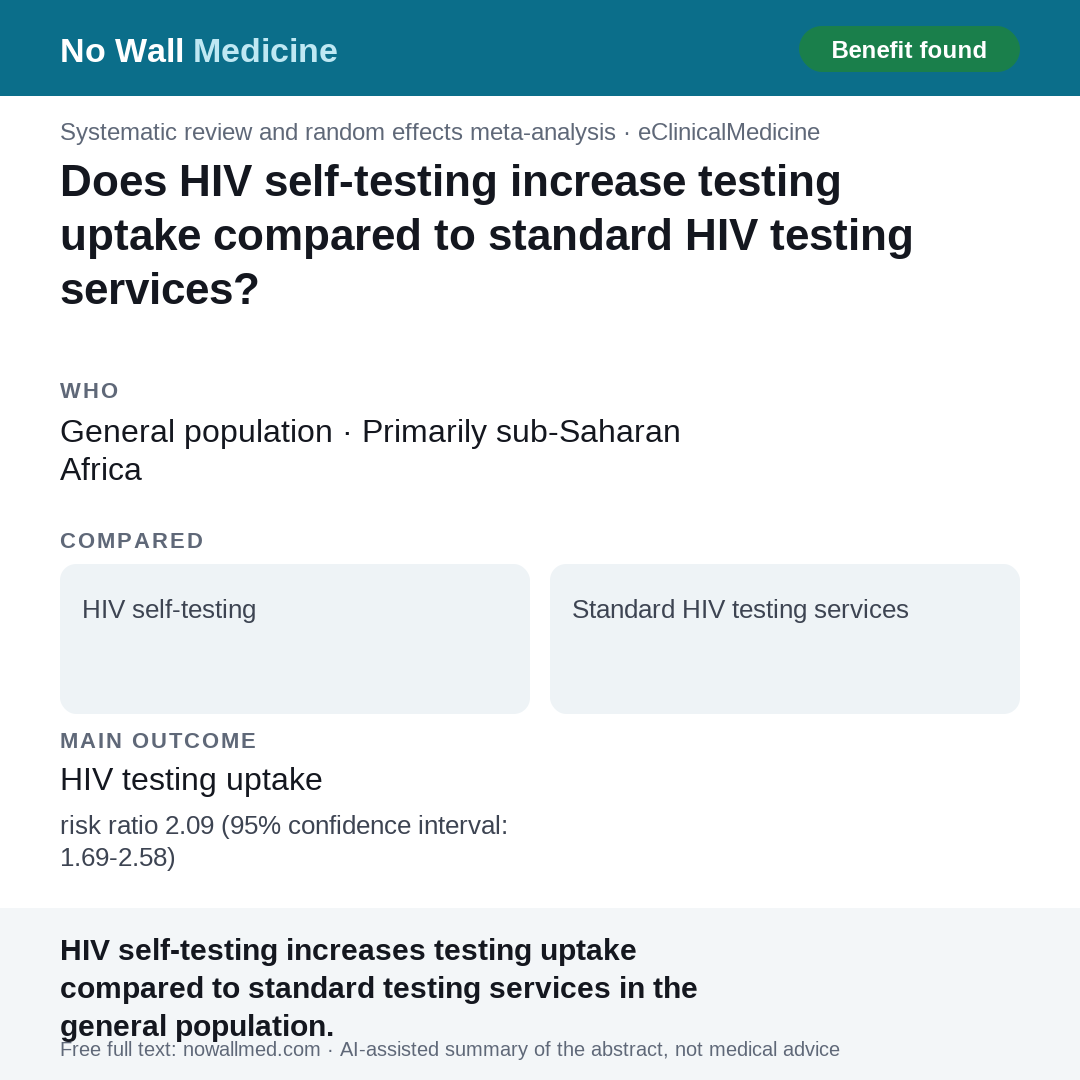
Clinical question: Does HIV self-testing increase testing uptake compared to standard HIV testing services?
Why it matters: It was unclear how HIV self-testing compares to standard testing services regarding testing uptake and linkage to care among the general population.
Key points
- Researchers analyzed 14 randomized controlled trials comparing HIV self-testing to standard testing services, with 13 studies conducted in sub-Saharan Africa.
- HIV self-testing was associated with increased testing uptake with a risk ratio of 2.09 (95% confidence interval: 1.69-2.58; p < 0.0001).
- The number of people diagnosed HIV-positive (RR: 0.81, 0.45-1.47; p = 0.50) and linked to care (RR: 0.95, 0.79-1.13; p = 0.52) were similar between both methods.
Headline and key points written with AI from the paper’s abstract, with every number checked against it. Read the paper before relying on them.
Was this summary helpful?
Cite this article
Jamil MS, Eshun-Wilson I, Witzel TC, Siegfried N, Figueroa C, Chitembo L. Examining the effects of HIV self-testing compared to standard HIV testing services in the general population: A systematic review and meta-analysis. eClinicalMedicine. 2021. doi:10.1016/j.eclinm.2021.100991
Spotted a mistake? Suggest a correction