Examining the effects of HIV self-testing compared to standard HIV testing services in the general population: A systematic review and meta-analysis
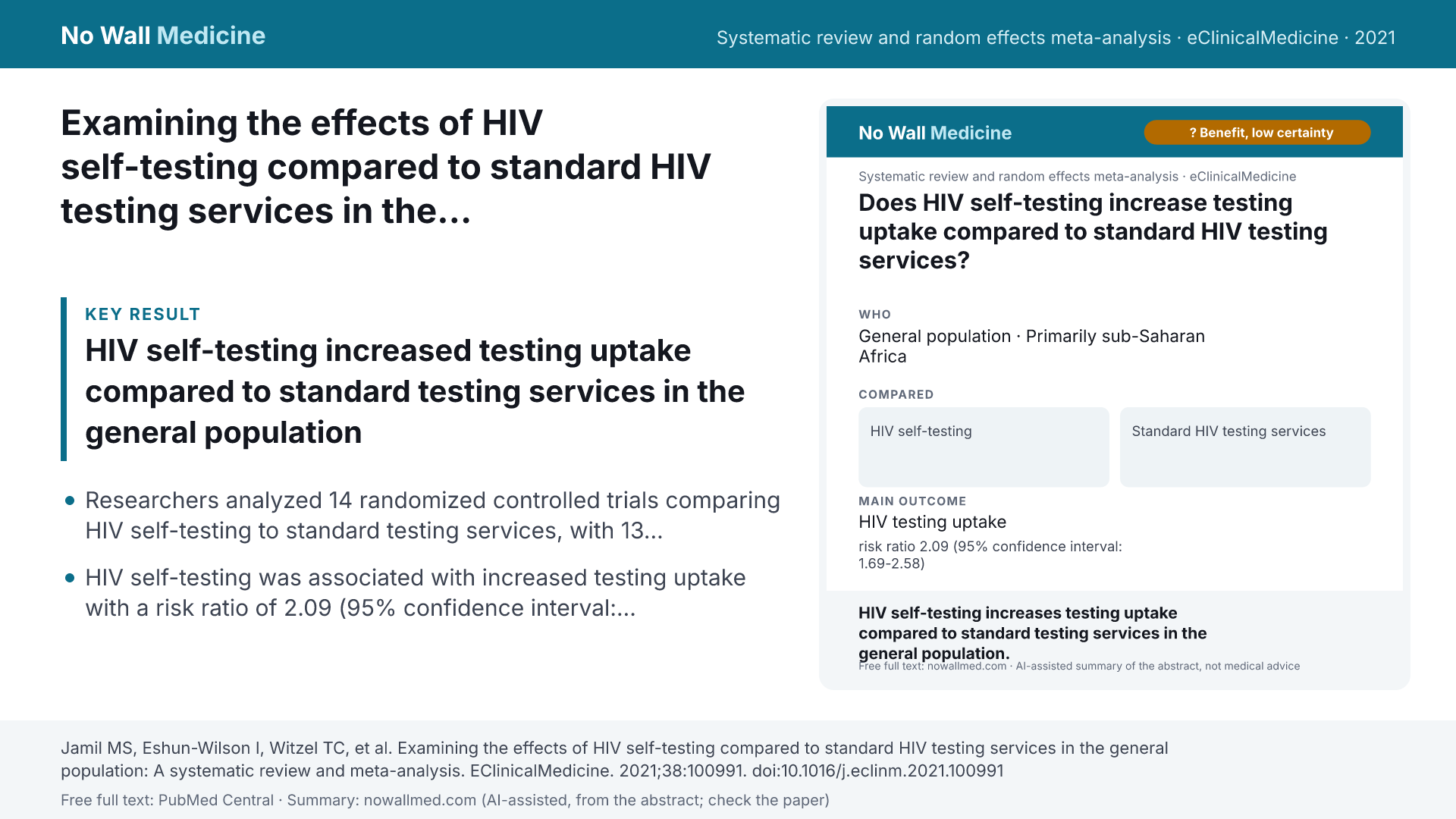
Key result: HIV self-testing increased testing uptake compared to standard testing services in the general population
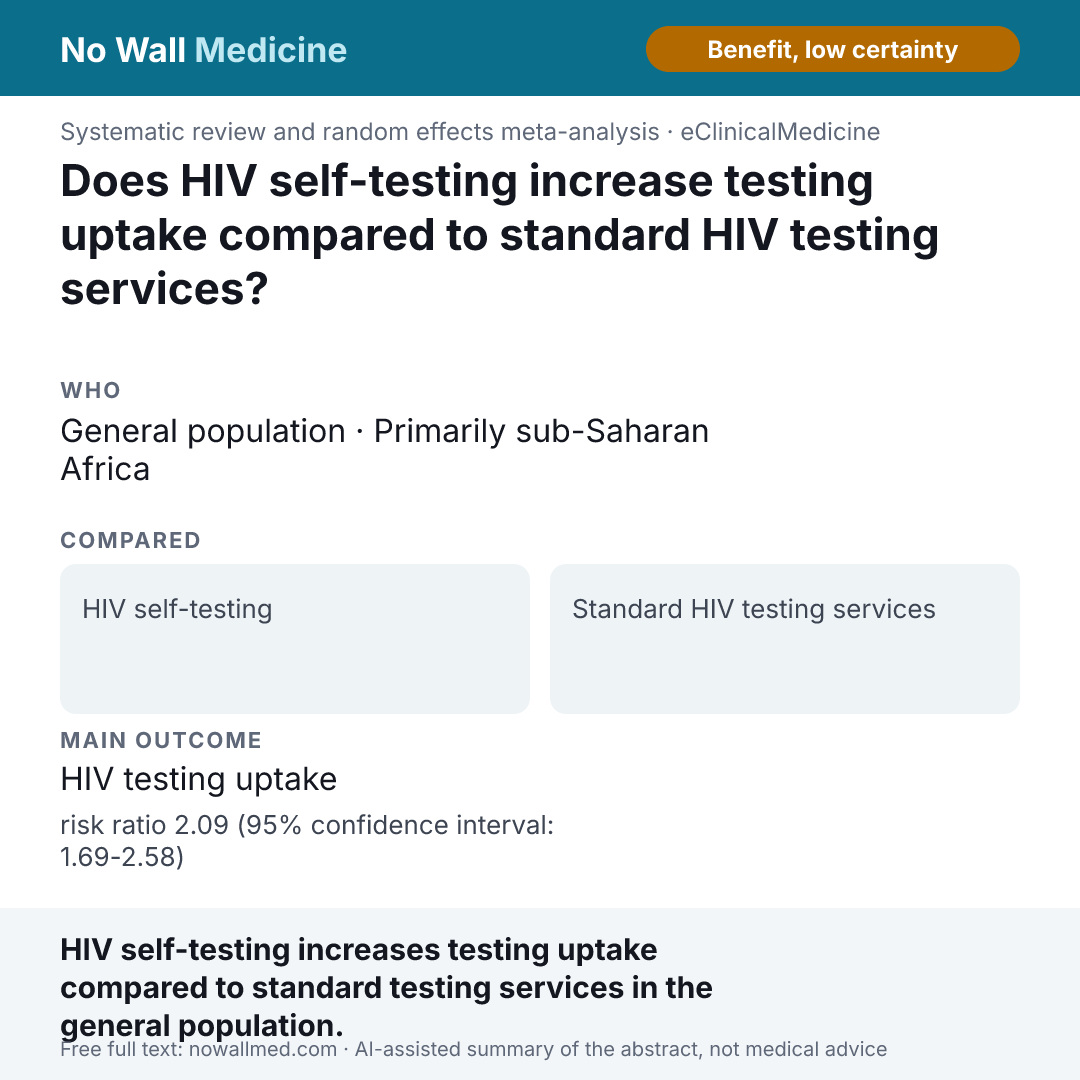
Systematic review and random effects meta-analysisBenefit, low certainty
Does HIV self-testing increase testing uptake compared to standard HIV testing services?
Who
General population · Primarily sub-Saharan Africa
Compared
HIV self-testing
Standard HIV testing services
Main outcome
HIV testing uptake
Result: risk ratio 2.09 (95% confidence interval: 1.69-2.58)
Bottom line: HIV self-testing increases testing uptake compared to standard testing services in the general population.
eClinicalMedicine · 2021-07-07 · Save PNG
Key points
- Researchers analyzed 14 randomized controlled trials comparing HIV self-testing to standard testing services, with 13 studies conducted in sub-Saharan Africa.
- HIV self-testing was associated with increased testing uptake with a risk ratio of 2.09 (95% confidence interval: 1.69-2.58; p < 0.0001).
- The number of people diagnosed HIV-positive (RR: 0.81, 0.45-1.47; p = 0.50) and linked to care (RR: 0.95, 0.79-1.13; p = 0.52) were similar between both methods.
Discussion prompts
- Would these patients look like yours? Who was left out?
- Is the main outcome one that matters to patients?
- Is the difference large enough to change what you do?
Cite: Jamil MS, Eshun-Wilson I, Witzel TC, et al. Examining the effects of HIV self-testing compared to standard HIV testing services in the general population: A systematic review and meta-analysis. EClinicalMedicine. 2021;38:100991. doi:10.1016/j.eclinm.2021.100991
Free full text: PubMed Central · Summary and visual abstract: nowallmed.com/a/examining-the-effects-of-hiv-self-testing-compared-to-standard-hiv-qnv59m/ (AI-assisted from the abstract; check the paper before relying on it).