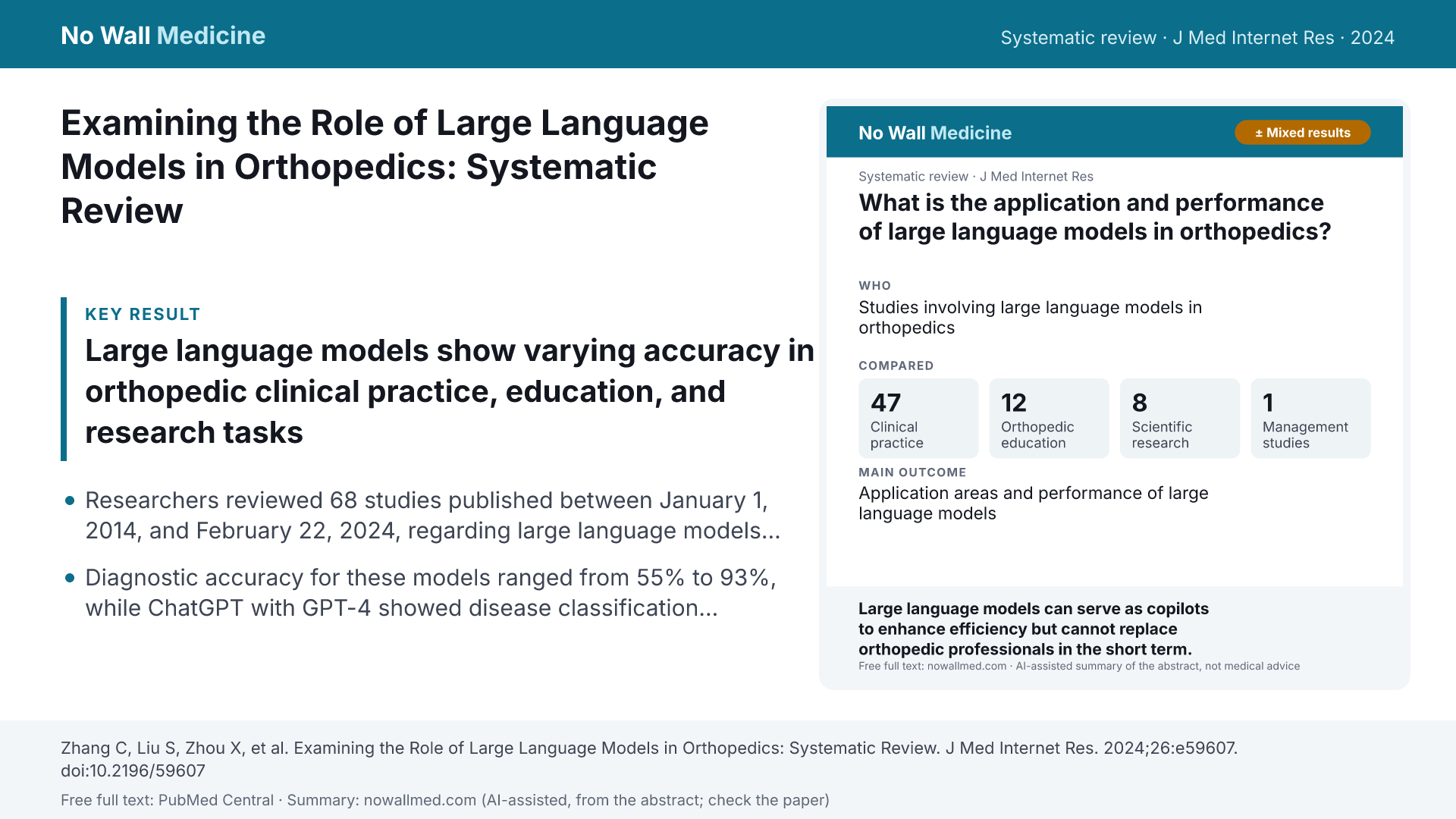
Large language models show varying accuracy in orthopedic clinical practice, education, and research tasks
Examining the Role of Large Language Models in Orthopedics: Systematic Review
Systematic reviewMixed results
What is the application and performance of large language models in orthopedics?
Who
Studies involving large language models in orthopedics
Compared
47Clinical practice studies (69%)
12Orthopedic education studies (18%)
8Scientific research studies (12%)
1Management studies (1%)
Main outcome
Application areas and performance of large language models
Bottom line: Large language models can serve as copilots to enhance efficiency but cannot replace orthopedic professionals in the short term.
Limitation: Considerable heterogeneity in the definition, measurement, and evaluation of performance across studies.
J Med Internet Res · 2024-11-15 · Save PNG
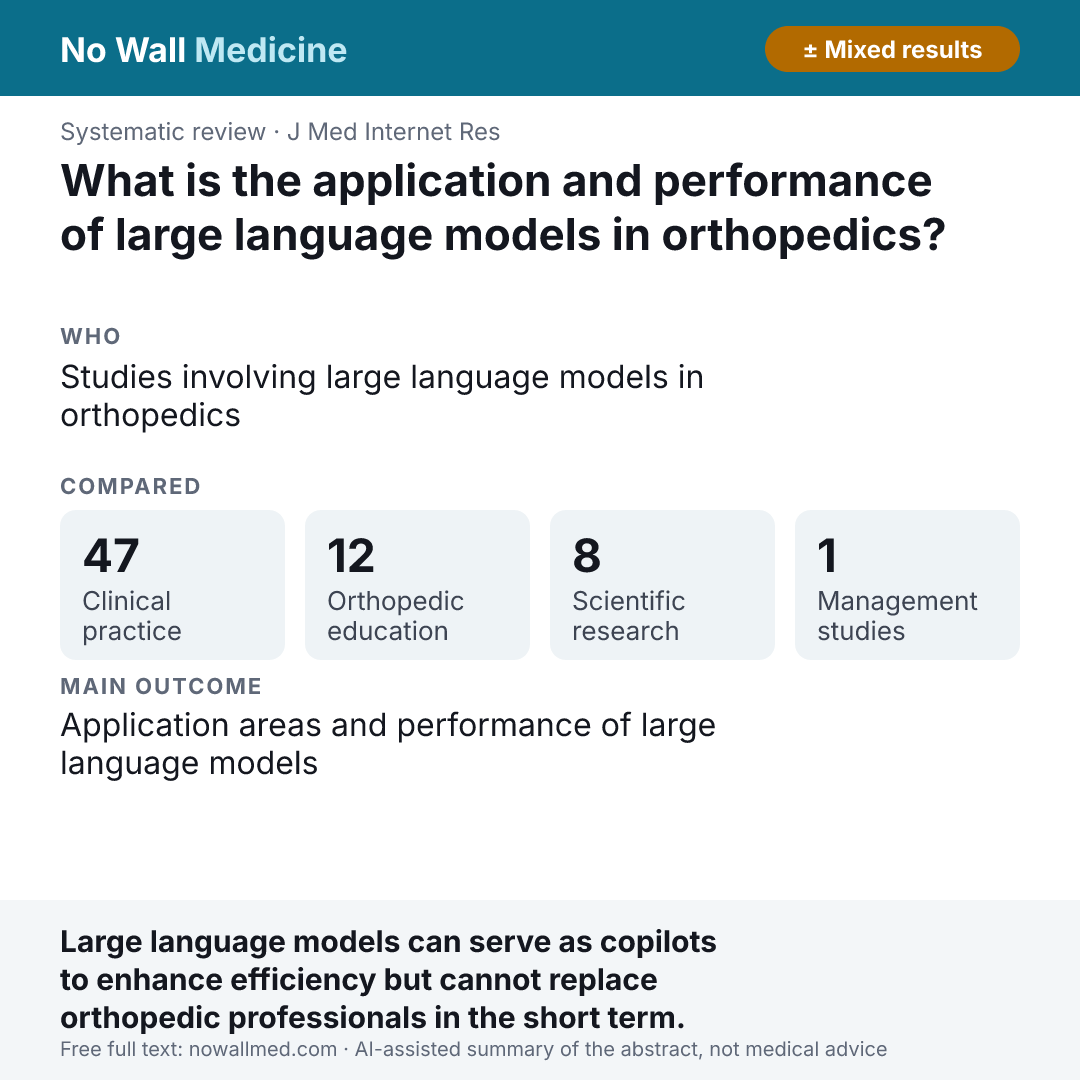
Clinical question: What is the application and performance of large language models in orthopedics?
Why it matters: A systematic summary of existing research regarding the application of large language models in the field of orthopedics was absent.
Key points
- Researchers reviewed 68 studies published between January 1, 2014, and February 22, 2024, regarding large language models in orthopedics.
- Diagnostic accuracy for these models ranged from 55% to 93%, while ChatGPT with GPT-4 showed disease classification accuracy from 2% to 100%.
- Only 8 of the 68 studies recruited patients and only 1 study was a high-quality randomized controlled trial.
Limitation the authors note: There was considerable heterogeneity in the definition, measurement, and evaluation of the large language models' performance across the different studies.
Headline and key points written with AI from the paper’s abstract, with every number checked against it. Read the paper before relying on them.
Was this summary helpful?
Subject terms
Headline, design, result, key points, caveat and citation as plain text.
Cite this article
Zhang C, Liu S, Zhou X, et al. Examining the Role of Large Language Models in Orthopedics: Systematic Review. J Med Internet Res. 2024;26:e59607. doi:10.2196/59607
Spotted a mistake? Suggest a correction