Examining the variability of neurocognitive functioning in individuals at clinical high risk for psychosis: a meta-analysis
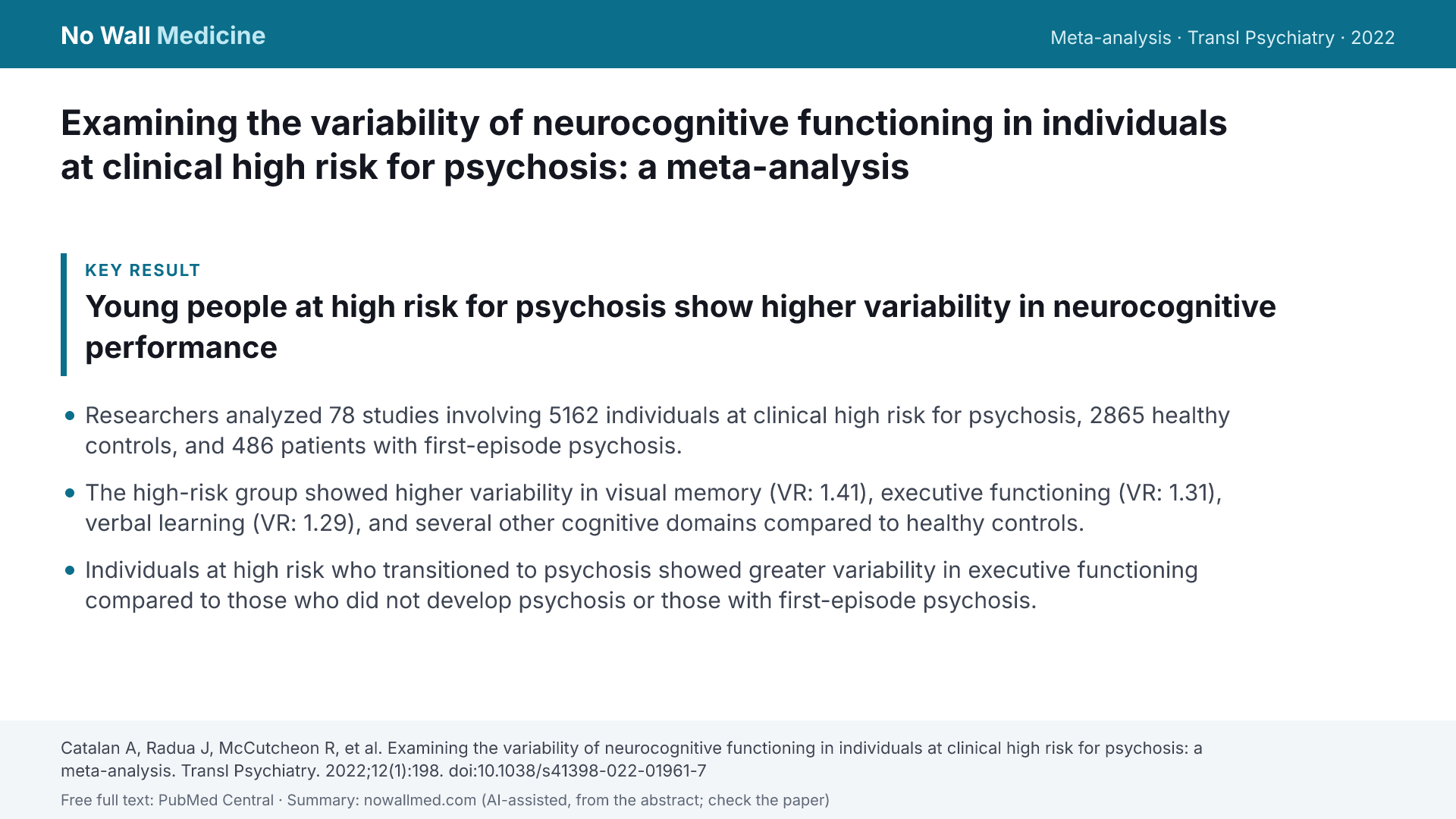
Key result: Young people at high risk for psychosis show higher variability in neurocognitive performance
Key points
- Researchers analyzed 78 studies involving 5162 individuals at clinical high risk for psychosis, 2865 healthy controls, and 486 patients with first-episode psychosis.
- The high-risk group showed higher variability in visual memory (VR: 1.41), executive functioning (VR: 1.31), verbal learning (VR: 1.29), and several other cognitive domains compared to healthy controls.
- Individuals at high risk who transitioned to psychosis showed greater variability in executive functioning compared to those who did not develop psychosis or those with first-episode psychosis.
Why it matters: The magnitude of within-group variability in neurocognitive functioning among young people at clinical high risk for psychosis was not previously characterized.
Limitation the authors note: The authors state that the validity of the variability ratio and coefficient of variation ratio as an index of variability has received debate.
Discussion prompts
- Would these patients look like yours? Who was left out?
- Is the main outcome one that matters to patients?
- Is the difference large enough to change what you do?
Cite: Catalan A, Radua J, McCutcheon R, et al. Examining the variability of neurocognitive functioning in individuals at clinical high risk for psychosis: a meta-analysis. Transl Psychiatry. 2022;12(1):198. doi:10.1038/s41398-022-01961-7
Free full text: PubMed Central · Summary and visual abstract: nowallmed.com/a/examining-the-variability-of-neurocognitive-functioning-in-ku8bdo/ (AI-assisted from the abstract; check the paper before relying on it).