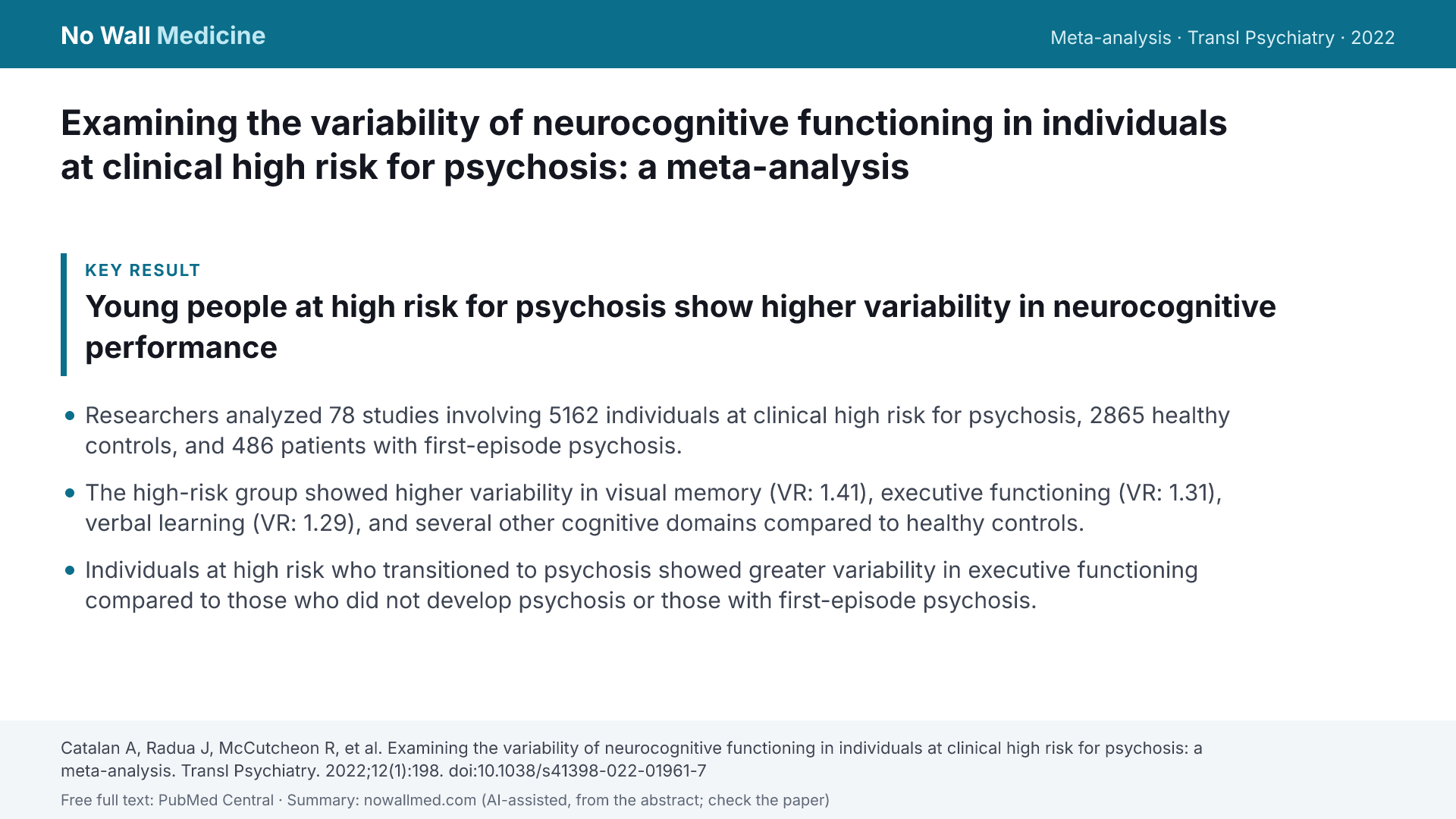
Young people at high risk for psychosis show higher variability in neurocognitive performance
Examining the variability of neurocognitive functioning in individuals at clinical high risk for psychosis: a meta-analysis
Why it matters: The magnitude of within-group variability in neurocognitive functioning among young people at clinical high risk for psychosis was not previously characterized.
Key points
- Researchers analyzed 78 studies involving 5162 individuals at clinical high risk for psychosis, 2865 healthy controls, and 486 patients with first-episode psychosis.
- The high-risk group showed higher variability in visual memory (VR: 1.41), executive functioning (VR: 1.31), verbal learning (VR: 1.29), and several other cognitive domains compared to healthy controls.
- Individuals at high risk who transitioned to psychosis showed greater variability in executive functioning compared to those who did not develop psychosis or those with first-episode psychosis.
Limitation the authors note: The authors state that the validity of the variability ratio and coefficient of variation ratio as an index of variability has received debate.
Headline and key points written with AI from the paper’s abstract, with every number checked against it. Read the paper before relying on them.
Was this summary helpful?
Subject terms
Headline, design, result, key points, caveat and citation as plain text.
Cite this article
Catalan A, Radua J, McCutcheon R, et al. Examining the variability of neurocognitive functioning in individuals at clinical high risk for psychosis: a meta-analysis. Transl Psychiatry. 2022;12(1):198. doi:10.1038/s41398-022-01961-7
Spotted a mistake? Suggest a correction