Exercise-based cardiac rehabilitation improves quality of life after coronary artery procedures without increasing mortality
Exercise-based cardiac rehabilitation for patients undergoing coronary artery operation: a systematic review and meta-analysis based on current randomized controlled trials
Meta-analysis of 25 randomized controlled trialsBenefit found
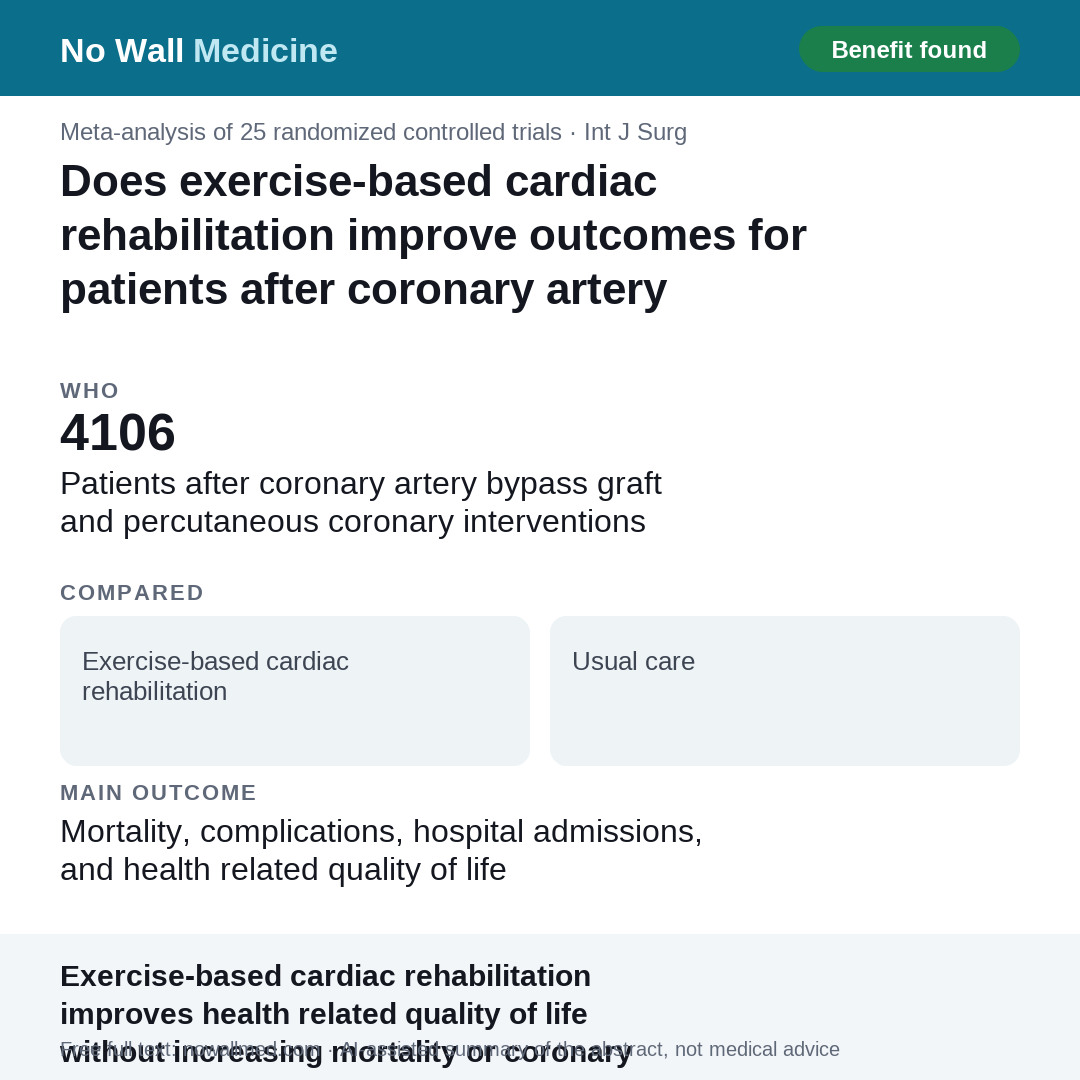
Does exercise-based cardiac rehabilitation improve outcomes for patients after coronary artery operation?
Who
4106
Patients after coronary artery bypass graft and percutaneous coronary interventions
Compared
Exercise-based cardiac rehabilitation
Usual care
Main outcome
Mortality, complications, hospital admissions, and health related quality of life
Result: standardized mean difference 0.24 (95% CI 0.11-0.38) for health related quality of life
Bottom line: Exercise-based cardiac rehabilitation improves health related quality of life without increasing mortality or coronary artery complications.
Int J Surg · 2025-03-01Download image
Clinical question: Does exercise-based cardiac rehabilitation improve outcomes for patients after coronary artery operation?
Why it matters: The effects of exercise-based cardiac rehabilitation on mortality, complications, hospital admissions, and quality of life for patients after heart bypass surgery or percutaneous coronary intervention are not fully established.
Key points
- Researchers analyzed 25 randomized controlled trials involving 4106 participants to compare exercise-based cardiac rehabilitation with usual care.
- Exercise-based rehabilitation was associated with a lower incidence of heart attack (RR: 0.50; 95% CI: 0.28-0.90) and all-cause hospital admissions (RR: 0.74; 95% CI: 0.62-0.88).
- The program was associated with improved health-related quality of life scores, including an SF-36 summary score (SMD: 0.24; 95% CI: 0.11-0.38) and 8 domains (SMD: 0.35; 95% CI: 0.24-0.46).
Headline and key points written with AI from the paper’s abstract, with every number checked against it. Read the paper before relying on them.
Topics
Cite this article
Shi Y, Xu H, Dong J. Exercise-based cardiac rehabilitation for patients undergoing coronary artery operation: a systematic review and meta-analysis based on current randomized controlled trials. Int J Surg. 2025. doi:10.1097/JS9.0000000000002268
Spotted a mistake? Suggest a correction