Exercise interventions were associated with lower depression, anxiety, and better quality of life in older adults with cancer
Exercise Interventions for Depression, Anxiety, and Quality of Life in Older Adults With Cancer: A Systematic Review and Meta-Analysis
Systematic review and meta-analysis of 27 randomized clinical trialsBenefit found
Do exercise interventions improve psychological outcomes in older adults with cancer?
Who
1929
Older adults with a diagnosis of any cancer
Compared
Exercise interventions
Usual care
Main outcome
Depression, anxiety, and health-related quality of life
Result: depression SMD -0.53 (95% CI -0.79 to -0.28), anxiety SMD -0.39 (95% CI -0.66 to -0.12), HRQOL SMD 0.63 (95% CI 0.10 to 1.17)
Bottom line: Exercise interventions are associated with reduced depression and anxiety and improved health-related quality of life in older adults with cancer.
JAMA Netw Open · 2025-02-03 · Save PNG
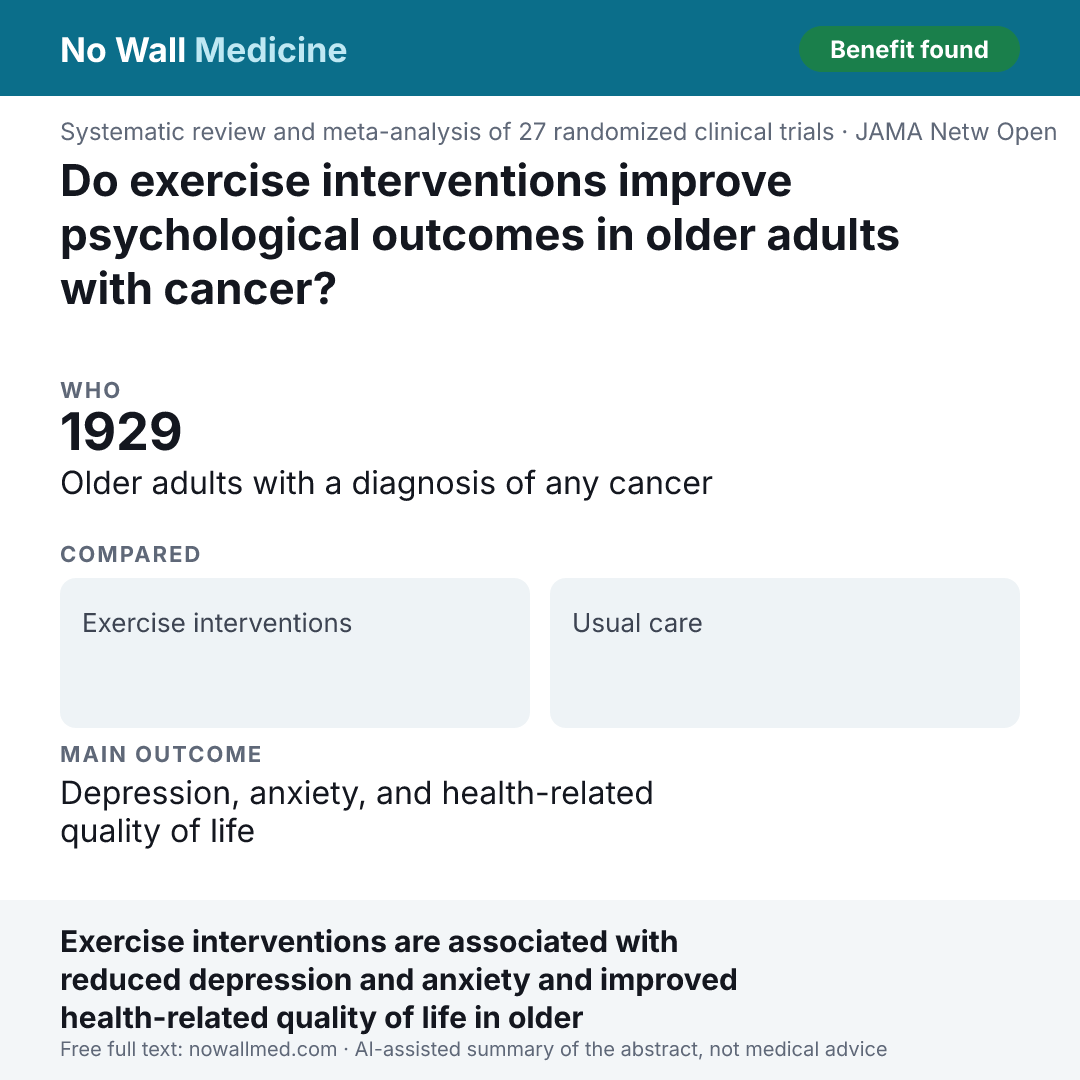
Clinical question: Do exercise interventions improve psychological outcomes in older adults with cancer?
Key points
- Researchers analyzed 27 randomized clinical trials involving 1929 participants with a mean age over 60 years.
- Exercise was associated with reduced depression (SMD = -0.53; 95% CI, -0.79 to -0.28), reduced anxiety (SMD = -0.39; 95% CI, -0.66 to -0.12), and improved health-related quality of life (SMD = 0.63; 95% CI, 0.10 to 1.17).
- Mind-body exercise was associated with greater improvements in depression (SMD = -0.89; 95% CI, -1.51 to -0.27) and anxiety (SMD = -0.77; 95% CI, -1.54 to -0.01) than conventional exercise.
Headline and key points written with AI from the paper’s abstract, with every number checked against it. Read the paper before relying on them.
Was this summary helpful?
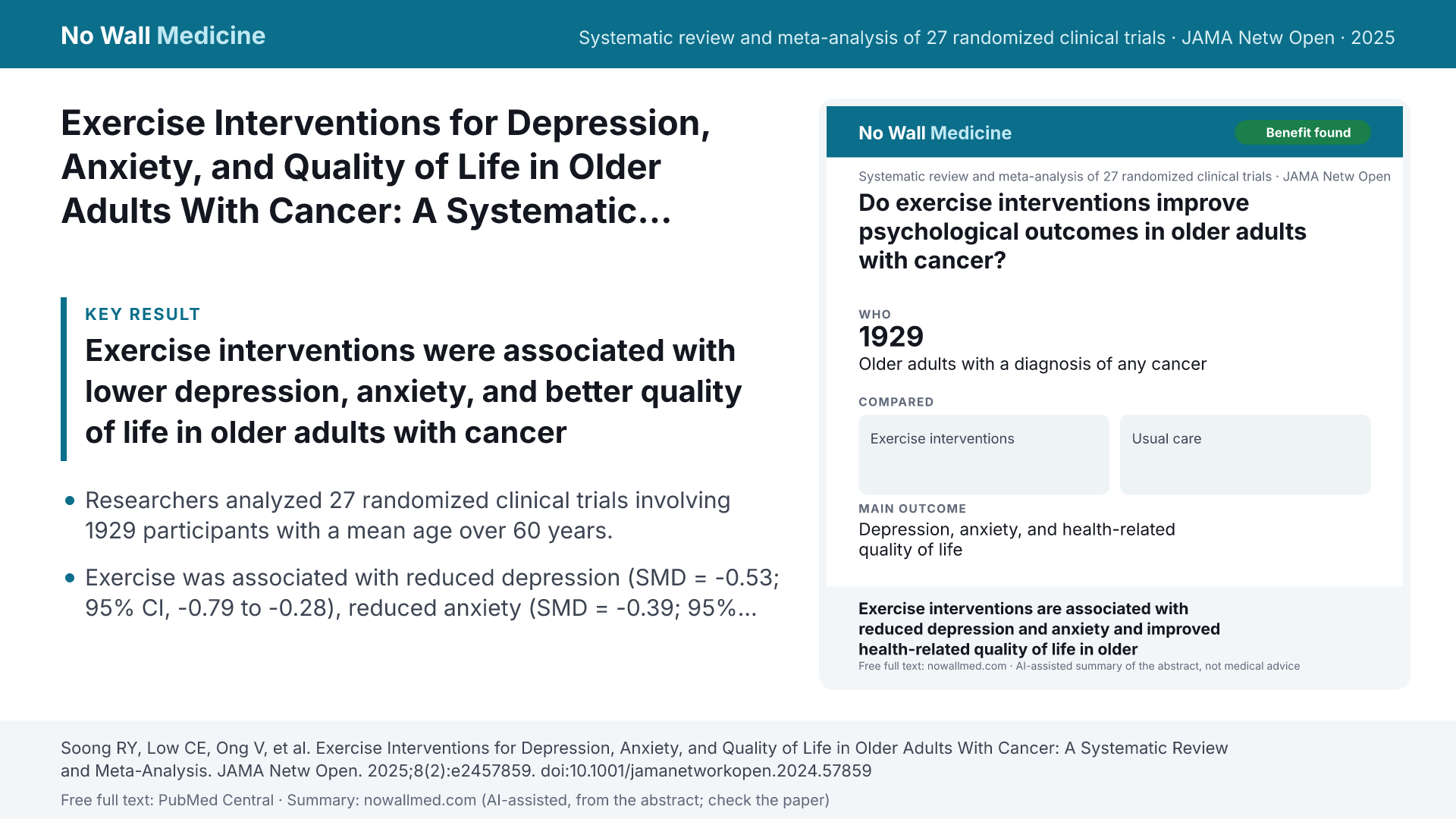
Subject terms
Headline, design, result, key points, caveat and citation as plain text.
Cite this article
Soong RY, Low CE, Ong V, et al. Exercise Interventions for Depression, Anxiety, and Quality of Life in Older Adults With Cancer: A Systematic Review and Meta-Analysis. JAMA Netw Open. 2025;8(2):e2457859. doi:10.1001/jamanetworkopen.2024.57859
Spotted a mistake? Suggest a correction