Type 2 diabetes is associated with lower cardiorespiratory fitness compared to individuals without insulin resistance
Exercise Intolerance in Type 2 Diabetes: A Systematic Review and Meta-Analysis
Meta-analysis of 30 cohortsHarm found
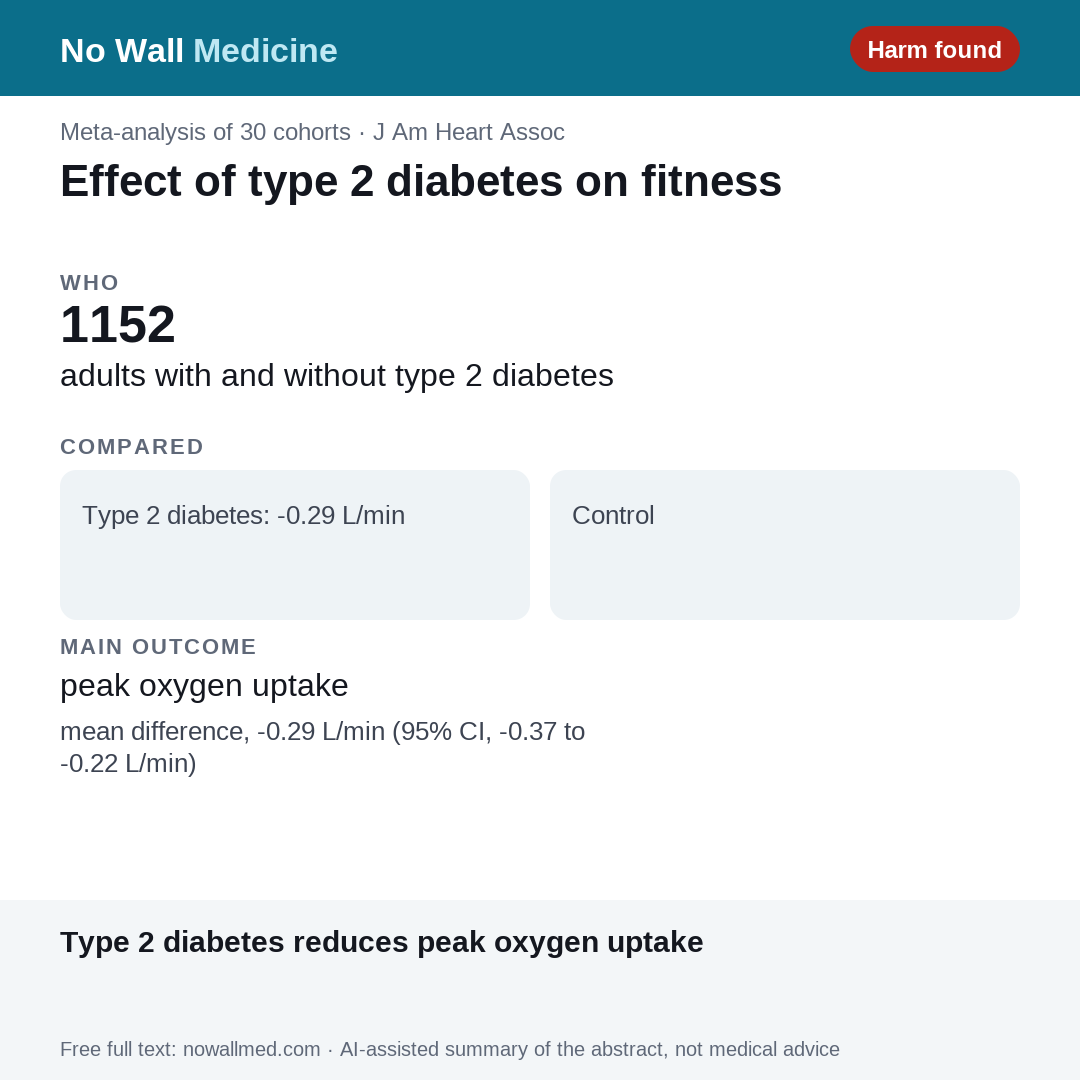
Effect of type 2 diabetes on fitness
Who
1152
adults with and without type 2 diabetes
Compared
Type 2 diabetes: -0.29 L/min
Control
Main outcome
peak oxygen uptake
Result: mean difference, -0.29 L/min (95% CI, -0.37 to -0.22 L/min)
Bottom line: Type 2 diabetes reduces peak oxygen uptake
J Am Heart Assoc · 2025-03-03Download image
Why it matters: It was unknown how type 2 diabetes affects cardiorespiratory fitness and which factors contribute to exercise intolerance in these individuals.
Key points
- Researchers analyzed 30 cohorts with 1152 subjects and 11 cohorts with 1191 subjects to compare peak oxygen uptake, a measure of aerobic fitness, between groups.
- The type 2 diabetes group had an absolute peak oxygen uptake mean difference of -0.29 L/min and a relative peak oxygen uptake mean difference of -4.68 mL/kg per min.
- Time since diagnosis and certain markers of heart relaxation, such as left atrial volume index, were associated with differences in fitness levels.
Headline and key points written with AI from the paper’s abstract, with every number checked against it. Read the paper before relying on them.
Was this summary helpful?
Subject terms
Cite this article
Anderson KC, Weeldreyer NR, Leicht ZS, Angadi SS, Liu Z. Exercise Intolerance in Type 2 Diabetes: A Systematic Review and Meta-Analysis. J Am Heart Assoc. 2025. doi:10.1161/JAHA.124.035721
Spotted a mistake? Suggest a correction
Top studies every Monday
The week’s key trials and guidelines in your specialties, plus any topics you follow. By email, free.
Get the weekly digest