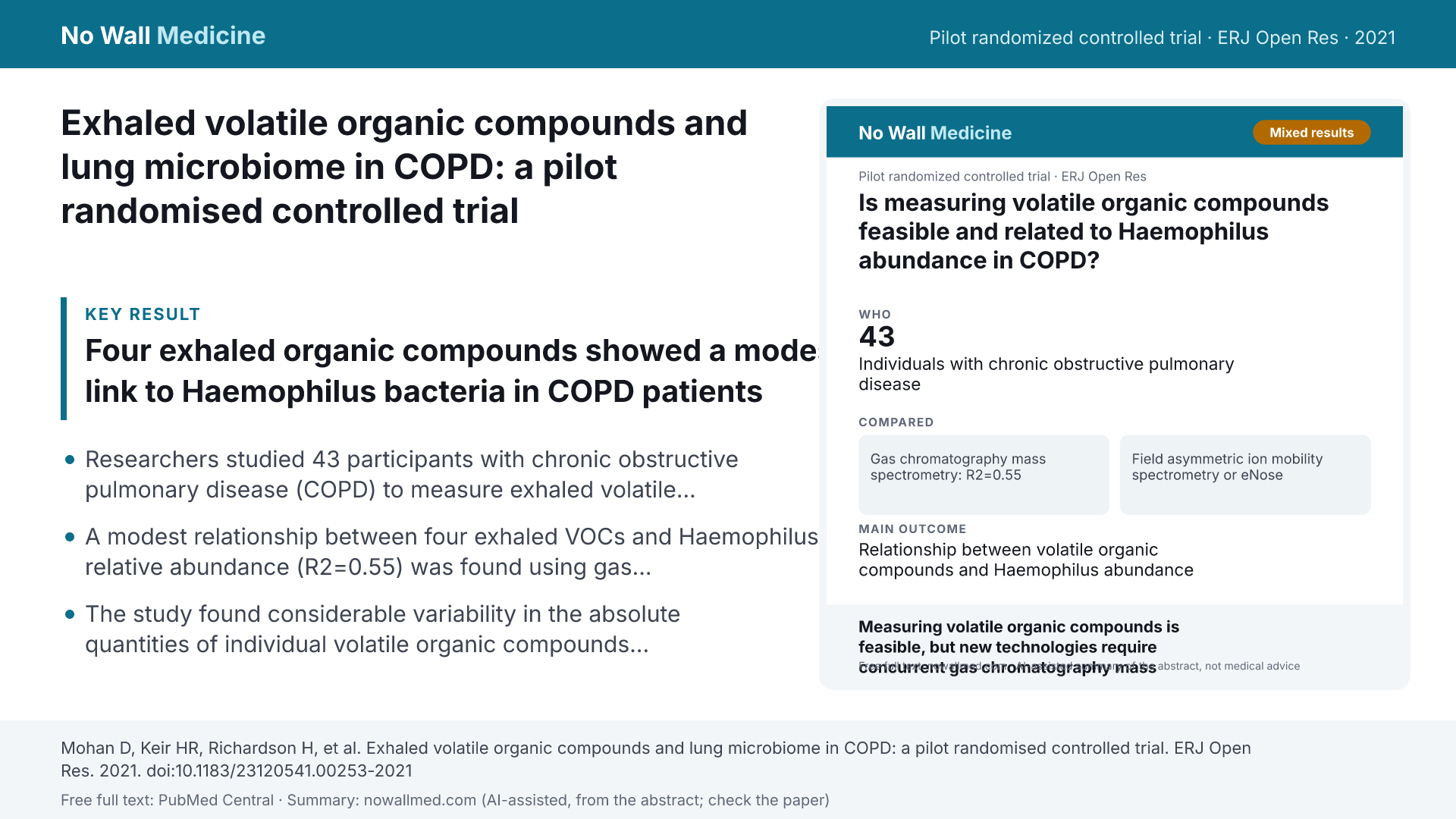
Four exhaled organic compounds showed a modest link to Haemophilus bacteria in COPD patients
Exhaled volatile organic compounds and lung microbiome in COPD: a pilot randomised controlled trial
Pilot randomized controlled trialMixed results
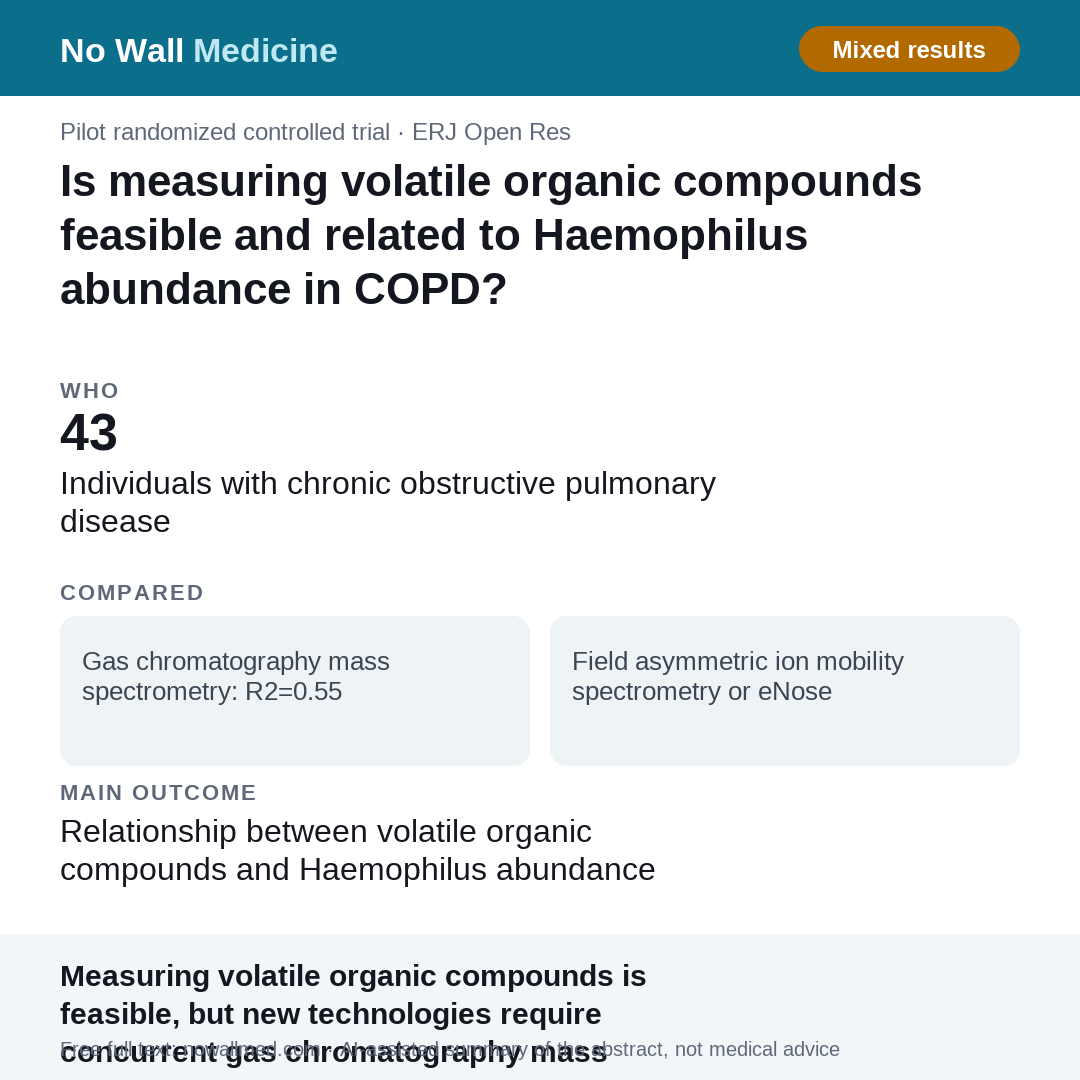
Is measuring volatile organic compounds feasible and related to Haemophilus abundance in COPD?
Who
43
Individuals with chronic obstructive pulmonary disease
Compared
Gas chromatography mass spectrometry: R2=0.55
Field asymmetric ion mobility spectrometry or eNose
Main outcome
Relationship between volatile organic compounds and Haemophilus abundance
Bottom line: Measuring volatile organic compounds is feasible, but new technologies require concurrent gas chromatography mass spectrometry validation.
ERJ Open Res · 2021-10-04Download image
Clinical question: Is measuring volatile organic compounds feasible and related to Haemophilus abundance in COPD?
Key points
- Researchers studied 43 participants with chronic obstructive pulmonary disease (COPD) to measure exhaled volatile organic compounds (VOCs) and lung bacteria.
- A modest relationship between four exhaled VOCs and Haemophilus relative abundance (R2=0.55) was found using gas chromatography mass spectrometry, but not with other technologies.
- The study found considerable variability in the absolute quantities of individual volatile organic compounds measured over the 14 day period.
Headline and key points written with AI from the paper’s abstract, with every number checked against it. Read the paper before relying on them.
Was this summary helpful?
Headline, design, result, key points, caveat and citation as plain text.
Cite this article
Mohan D, Keir HR, Richardson H, et al. Exhaled volatile organic compounds and lung microbiome in COPD: a pilot randomised controlled trial. ERJ Open Res. 2021. doi:10.1183/23120541.00253-2021
Spotted a mistake? Suggest a correction