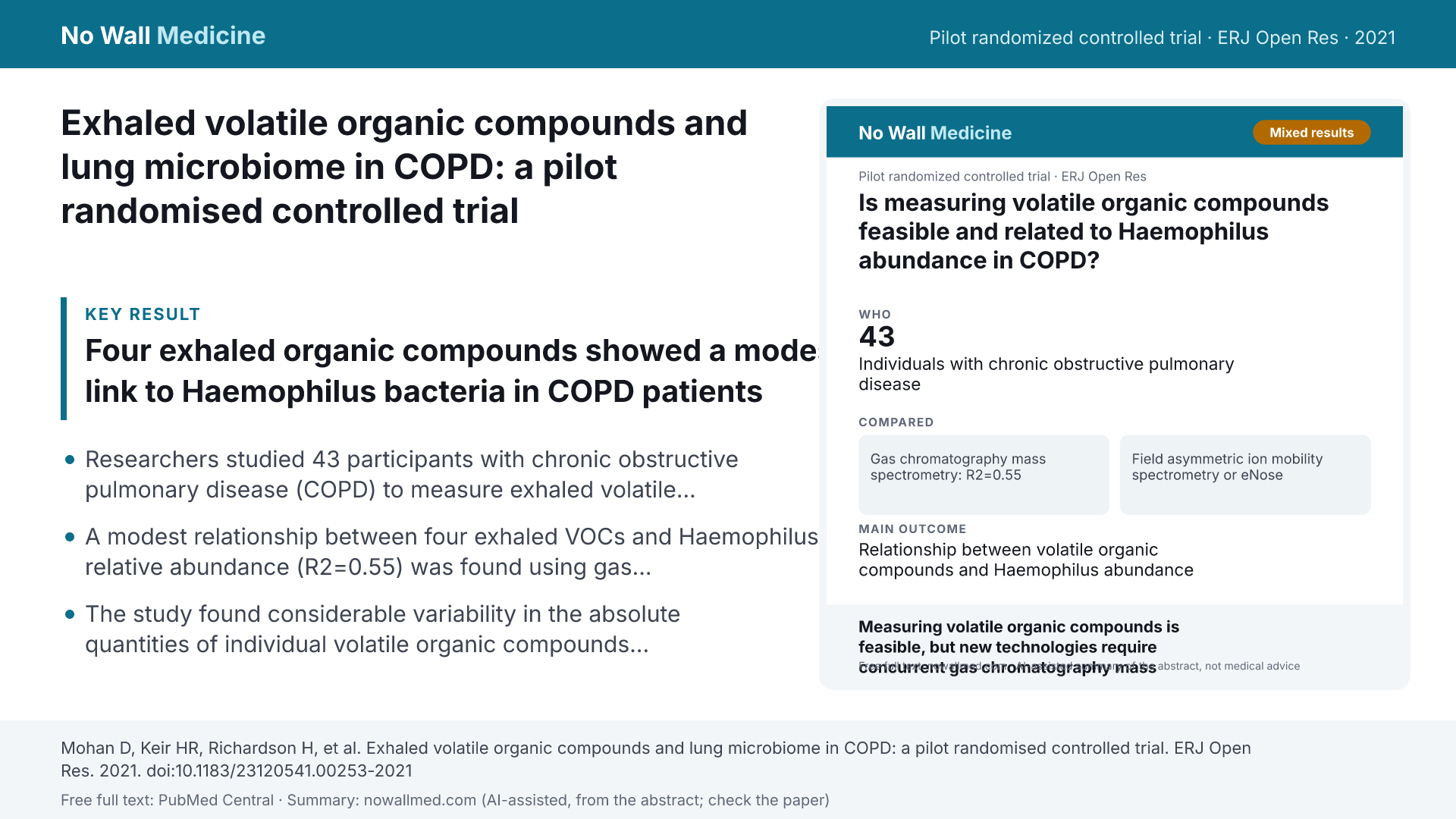
Exhaled volatile organic compounds and lung microbiome in COPD: a pilot randomised controlled trial
Key result: Four exhaled organic compounds showed a modest link to Haemophilus bacteria in COPD patients
Pilot randomized controlled trialMixed results
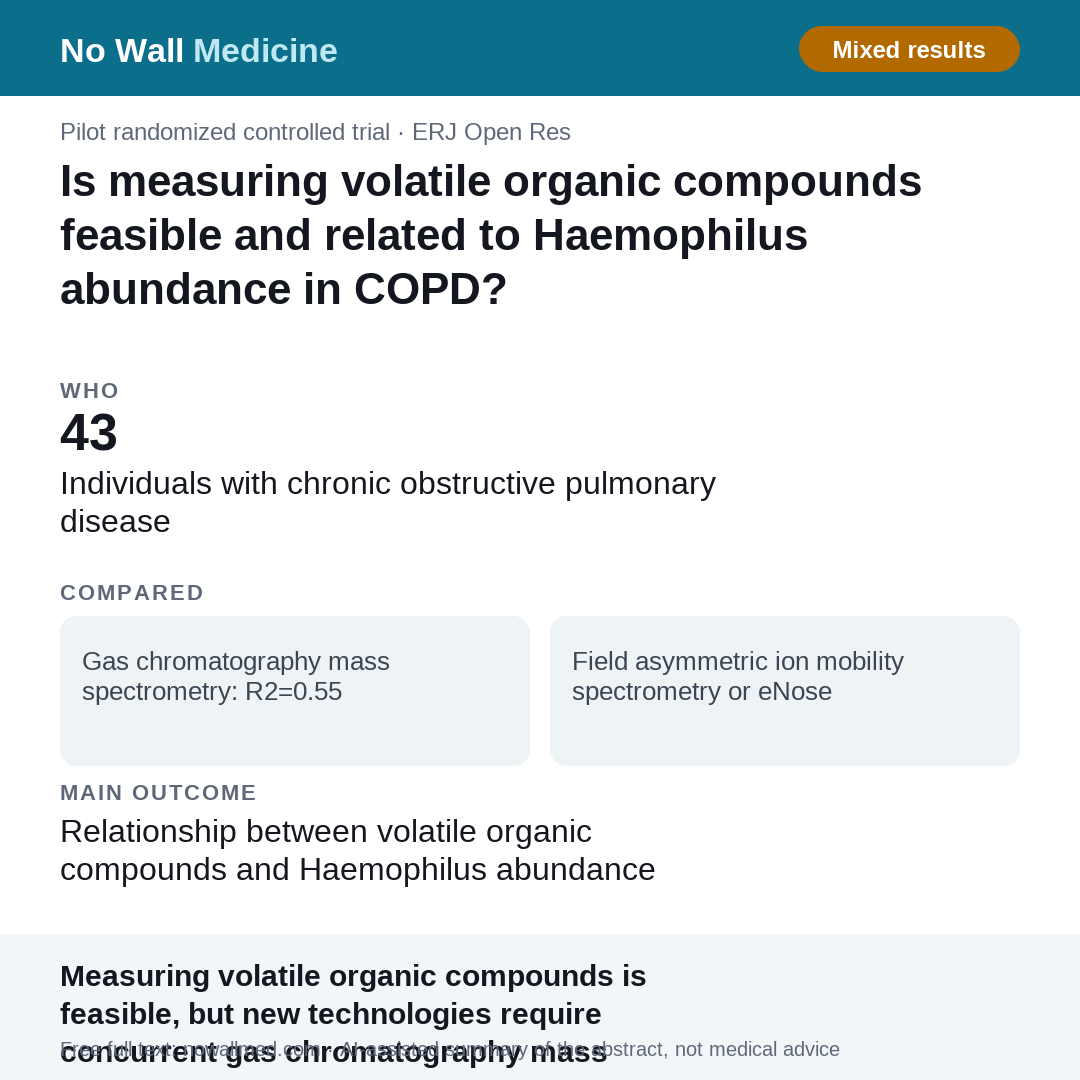
Is measuring volatile organic compounds feasible and related to Haemophilus abundance in COPD?
Who
43
Individuals with chronic obstructive pulmonary disease
Compared
Gas chromatography mass spectrometry: R2=0.55
Field asymmetric ion mobility spectrometry or eNose
Main outcome
Relationship between volatile organic compounds and Haemophilus abundance
Bottom line: Measuring volatile organic compounds is feasible, but new technologies require concurrent gas chromatography mass spectrometry validation.
ERJ Open Res · 2021-10-04Download image
Key points
- Researchers studied 43 participants with chronic obstructive pulmonary disease (COPD) to measure exhaled volatile organic compounds (VOCs) and lung bacteria.
- A modest relationship between four exhaled VOCs and Haemophilus relative abundance (R2=0.55) was found using gas chromatography mass spectrometry, but not with other technologies.
- The study found considerable variability in the absolute quantities of individual volatile organic compounds measured over the 14 day period.
Discussion prompts
- Would these patients look like yours? Who was left out?
- Is the main outcome one that matters to patients?
- Is the difference large enough to change what you do?
Cite: Mohan D, Keir HR, Richardson H, et al. Exhaled volatile organic compounds and lung microbiome in COPD: a pilot randomised controlled trial. ERJ Open Res. 2021. doi:10.1183/23120541.00253-2021
Free full text: PubMed Central · Summary and visual abstract: nowallmed.com/a/exhaled-volatile-organic-compounds-and-lung-microbiome-in-copd-a-sqlok2/ (AI-assisted from the abstract; check the paper before relying on it).