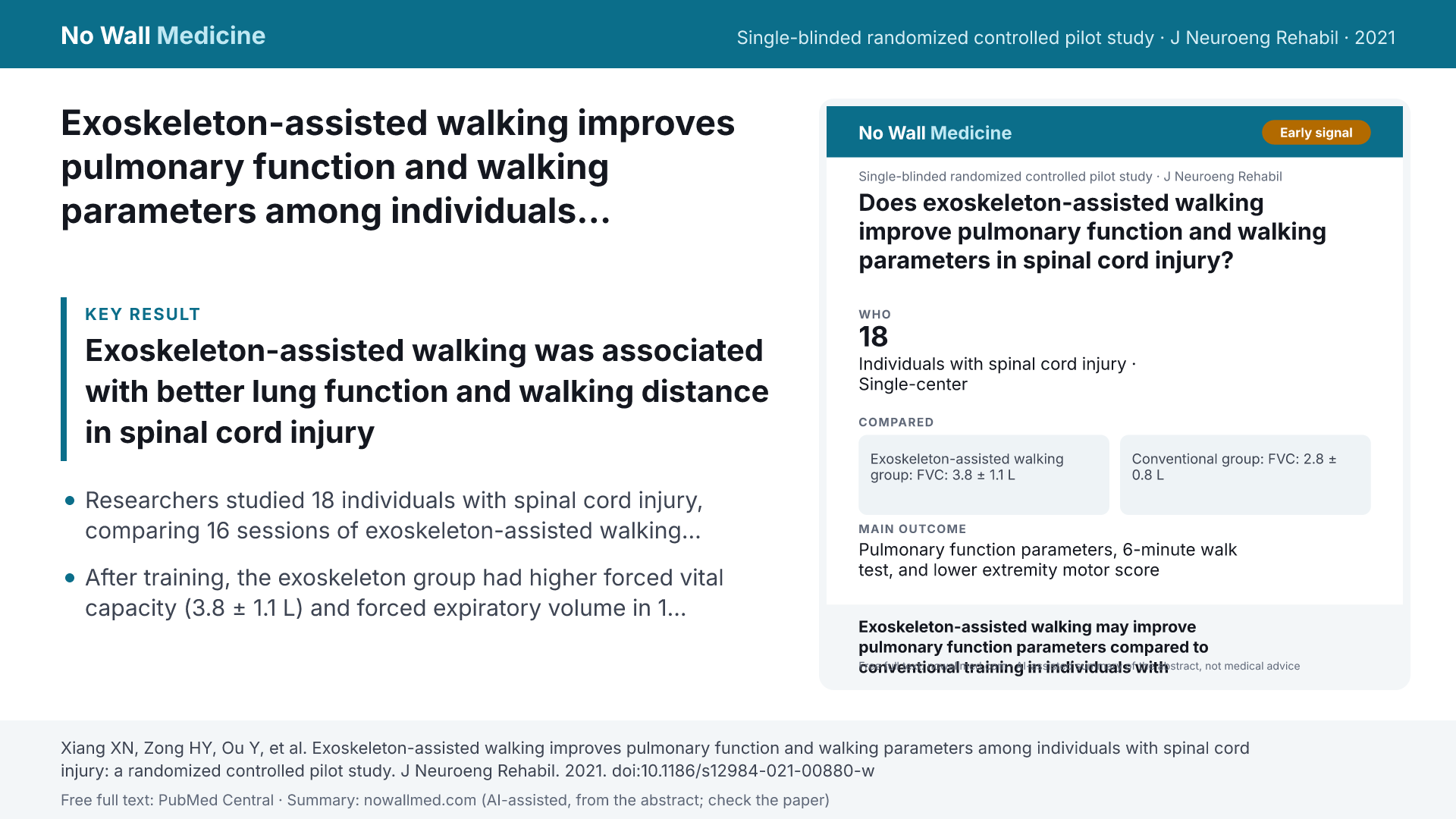
Exoskeleton-assisted walking was associated with better lung function and walking distance in spinal cord injury
Exoskeleton-assisted walking improves pulmonary function and walking parameters among individuals with spinal cord injury: a randomized controlled pilot study
Single-blinded randomized controlled pilot studyEarly signal
Does exoskeleton-assisted walking improve pulmonary function and walking parameters in spinal cord injury?
Who
18
Individuals with spinal cord injury · Single-center
Compared
Exoskeleton-assisted walking group: FVC: 3.8 ± 1.1 L
Conventional group: FVC: 2.8 ± 0.8 L
Main outcome
Pulmonary function parameters, 6-minute walk test, and lower extremity motor score
Bottom line: Exoskeleton-assisted walking may improve pulmonary function parameters compared to conventional training in individuals with spinal cord injury.
Limitation: Pilot study
J Neuroeng Rehabil · 2021-05-24Download image
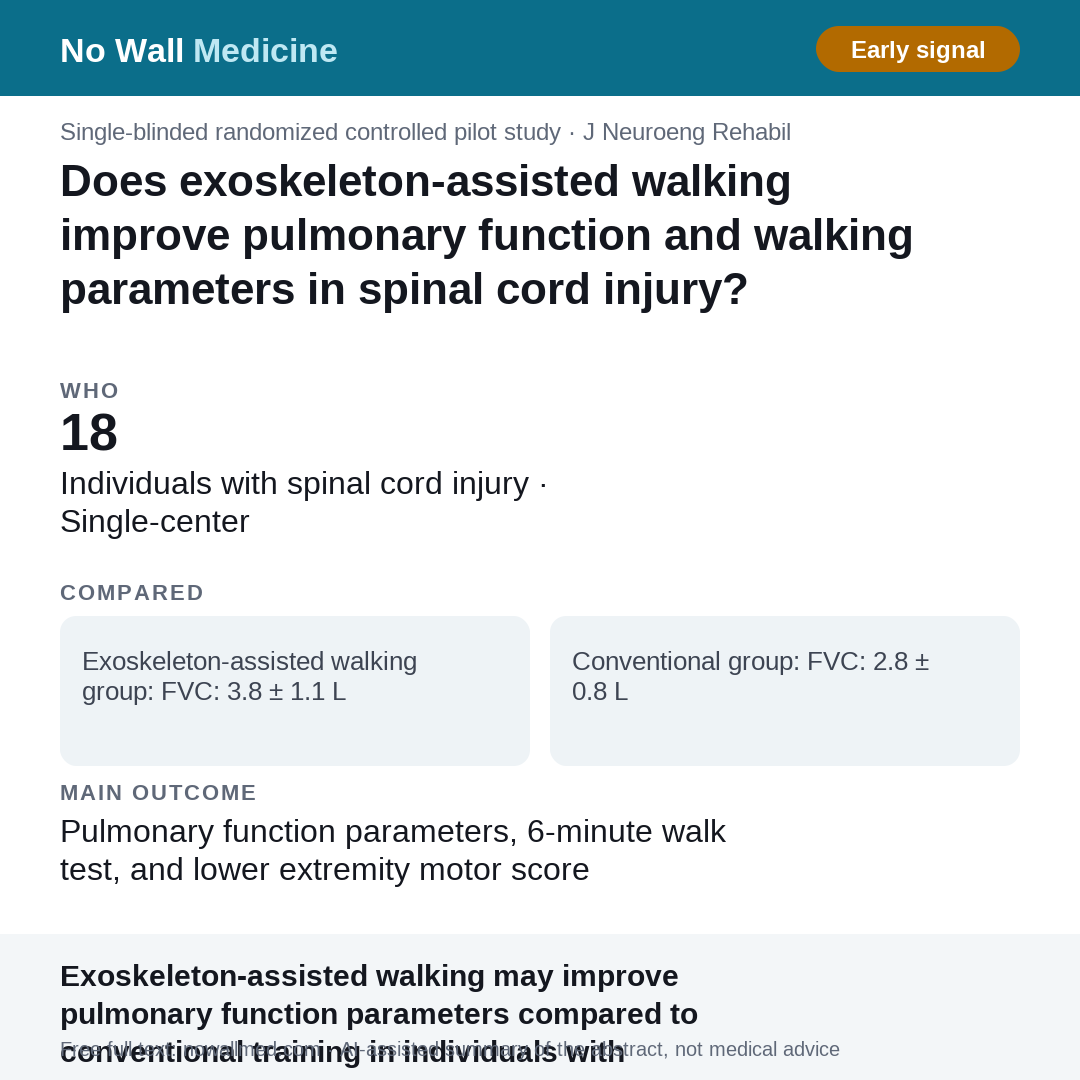
Clinical question: Does exoskeleton-assisted walking improve pulmonary function and walking parameters in spinal cord injury?
Key points
- Researchers studied 18 individuals with spinal cord injury, comparing 16 sessions of exoskeleton-assisted walking to conventional training.
- After training, the exoskeleton group had higher forced vital capacity (3.8 ± 1.1 L) and forced expiratory volume in 1 second (3.5 ± 1.0 L) than the conventional group.
- The exoskeleton group completed a 6-minute walk test with a median of 17.3 m, while no difference was found in lower extremity motor scores.
Limitation the authors note: This was a single-center, single-blinded randomized controlled pilot study.
Headline and key points written with AI from the paper’s abstract, with every number checked against it. Read the paper before relying on them.
Was this summary helpful?
Subject terms
Headline, design, result, key points, caveat and citation as plain text.
Cite this article
Xiang XN, Zong HY, Ou Y, et al. Exoskeleton-assisted walking improves pulmonary function and walking parameters among individuals with spinal cord injury: a randomized controlled pilot study. J Neuroeng Rehabil. 2021. doi:10.1186/s12984-021-00880-w
Spotted a mistake? Suggest a correction