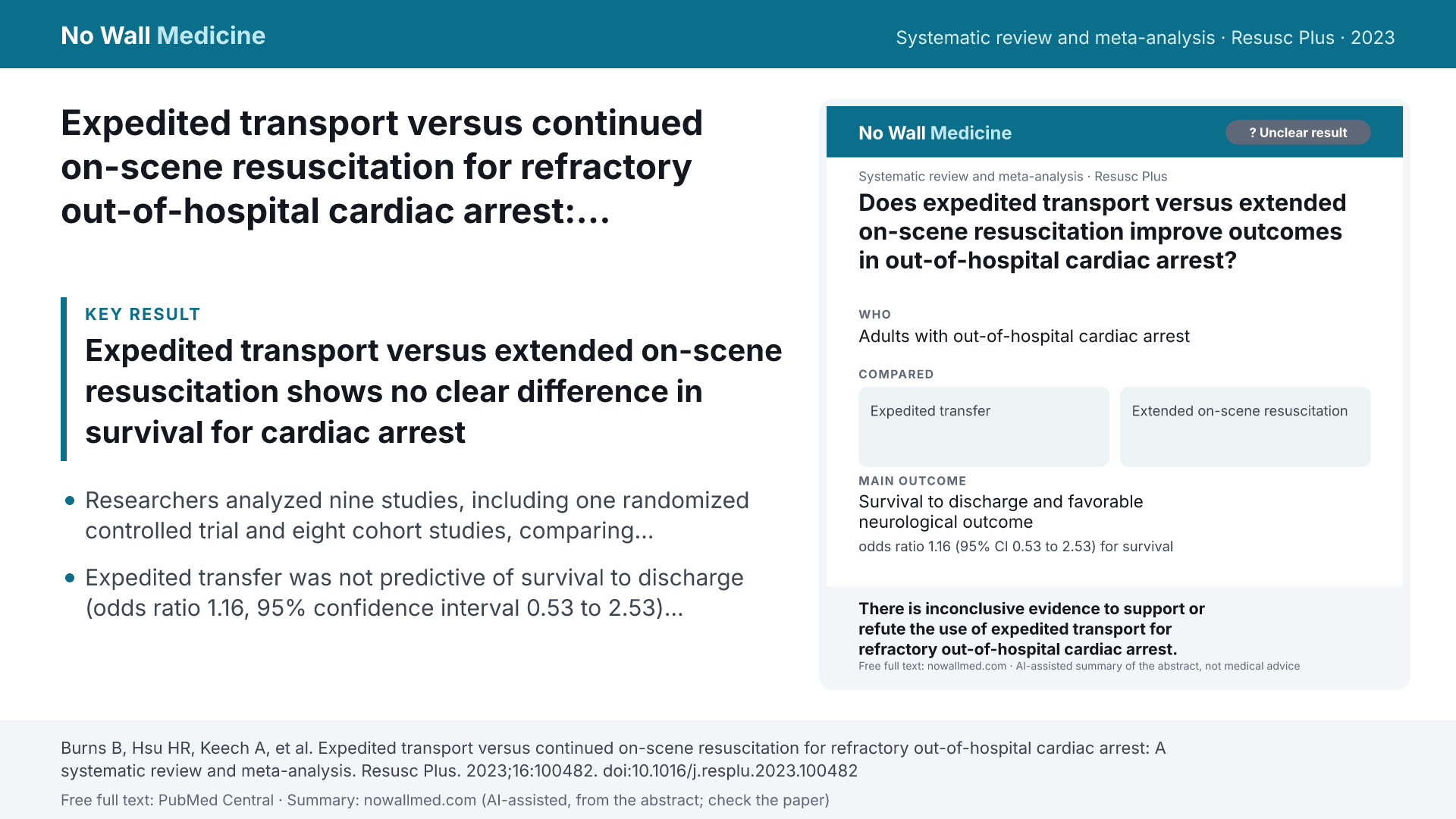
Expedited transport versus extended on-scene resuscitation shows no clear difference in survival for cardiac arrest
Expedited transport versus continued on-scene resuscitation for refractory out-of-hospital cardiac arrest: A systematic review and meta-analysis
Systematic review and meta-analysisUnclear result
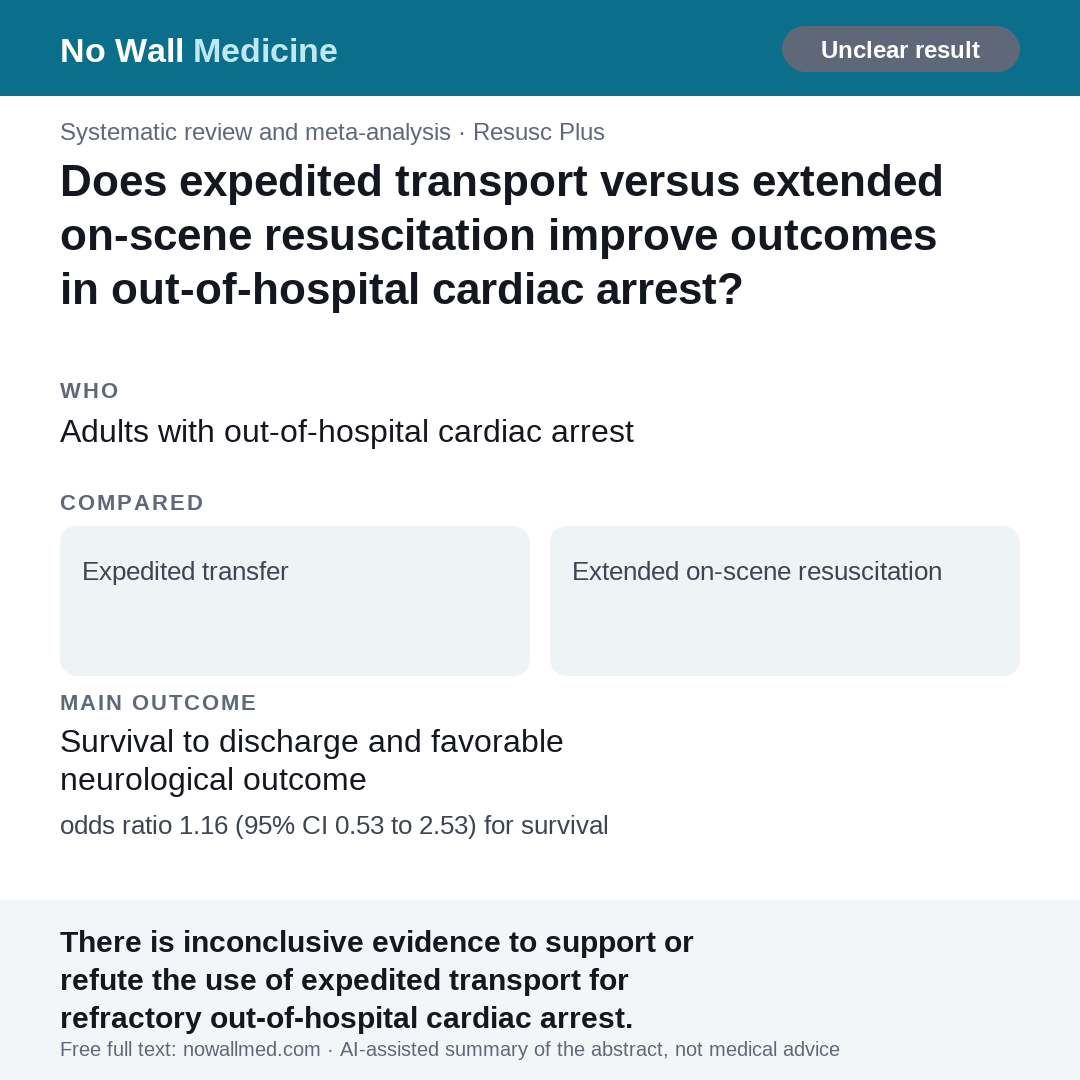
Does expedited transport versus extended on-scene resuscitation improve outcomes in out-of-hospital cardiac arrest?
Who
Adults with out-of-hospital cardiac arrest
Compared
Expedited transfer
Extended on-scene resuscitation
Main outcome
Survival to discharge and favorable neurological outcome
Result: odds ratio 1.16 (95% CI 0.53 to 2.53) for survival
Bottom line: There is inconclusive evidence to support or refute the use of expedited transport for refractory out-of-hospital cardiac arrest.
Limitation: Certainty of evidence was very low with a moderate risk of bias and significant heterogeneity.
Resusc Plus · 2023-10-07Download image
Clinical question: Does expedited transport versus extended on-scene resuscitation improve outcomes in out-of-hospital cardiac arrest?
Why it matters: It is uncertain whether rapid transport to a hospital or extended resuscitation at the scene is more beneficial for patients experiencing out-of-hospital cardiac arrest.
Key points
- Researchers analyzed nine studies, including one randomized controlled trial and eight cohort studies, comparing rapid transport to extended on-scene resuscitation for adults in out-of-hospital cardiac arrest.
- Expedited transfer was not predictive of survival to discharge (odds ratio 1.16, 95% confidence interval 0.53 to 2.53) or favorable neurological outcome (odds ratio 1.06, 95% confidence interval 0.48 to 2.37).
- The certainty of evidence across the included studies was assessed as very low with a moderate risk of bias.
Limitation the authors note: The certainty of evidence was very low with a moderate risk of bias and significant heterogeneity caused by the region of publication.
Headline and key points written with AI from the paper’s abstract, with every number checked against it. Read the paper before relying on them.
Was this summary helpful?
Cite this article
Burns B, Hsu HR, Keech A, Huang Y, Tian DH, Coggins A. Expedited transport versus continued on-scene resuscitation for refractory out-of-hospital cardiac arrest: A systematic review and meta-analysis. Resusc Plus. 2023. doi:10.1016/j.resplu.2023.100482
Spotted a mistake? Suggest a correction
Top studies every Monday
The week’s key trials and guidelines in your specialties, plus any topics you follow. By email, free.
Get the weekly digest