Extended Knee Control programme was associated with lower weekly hamstring, knee, and ankle injury prevalence
Extended Knee Control programme lowers weekly hamstring, knee and ankle injury prevalence compared with an adductor strength programme or self-selected injury prevention exercises in adolescent and adult amateur football players: a two-armed cluster-randomised trial with an additional comparison arm
Two-armed cluster-randomised trial with additional non-randomised armBenefit found
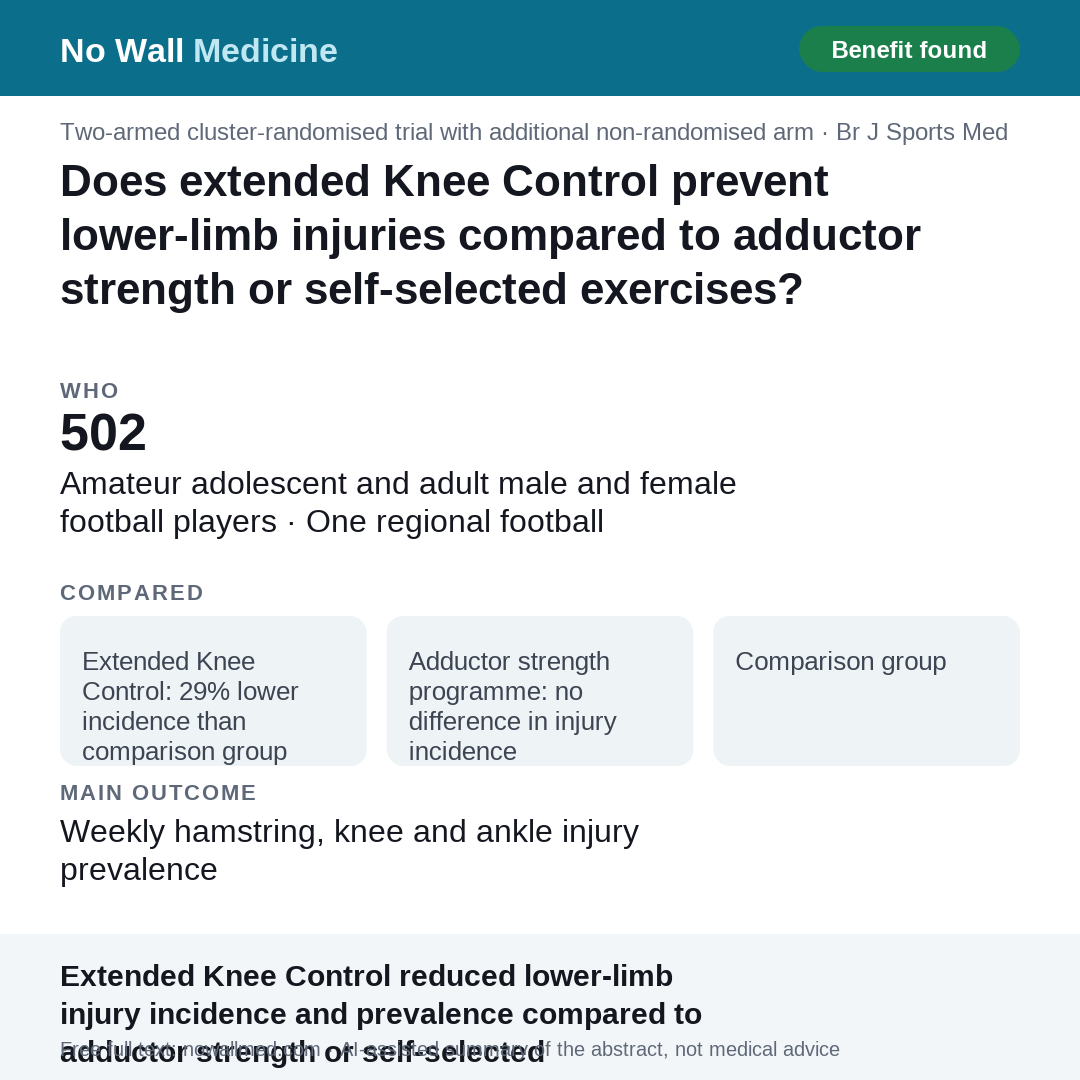
Does extended Knee Control prevent lower-limb injuries compared to adductor strength or self-selected exercises?
Who
502
Amateur adolescent and adult male and female football players · One regional football district
Compared
Extended Knee Control: 29% lower incidence than comparison group
Adductor strength programme: no difference in injury incidence
Comparison group
Main outcome
Weekly hamstring, knee and ankle injury prevalence
Result: incidence rate ratio 0.71 (95% CI 0.52 to 0.98)
Bottom line: Extended Knee Control reduced lower-limb injury incidence and prevalence compared to adductor strength or self-selected exercises.
Br J Sports Med · 2022-10-31Download image
Clinical question: Does extended Knee Control prevent lower-limb injuries compared to adductor strength or self-selected exercises?
Why it matters: It was unknown whether an extended version of the Knee Control injury prevention programme is more effective than adductor strength training or self-selected exercises.
Key points
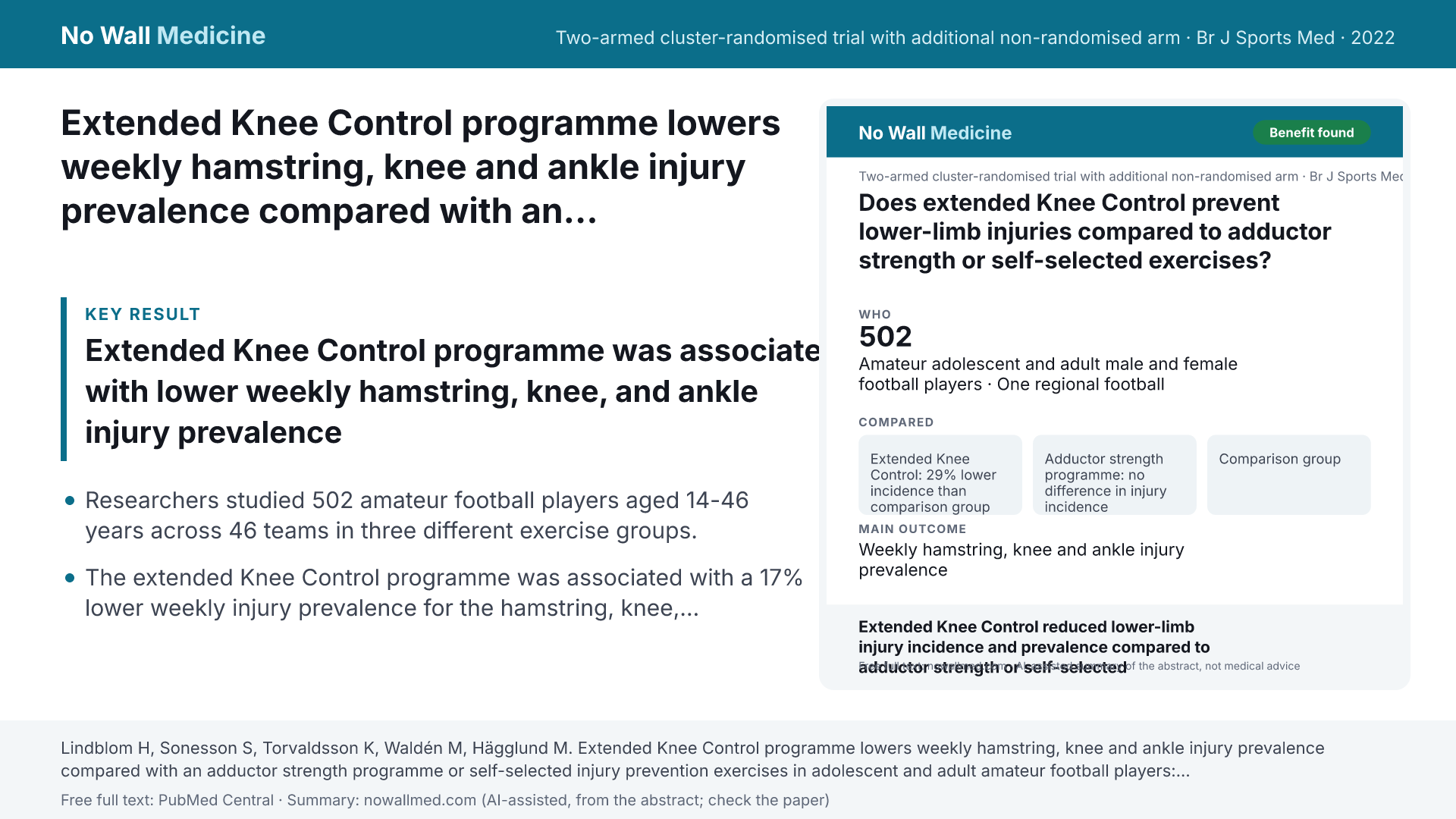
- Researchers studied 502 amateur football players aged 14-46 years across 46 teams in three different exercise groups.
- The extended Knee Control programme was associated with a 17% lower weekly injury prevalence for the hamstring, knee, and ankle compared to the adductor strength programme.
- The extended Knee Control programme was associated with a 26% lower weekly injury prevalence for those three locations compared to the self-selected exercise group.
Headline and key points written with AI from the paper’s abstract, with every number checked against it. Read the paper before relying on them.
Was this summary helpful?
Abstract
Objective
To evaluate the preventive efficacy of an extended version of the Knee Control injury prevention exercise programme (IPEP) compared with an adductor strength programme and to a comparison group using a self-selected IPEP in amateur adolescent and adult male and female football players. Methods
Two-armed cluster-randomised trial with an additional non-randomised arm. All 251 amateur teams (players 14-46 years) in one regional football district were approached. Teams meeting inclusion criteria were randomised to (1) extended Knee Control or (2) an adductor strength programme. Teams already using an IPEP were allocated to a comparison group and received no new intervention. Players responded to weekly questionnaires about football exposures and injuries during a 7-month season. Results
Seventeen teams in the extended Knee Control, 12 in the adductor and 17 in the comparison group participated, with 502 players. For the primary outcomes, no difference in injury incidence in three lower-limb injury locations combined (hamstring, knee and ankle) was seen between extended Knee Control and the adductor group, whereas extended Knee Control had 29% lower incidence than the comparison group (incidence rate ratio 0.71, 95% CI 0.52 to 0.98). No between-group differences in groin injury incidence were seen. The weekly injury prevalence rates in the three lower limb locations combined (hamstring, knee and ankle) were 17% lower (prevalence rate ratio (PRR) 0.83, 95% CI 0.69 to 1.00) and 26% lower (PRR 0.74, 95% CI 0.63 to 0.87) in extended Knee Control compared with the adductor and comparison groups, respectively. Conclusion
No difference in injury incidence was seen between the extended Knee Control and the adductor programme whereas extended Knee Control reduced injury incidence by nearly one-third compared with a self-selected IPEP. Players in extended Knee Control had lower injury prevalence compared with an adductor or self-selected IPEP. Trial registration number
NCT04272047; Clinical trials.
Abstract reproduced under the article’s CC BY licence.
Subject terms
Cite this article
Lindblom H, Sonesson S, Torvaldsson K, Waldén M, Hägglund M. Extended Knee Control programme lowers weekly hamstring, knee and ankle injury prevalence compared with an adductor strength programme or self-selected injury prevention exercises in adolescent and adult amateur football players: a two-armed cluster-randomised trial with an additional comparison arm. Br J Sports Med. 2022. doi:10.1136/bjsports-2022-105890
Spotted a mistake? Suggest a correction
Top studies every Monday
The week’s key trials and guidelines in your specialties, plus any topics you follow. By email, free.
Get the weekly digest