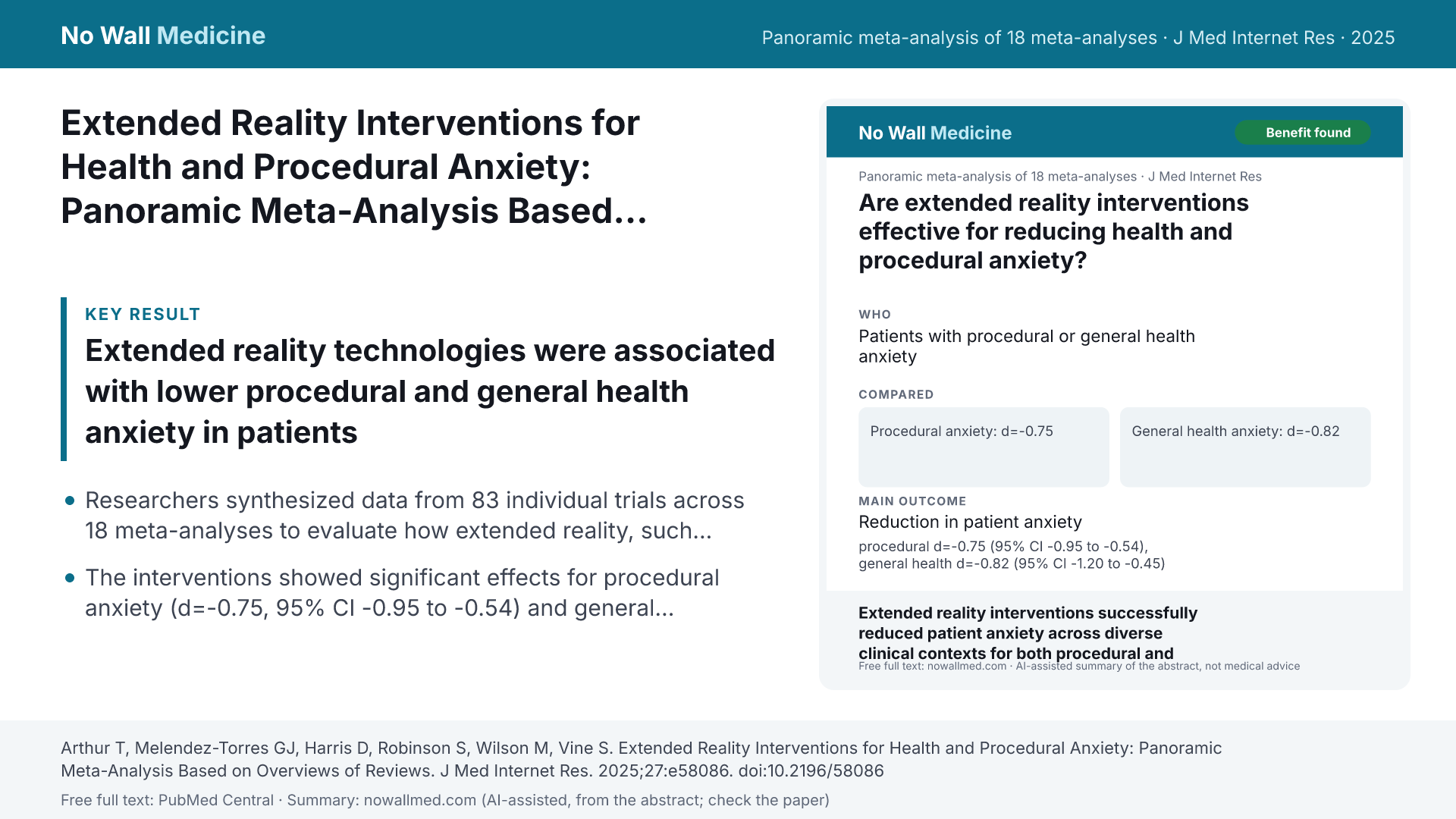
Extended reality technologies were associated with lower procedural and general health anxiety in patients
Extended Reality Interventions for Health and Procedural Anxiety: Panoramic Meta-Analysis Based on Overviews of Reviews
Panoramic meta-analysis of 18 meta-analysesBenefit found
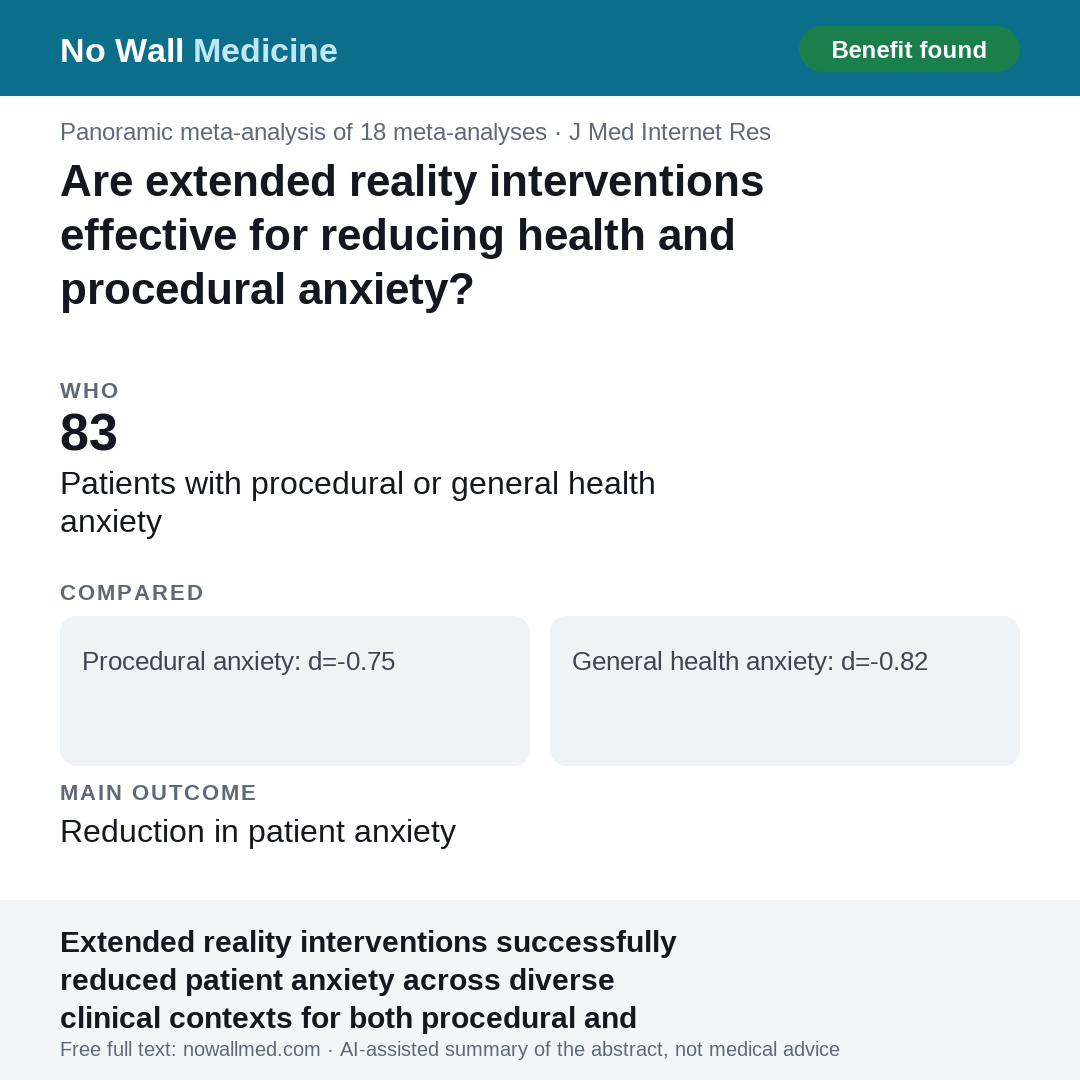
Are extended reality interventions effective for reducing health and procedural anxiety?
Who
83
Patients with procedural or general health anxiety
Compared
Procedural anxiety: d=-0.75
General health anxiety: d=-0.82
Main outcome
Reduction in patient anxiety
Result: procedural d=-0.75 (95% CI -0.95 to -0.54), general health d=-0.82 (95% CI -1.20 to -0.45)
Bottom line: Extended reality interventions successfully reduced patient anxiety across diverse clinical contexts for both procedural and general health indications.
Limitation: Existing evidence is limited in methodological quality and generalizability remains uncertain.
J Med Internet Res · 2025-01-08Download image
Clinical question: Are extended reality interventions effective for reducing health and procedural anxiety?
Why it matters: The global effectiveness of extended reality interventions for health and procedural anxiety is uncertain and patient outcomes may vary between different contexts and modalities.
Key points
- Researchers synthesized data from 83 individual trials across 18 meta-analyses to evaluate how extended reality, such as virtual or augmented reality, affects patient anxiety.
- The interventions showed significant effects for procedural anxiety (d=-0.75, 95% CI -0.95 to -0.54) and general health anxiety (d=-0.82, 95% CI -1.20 to -0.45) compared to usual care.
- For procedural anxieties, effects appeared more pronounced for children compared to adults and for nonimmersive technology compared to immersive technology.
Limitation the authors note: Existing evidence is limited in methodological quality and significant uncertainty remains about the generalizability of effects within various unexplored indications.
Headline and key points written with AI from the paper’s abstract, with every number checked against it. Read the paper before relying on them.
Was this summary helpful?
Subject terms
Cite this article
Arthur T, Melendez-Torres GJ, Harris D, Robinson S, Wilson M, Vine S. Extended Reality Interventions for Health and Procedural Anxiety: Panoramic Meta-Analysis Based on Overviews of Reviews. J Med Internet Res. 2025. doi:10.2196/58086
Spotted a mistake? Suggest a correction