Extended-release buprenorphine injection and sublingual buprenorphine-naloxone compared for opioid use disorder with fentanyl use
Extended-Release Injection vs Sublingual Buprenorphine for Opioid Use Disorder With Fentanyl Use: A Post Hoc Analysis of a Randomized Clinical Trial
Post hoc analysis of a randomized, double-blind clinical trialBenefit found
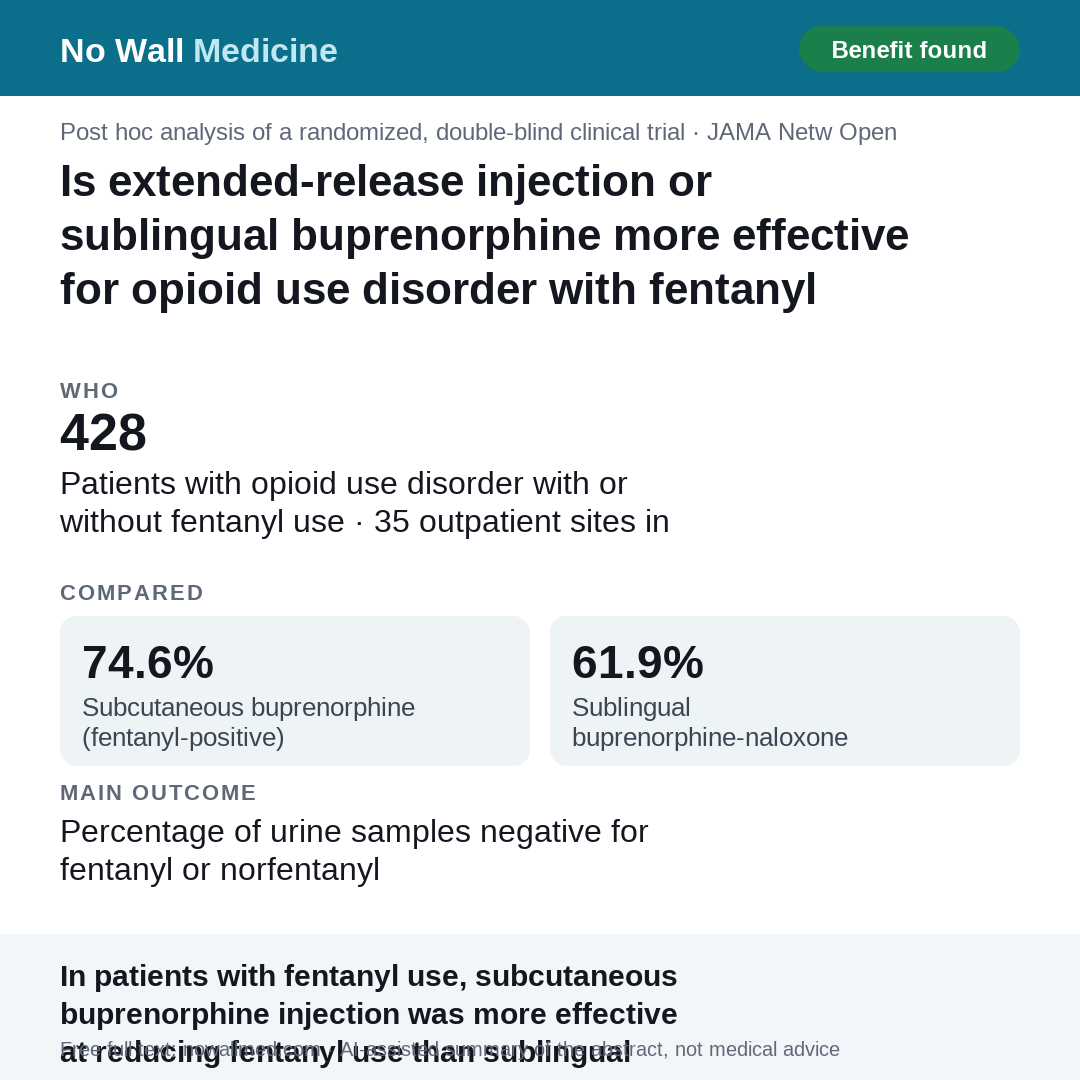
Is extended-release injection or sublingual buprenorphine more effective for opioid use disorder with fentanyl use?
Who
428
Patients with opioid use disorder with or without fentanyl use · 35 outpatient sites in the US
Compared
74.6%Subcutaneous buprenorphine (fentanyl-positive)
61.9%Sublingual buprenorphine-naloxone (fentanyl-positive)
Main outcome
Percentage of urine samples negative for fentanyl or norfentanyl
Result: difference, 12.7%; 95% CI, 9.6%-15.9%
Bottom line: In patients with fentanyl use, subcutaneous buprenorphine injection was more effective at reducing fentanyl use than sublingual buprenorphine-naloxone.
Limitation: This was a post hoc analysis of a randomized clinical trial
JAMA Netw Open · 2024-06-03Download image
Clinical question: Is extended-release injection or sublingual buprenorphine more effective for opioid use disorder with fentanyl use?
Why it matters: Data on how effective medications for opioid use disorder are for patients specifically using fentanyl are limited.
Key points
- Researchers analyzed 428 participants in a randomized clinical trial, comparing subcutaneous buprenorphine injections to daily sublingual buprenorphine-naloxone for opioid use disorder.
- In the subgroup with baseline fentanyl use, the mean percentage of urine samples negative for fentanyl was 74.6% for the injection group versus 61.9% for the sublingual group.
- Across all groups, scores for opioid withdrawal and cravings decreased rapidly after starting treatment.
Headline and key points written with AI from the paper’s abstract, with every number checked against it. Read the paper before relying on them.
Was this summary helpful?
Subject terms
Cite this article
Nunes EV, Comer SD, Lofwall MR, Walsh SL, Peterson S, Tiberg F. Extended-Release Injection vs Sublingual Buprenorphine for Opioid Use Disorder With Fentanyl Use: A Post Hoc Analysis of a Randomized Clinical Trial. JAMA Netw Open. 2024. doi:10.1001/jamanetworkopen.2024.17377
Spotted a mistake? Suggest a correction
Top studies every Monday
The week’s key trials and guidelines in your specialties, plus any topics you follow. By email, free.
Get the weekly digest