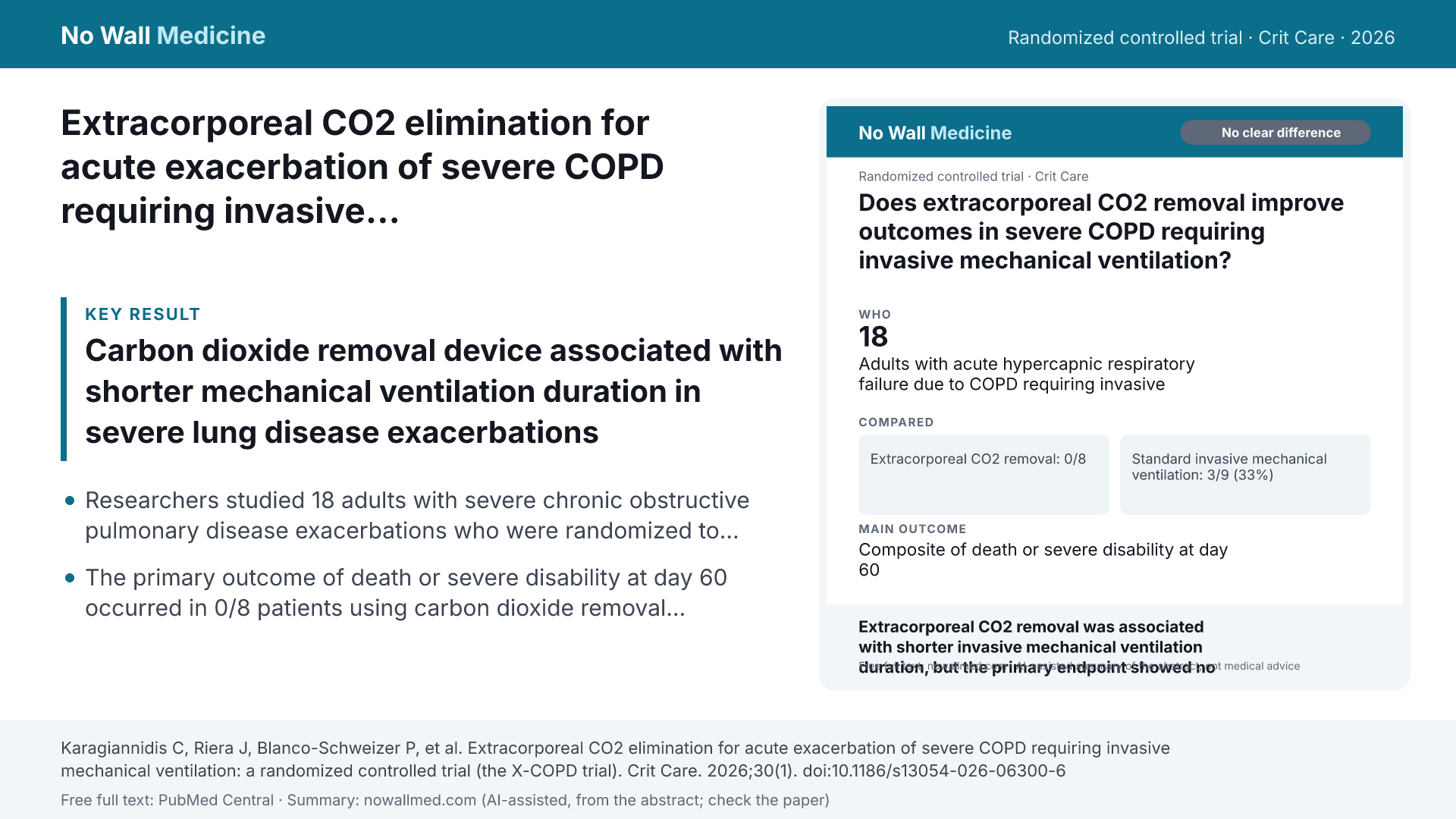
Extracorporeal CO2 elimination for acute exacerbation of severe COPD requiring invasive mechanical ventilation: a randomized controlled trial (the X-COPD trial)
Key result: Carbon dioxide removal device associated with shorter mechanical ventilation duration in severe lung disease exacerbations
Key points
- Researchers studied 18 adults with severe chronic obstructive pulmonary disease exacerbations who were randomized to receive either extracorporeal carbon dioxide removal or standard invasive mechanical ventilation.
- The primary outcome of death or severe disability at day 60 occurred in 0/8 patients using carbon dioxide removal versus 3/9 patients in the standard group (p = 0.21).
- Invasive mechanical ventilation lasted 7.1 ± 2.0 days in the carbon dioxide removal group compared to 24.3 ± 21.4 days in the standard group (p = 0.043).
Why it matters: Doctors do not know if using a device to remove carbon dioxide from the blood can help patients with severe lung disease be taken off ventilators sooner.
Limitation the authors note: The trial was terminated early by the sponsor for financial reasons and had a very small sample size.
Discussion prompts
- Would these patients look like yours? Who was left out?
- Is the main outcome one that matters to patients?
- Is the difference large enough to change what you do?
Cite: Karagiannidis C, Riera J, Blanco-Schweizer P, et al. Extracorporeal CO2 elimination for acute exacerbation of severe COPD requiring invasive mechanical ventilation: a randomized controlled trial (the X-COPD trial). Crit Care. 2026;30(1). doi:10.1186/s13054-026-06300-6
Free full text: PubMed Central · Summary and visual abstract: nowallmed.com/a/extracorporeal-co2-elimination-for-acute-exacerbation-of-severe-copd-757d6x/ (AI-assisted from the abstract; check the paper before relying on it).