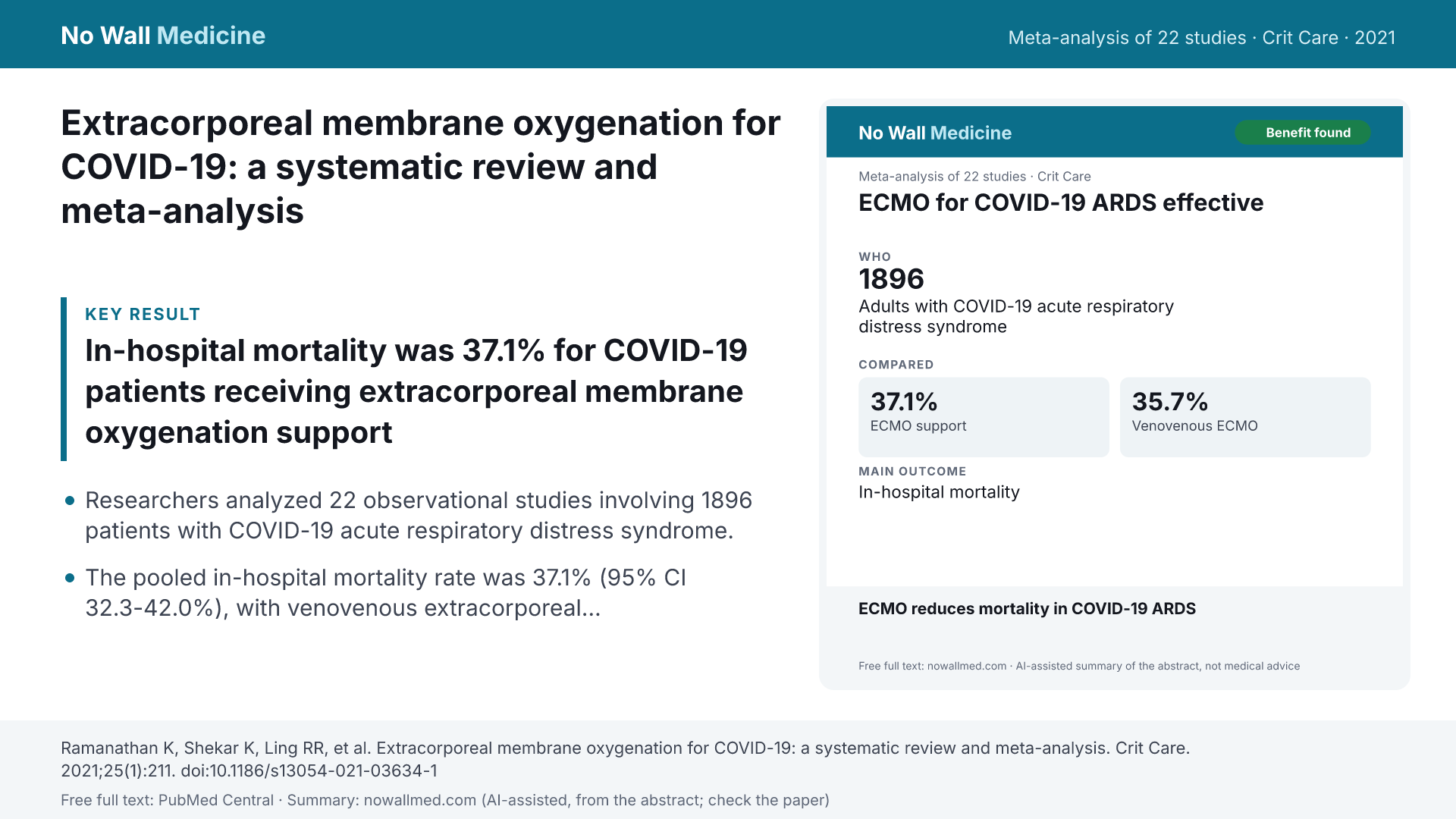
In-hospital mortality was 37.1% for COVID-19 patients receiving extracorporeal membrane oxygenation support
Extracorporeal membrane oxygenation for COVID-19: a systematic review and meta-analysis
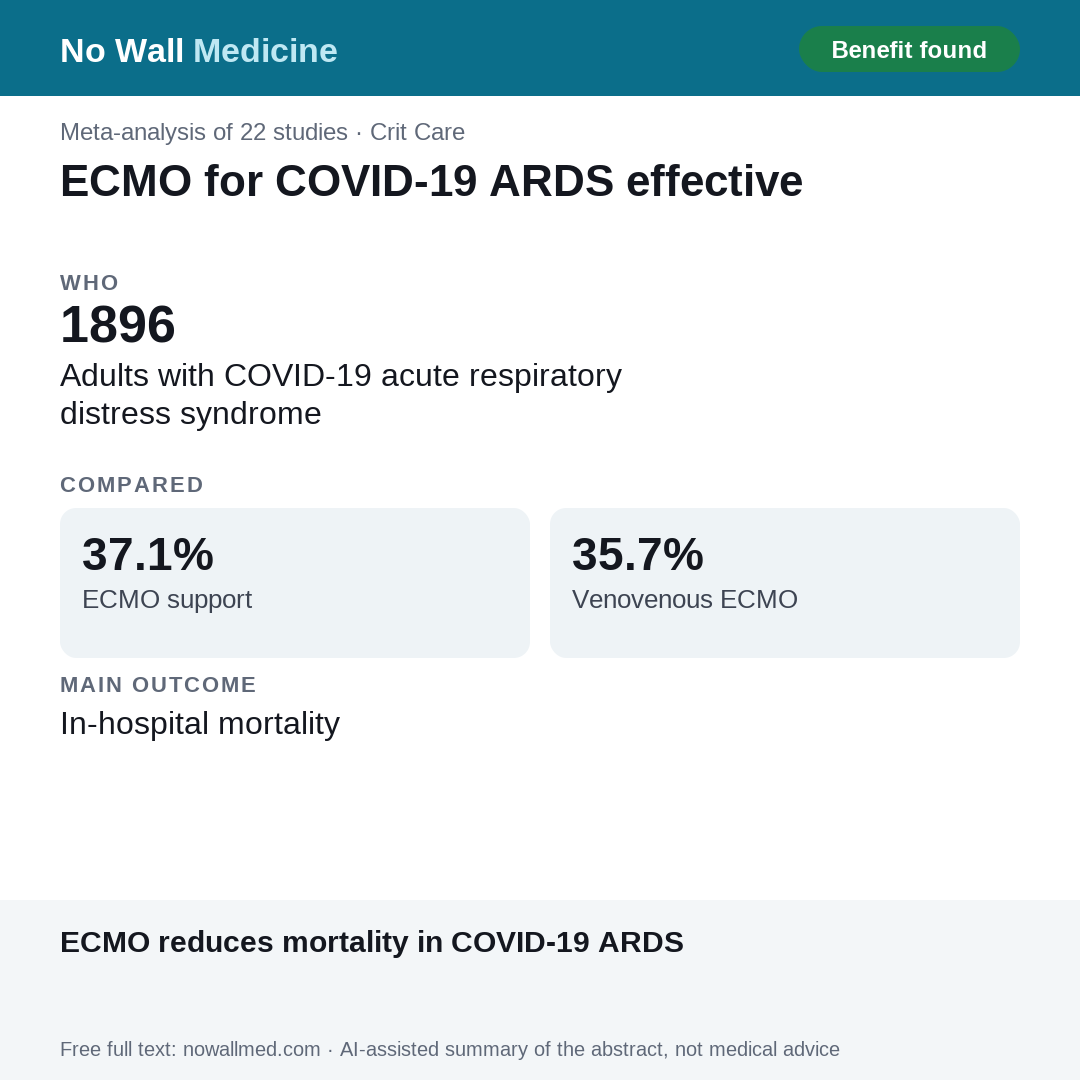
Meta-analysis of 22 studiesBenefit found
ECMO for COVID-19 ARDS effective
Who
1896
Adults with COVID-19 acute respiratory distress syndrome
Compared
37.1%ECMO support (95% CI 32.3-42.0%)
35.7%Venovenous ECMO (95% CI 30.7-40.7%)
Main outcome
In-hospital mortality
Bottom line: ECMO reduces mortality in COVID-19 ARDS
Crit Care · 2021-06-14Download image
Why it matters: Clinical decision-making and future research require guidance regarding the use of extracorporeal membrane oxygenation for patients with COVID-19 acute respiratory distress syndrome.
Key points
- Researchers analyzed 22 observational studies involving 1896 patients with COVID-19 acute respiratory distress syndrome.
- The pooled in-hospital mortality rate was 37.1% (95% CI 32.3-42.0%), with venovenous extracorporeal membrane oxygenation used in 98.6% of cases.
- Increased age and longer duration of extracorporeal membrane oxygenation support were associated with increased mortality.
Headline and key points written with AI from the paper’s abstract, with every number checked against it. Read the paper before relying on them.
Was this summary helpful?
Abstract
Background
There are several reports of extracorporeal membrane oxygenation (ECMO) use in patients with coronavirus disease 2019 (COVID-19) who develop severe acute respiratory distress syndrome (ARDS). We conducted a systematic review and meta-analysis to guide clinical decision-making and future research. Methods
We searched MEDLINE, Embase, Cochrane and Scopus databases from 1 December 2019 to 10 January 2021 for observational studies or randomised clinical trials examining ECMO in adults with COVID-19 ARDS. We performed random-effects meta-analyses and meta-regression, assessed risk of bias using the Joanna Briggs Institute checklist and rated the certainty of evidence using the GRADE approach. Survival outcomes were presented as pooled proportions while continuous outcomes were presented as pooled means, both with corresponding 95% confidence intervals [CIs]. The primary outcome was in-hospital mortality. Secondary outcomes were duration of ECMO therapy and mechanical ventilation, weaning rate from ECMO and complications during ECMO. Results
We included twenty-two observational studies with 1896 patients in the meta-analysis. Venovenous ECMO was the predominant mode used (98.6%). The pooled in-hospital mortality in COVID-19 patients (22 studies, 1896 patients) supported with ECMO was 37.1% (95% CI 32.3-42.0%, high certainty). Pooled mortality in the venovenous ECMO group was 35.7% (95% CI 30.7-40.7%, high certainty). Meta-regression found that age and ECMO duration were associated with increased mortality. Duration of ECMO support (18 studies, 1844 patients) was 15.1 days (95% CI 13.4-18.7). Weaning from ECMO (17 studies, 1412 patients) was accomplished in 67.6% (95% CI 50.5-82.7%) of patients. There were a total of 1583 ECMO complications reported (18 studies, 1721 patients) and renal complications were the most common. Conclusion
The majority of patients received venovenous ECMO support for COVID-19-related ARDS. In-hospital mortality in patients receiving ECMO support for COVID-19 was 37.1% during the first year of the pandemic, similar to those with non-COVID-19-related ARDS. Increasing age was a risk factor for death. Venovenous ECMO appears to be an effective intervention in selected patients with COVID-19-related ARDS. PROSPERO CRD42020192627.
Abstract reproduced under the article’s CC BY licence.
Subject terms
Cite this article
Ramanathan K, Shekar K, Ling RR, et al. Extracorporeal membrane oxygenation for COVID-19: a systematic review and meta-analysis. Crit Care. 2021. doi:10.1186/s13054-021-03634-1
Spotted a mistake? Suggest a correction