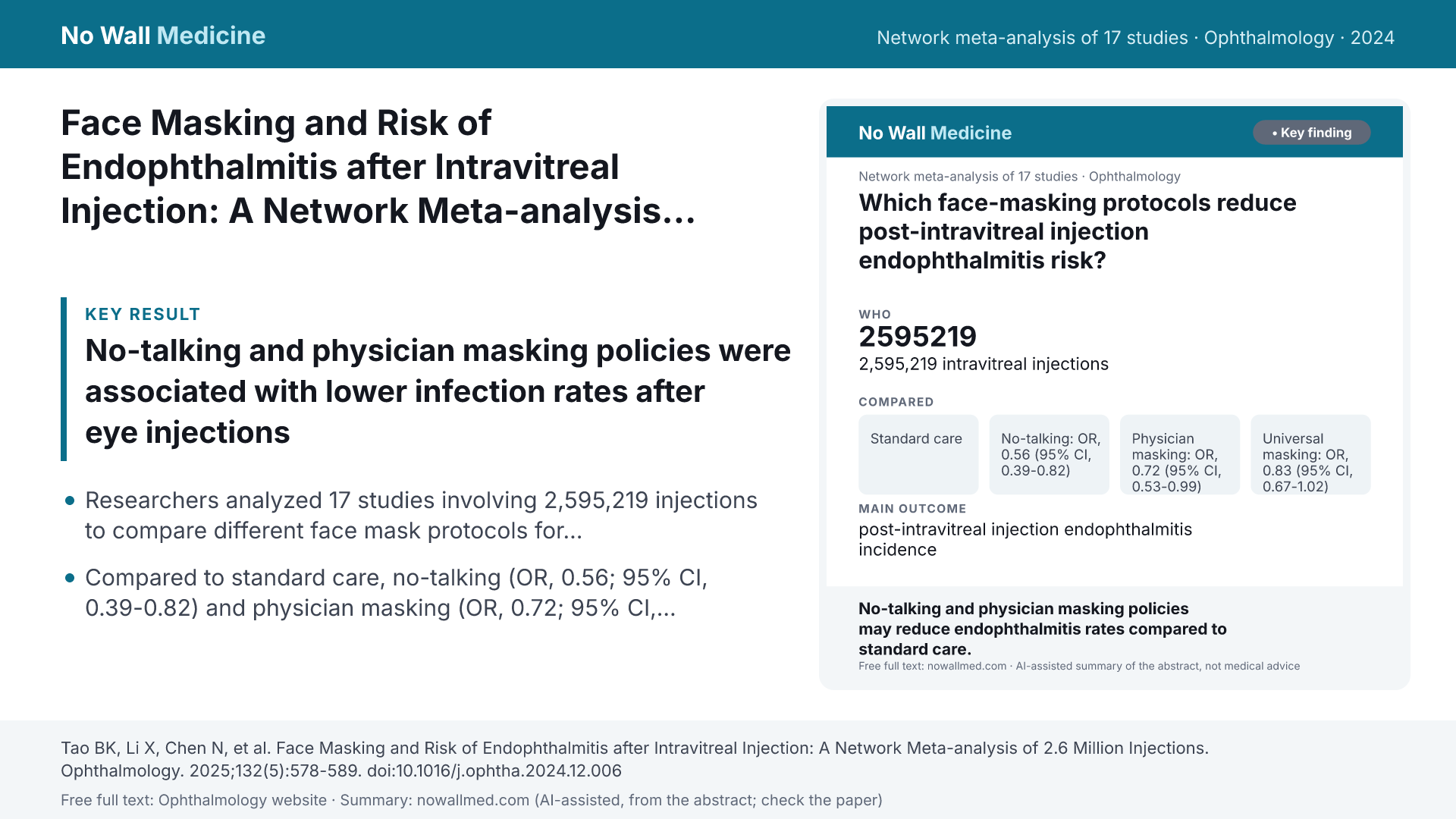
No-talking and physician masking policies were associated with lower infection rates after eye injections
Face Masking and Risk of Endophthalmitis after Intravitreal Injection: A Network Meta-analysis of 2.6 Million Injections
Network meta-analysis of 17 studiesKey finding
Which face-masking protocols reduce post-intravitreal injection endophthalmitis risk?
Who
2595219
2,595,219 intravitreal injections
Compared
Standard care
No-talking: OR, 0.56 (95% CI, 0.39-0.82)
Physician masking: OR, 0.72 (95% CI, 0.53-0.99)
Universal masking: OR, 0.83 (95% CI, 0.67-1.02)
Main outcome
post-intravitreal injection endophthalmitis incidence
Result: no-talking OR, 0.56 (95% CI, 0.39-0.82)
Bottom line: No-talking and physician masking policies may reduce endophthalmitis rates compared to standard care.
Limitation: Low- or very low-certainty evidence and limited study power for specific culture outcomes.
Ophthalmology · 2024-12-09 · Save PNG
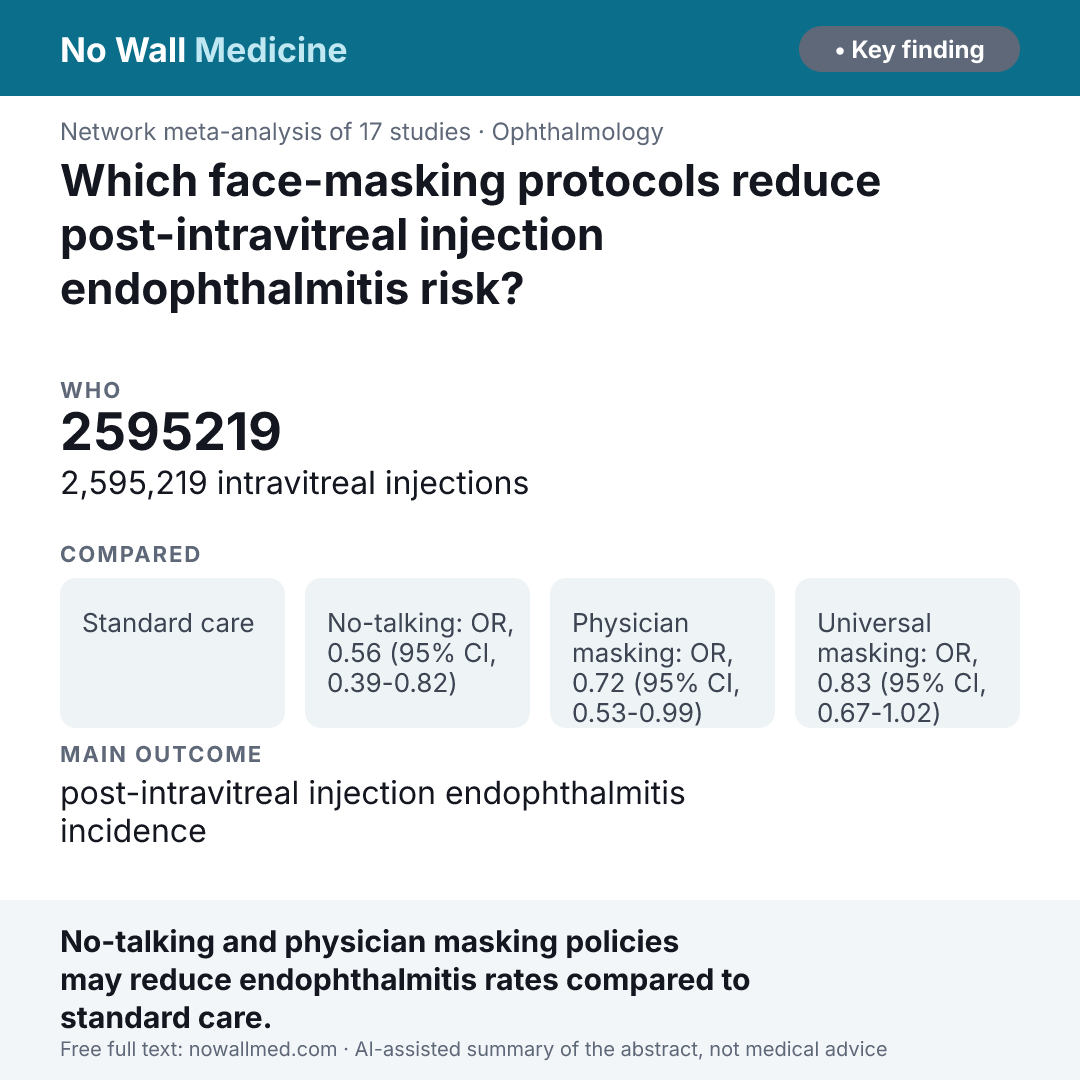
Clinical question: Which face-masking protocols reduce post-intravitreal injection endophthalmitis risk?
Key points
- Researchers analyzed 17 studies involving 2,595,219 injections to compare different face mask protocols for preventing endophthalmitis, an internal eye infection.
- Compared to standard care, no-talking (OR, 0.56; 95% CI, 0.39-0.82) and physician masking (OR, 0.72; 95% CI, 0.53-0.99) were associated with lower infection rates.
- In a subgroup analysis, universal masking for both patients and physicians was associated with a lower rate of any infection (OR, 0.70; 95% CI, 0.55-0.91).
Limitation the authors note: The evidence for these findings is rated as low- or very low-certainty.
Headline and key points written with AI from the paper’s abstract, with every number checked against it. Read the paper before relying on them.
Was this summary helpful?
Subject terms
Headline, design, result, key points, caveat and citation as plain text.
Cite this article
Tao BK, Li X, Chen N, et al. Face Masking and Risk of Endophthalmitis after Intravitreal Injection: A Network Meta-analysis of 2.6 Million Injections. Ophthalmology. 2025;132(5):578-589. doi:10.1016/j.ophtha.2024.12.006
Spotted a mistake? Suggest a correction