Factors affecting haemoglobin dynamics in African children with acute uncomplicated Plasmodium falciparum malaria treated with single low-dose primaquine or placebo
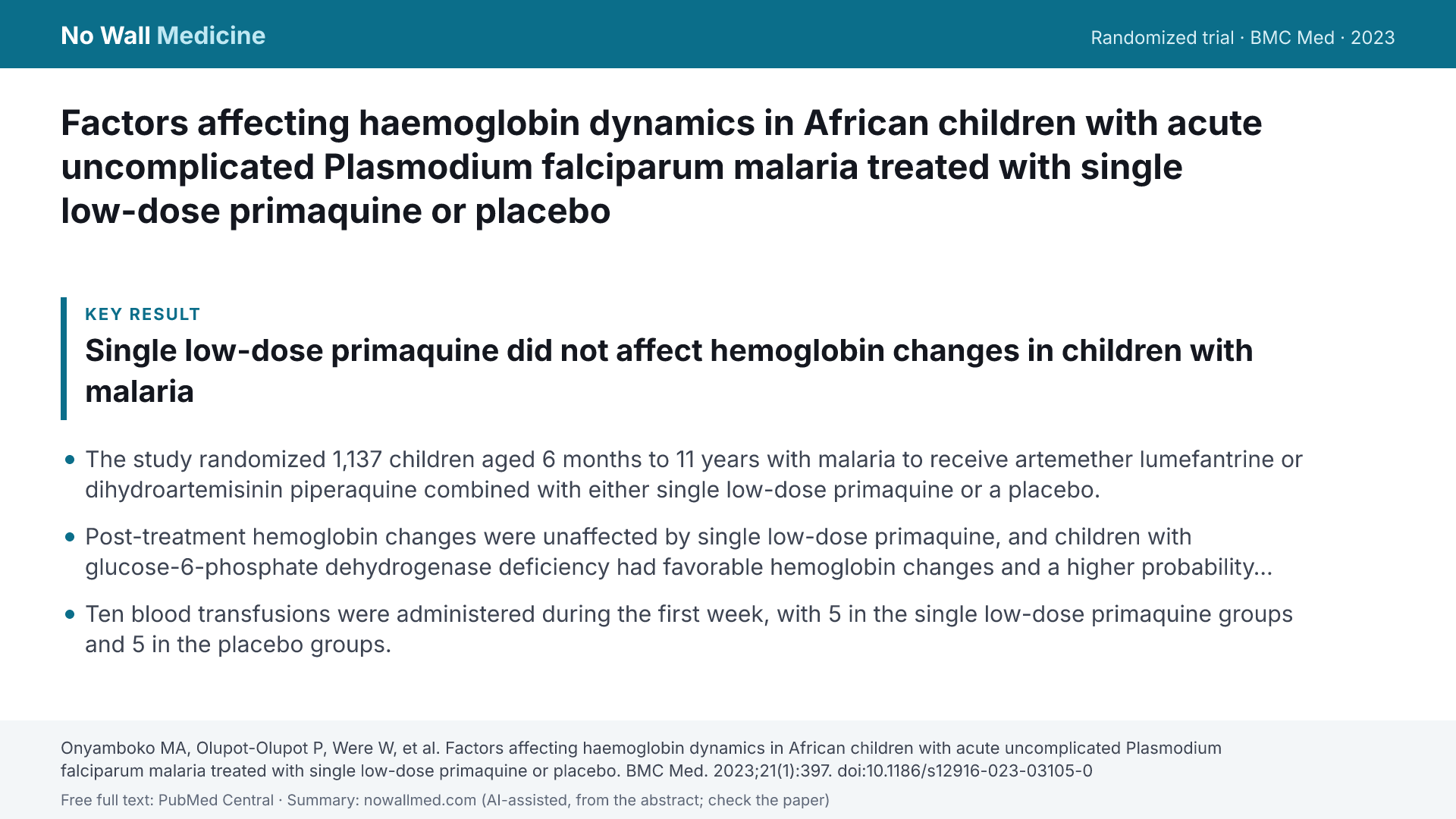
Key result: Single low-dose primaquine did not affect hemoglobin changes in children with malaria
Key points
- The study randomized 1,137 children aged 6 months to 11 years with malaria to receive artemether lumefantrine or dihydroartemisinin piperaquine combined with either single low-dose primaquine or a placebo.
- Post-treatment hemoglobin changes were unaffected by single low-dose primaquine, and children with glucose-6-phosphate dehydrogenase deficiency had favorable hemoglobin changes and a higher probability of hemoglobin recovery.
- Ten blood transfusions were administered during the first week, with 5 in the single low-dose primaquine groups and 5 in the placebo groups.
Why it matters: Concerns exist regarding the potential for single low-dose primaquine to cause blood cell breakdown in patients with glucose-6-phosphate dehydrogenase deficiency.
Discussion prompts
- Would these patients look like yours? Who was left out?
- Is the main outcome one that matters to patients?
- Is the difference large enough to change what you do?
Cite: Onyamboko MA, Olupot-Olupot P, Were W, et al. Factors affecting haemoglobin dynamics in African children with acute uncomplicated Plasmodium falciparum malaria treated with single low-dose primaquine or placebo. BMC Med. 2023;21(1):397. doi:10.1186/s12916-023-03105-0
Free full text: PubMed Central · Summary and visual abstract: nowallmed.com/a/factors-affecting-haemoglobin-dynamics-in-african-children-with-acute-n2pz78/ (AI-assisted from the abstract; check the paper before relying on it).