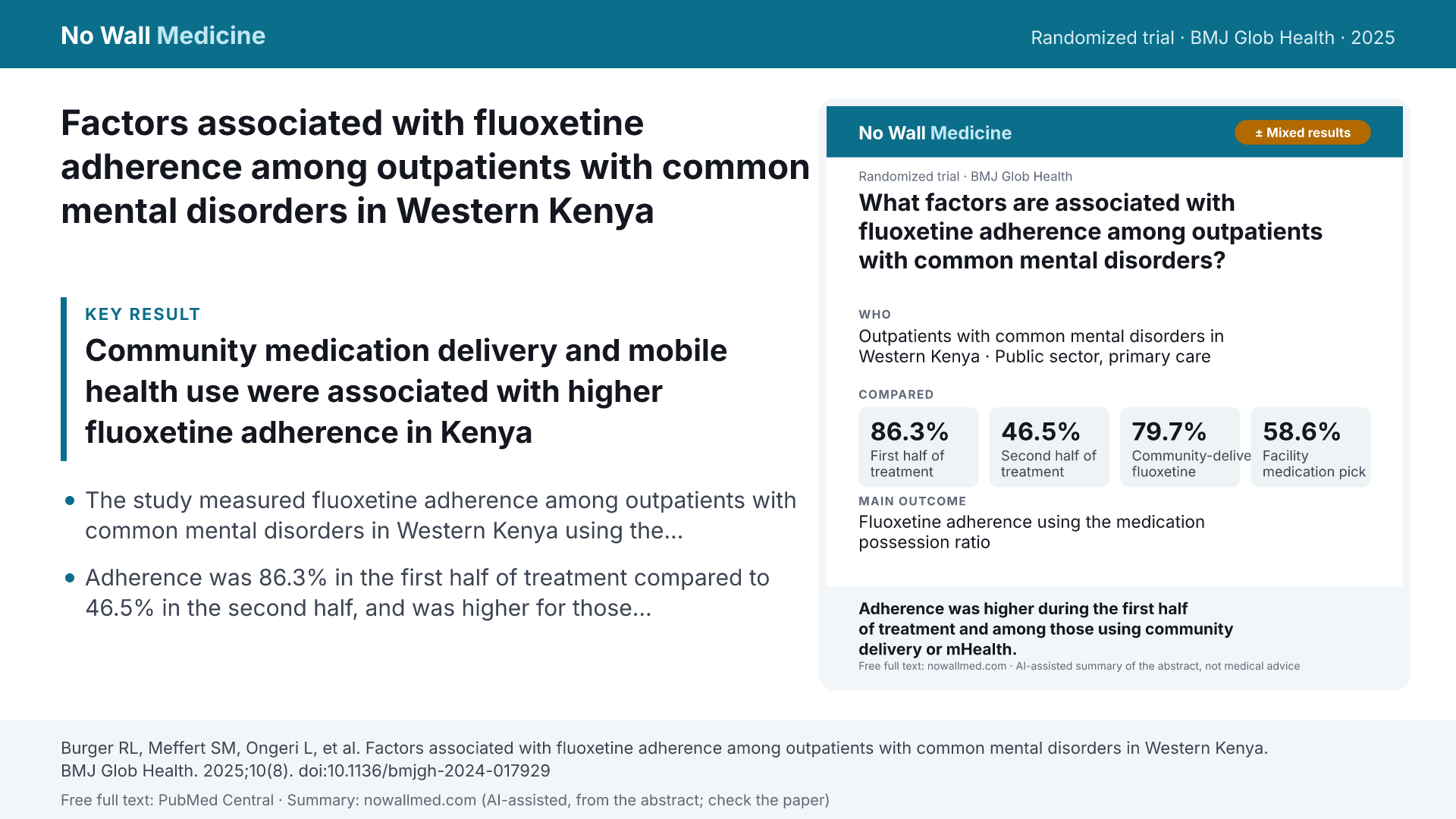
Community medication delivery and mobile health use were associated with higher fluoxetine adherence in Kenya
Factors associated with fluoxetine adherence among outpatients with common mental disorders in Western Kenya
Randomized trialMixed results
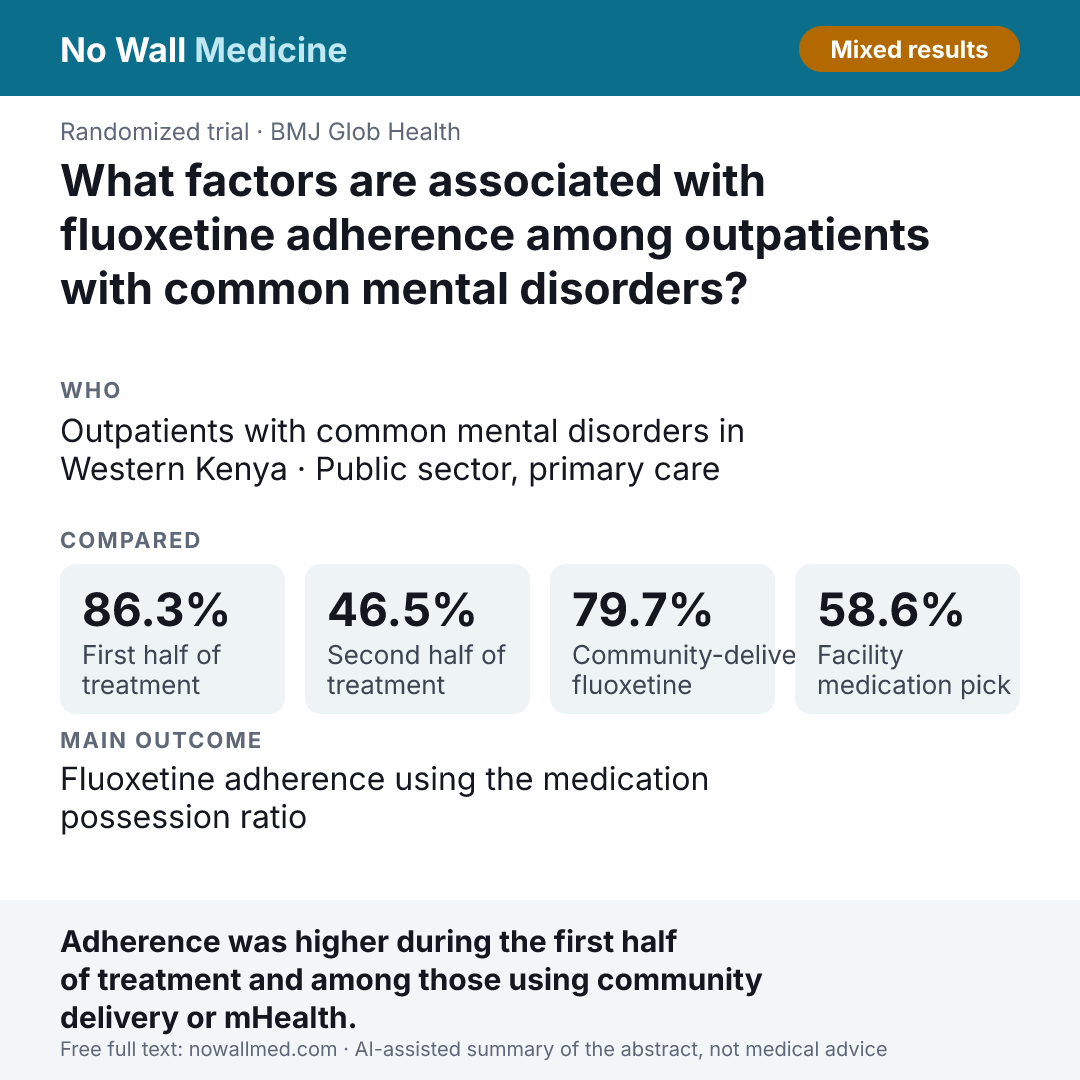
What factors are associated with fluoxetine adherence among outpatients with common mental disorders?
Who
Outpatients with common mental disorders in Western Kenya · Public sector, primary care settings in Western Kenya
Compared
86.3%First half of treatment period (95% CI 83.5% to 89.2%)
46.5%Second half of treatment period (44.3% to 48.8%)
79.7%Community-delivered fluoxetine (77.0% to 82.4%)
58.6%Facility medication pick up only (55.7% to 61.5%)
Main outcome
Fluoxetine adherence using the medication possession ratio
Bottom line: Adherence was higher during the first half of treatment and among those using community delivery or mHealth.
Limitation: Medication possession ratio does not always reflect the ingestion of medication.
BMJ Glob Health · 2025-08-25 · Save PNG
Same trial (NCT03466346)
Papers we list that report this registered trial, oldest first. Read a secondary analysis alongside the main results.
- Main results Mixed results
This paper BMJ Glob Health 2025-08 - Related analysis Benefit found
Treating depression and post-traumatic stress disorder in Kenya was associated with increased economic productivity BMJ Glob Health 2025-11
Clinical question: What factors are associated with fluoxetine adherence among outpatients with common mental disorders?
Why it matters: Knowledge is limited regarding factors associated with antidepressant adherence in low-income and middle-income countries, particularly within public sector primary care settings.
Key points
- The study measured fluoxetine adherence among outpatients with common mental disorders in Western Kenya using the medication possession ratio, which tracks how many doses are obtained.
- Adherence was 86.3% in the first half of treatment compared to 46.5% in the second half, and was higher for those using community delivery at 79.7% versus 58.6% for facility pick-up.
- Using mobile health (mHealth) for at least one but less than half of visits was associated with 84.6% adherence, compared to 49.6% for those who did not use mobile health.
Limitation the authors note: The medication possession ratio does not always reflect the actual ingestion of medication.
Headline and key points written with AI from the paper’s abstract, with every number checked against it. Read the paper before relying on them.
Was this summary helpful?
Abstract
Objective
Non-adherence to antidepressants has been linked to increased symptom severity, relapse and hospitalisation from common mental disorders. However, there is limited knowledge of factors associated with antidepressant adherence in low-income and middle-income countries, especially in public sector, primary care settings. Methods
We quantified fluoxetine adherence using the medication possession ratio. A limitation of this measure is that it does not always reflect the ingestion of medication. We constructed a generalised estimating equations linear regression with robust SEs, clustered by the participant, to identify independent predictors of fluoxetine adherence. Results
Participants randomised to fluoxetine were dispensed an average of 126 daily doses, or 70% of the 180 possible doses. Adherence was higher in the first half of the treatment period at 86.3%, 95% CI (83.5% to 89.2%) compared with 46.5% in the second half (44.3% to 48.8%) (p<0.001). Participants who opted for community-delivered fluoxetine demonstrated adherence at 79.7% (77.0% to 82.4%) compared with 58.6% (55.7% to 61.5%) of those who only picked up medication at the facility (p<0.001). Use of mHealth for at least one but less than half of the visits had the highest level of adherence at 84.6% (82.4% to 86.9%) compared with 49.6% (46.1% to 53.0%) among those who did not use mHealth and 67.2% (62.5% to 72.0%) for those who used mHealth at least half their visits (p<0.001). Conclusions
Adherence to fluoxetine was high relative to existing selective serotonin reuptake inhibitors adherence data, the majority of which is from high-income countries. Adherence was higher during the first half of treatment. People who were older, living with HIV and opted to use community delivery of medication and/or mHealth had higher adherence. Trial registration number
NCT03466346.
Abstract reproduced under the article’s CC BY NC licence.
Subject terms
Headline, design, result, key points, caveat and citation as plain text.
Cite this article
Burger RL, Meffert SM, Ongeri L, et al. Factors associated with fluoxetine adherence among outpatients with common mental disorders in Western Kenya. BMJ Glob Health. 2025;10(8). doi:10.1136/bmjgh-2024-017929
Spotted a mistake? Suggest a correction