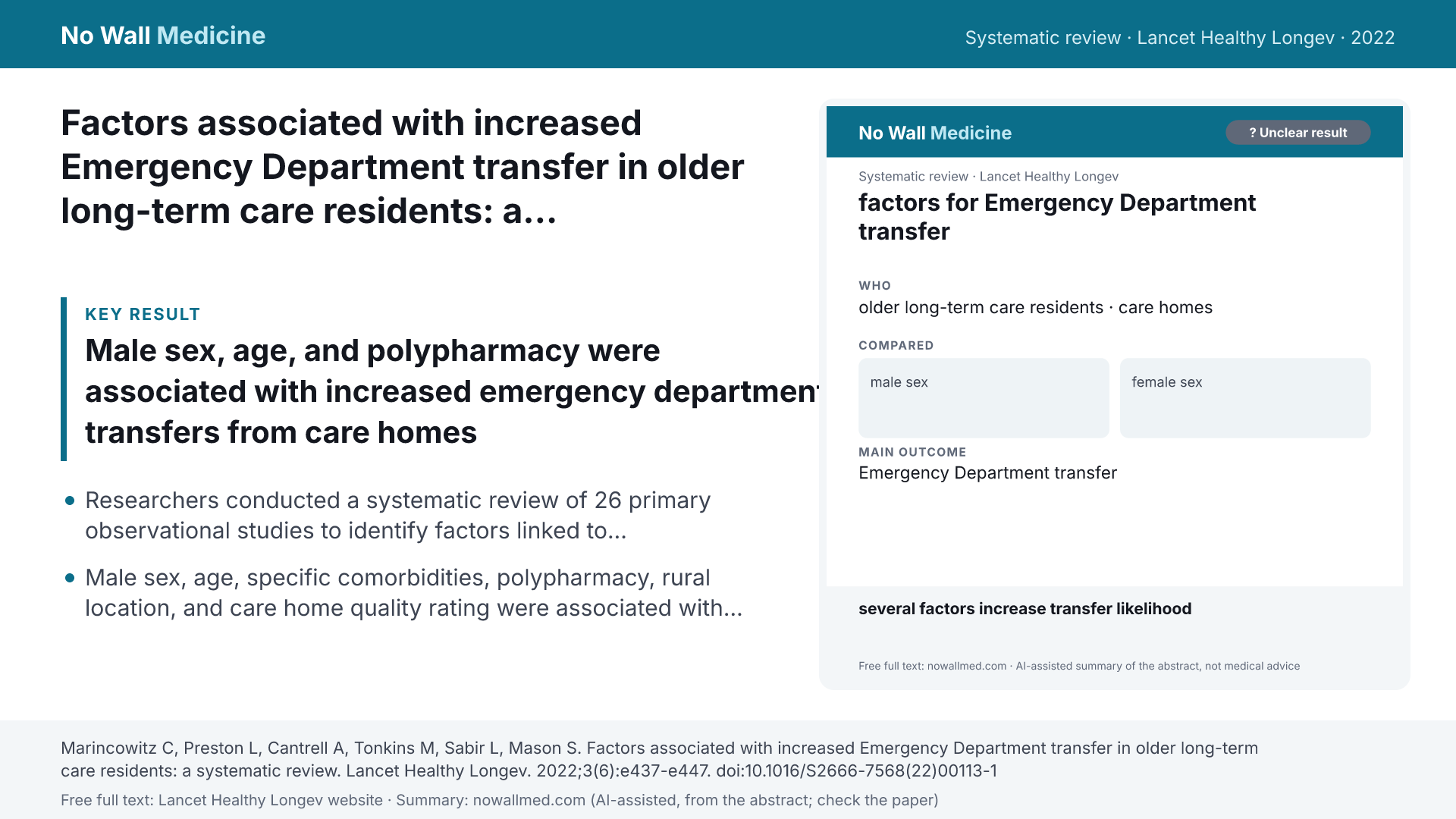
Male sex, age, and polypharmacy were associated with increased emergency department transfers from care homes
Factors associated with increased Emergency Department transfer in older long-term care residents: a systematic review
Systematic reviewUnclear result
factors for Emergency Department transfer
Who
older long-term care residents · care homes
Compared
male sex
female sex
Main outcome
Emergency Department transfer
Bottom line: several factors increase transfer likelihood
Lancet Healthy Longev · 2022-06-09Download image
Why it matters: It is unknown which resident or care home level factors predict emergency department transfers for the growing population of older adults in long-term care.
Key points
- Researchers conducted a systematic review of 26 primary observational studies to identify factors linked to emergency department transfers among care home residents.
- Male sex, age, specific comorbidities, polypharmacy, rural location, and care home quality rating were associated with a higher likelihood of emergency department transfer.
- Around 40% of emergency department attendances for care home residents might be avoidable.
Headline and key points written with AI from the paper’s abstract, with every number checked against it. Read the paper before relying on them.
Was this summary helpful?
Abstract
The proportion of adults older than 65 years is rapidly increasing. Care home residents in this age group have disproportionate rates of transfer to the Emergency Department (ED) and around 40% of attendances might be avoidable. We did a systematic review to identify factors that predict ED transfer from care homes. Six electronic databases were searched. Observational studies that provided estimates of association between ED attendance and variables at a resident or care home level were included. 26 primary studies met the inclusion criteria. Seven common domains of factors assessed for association with ED transfer were identified and within these domains, male sex, age, presence of specific comorbidities, polypharmacy, rural location, and care home quality rating were associated with likelihood of ED transfer. The identification of these factors provides useful information for policy makers and researchers intending to either develop interventions to reduce hospitalisations or use adjusted rates of hospitalisation as a care home quality indicator.
Abstract reproduced under the article’s CC BY licence.
Subject terms
Cite this article
Marincowitz C, Preston L, Cantrell A, Tonkins M, Sabir L, Mason S. Factors associated with increased Emergency Department transfer in older long-term care residents: a systematic review. Lancet Healthy Longev. 2022. doi:10.1016/S2666-7568(22)00113-1
Spotted a mistake? Suggest a correction