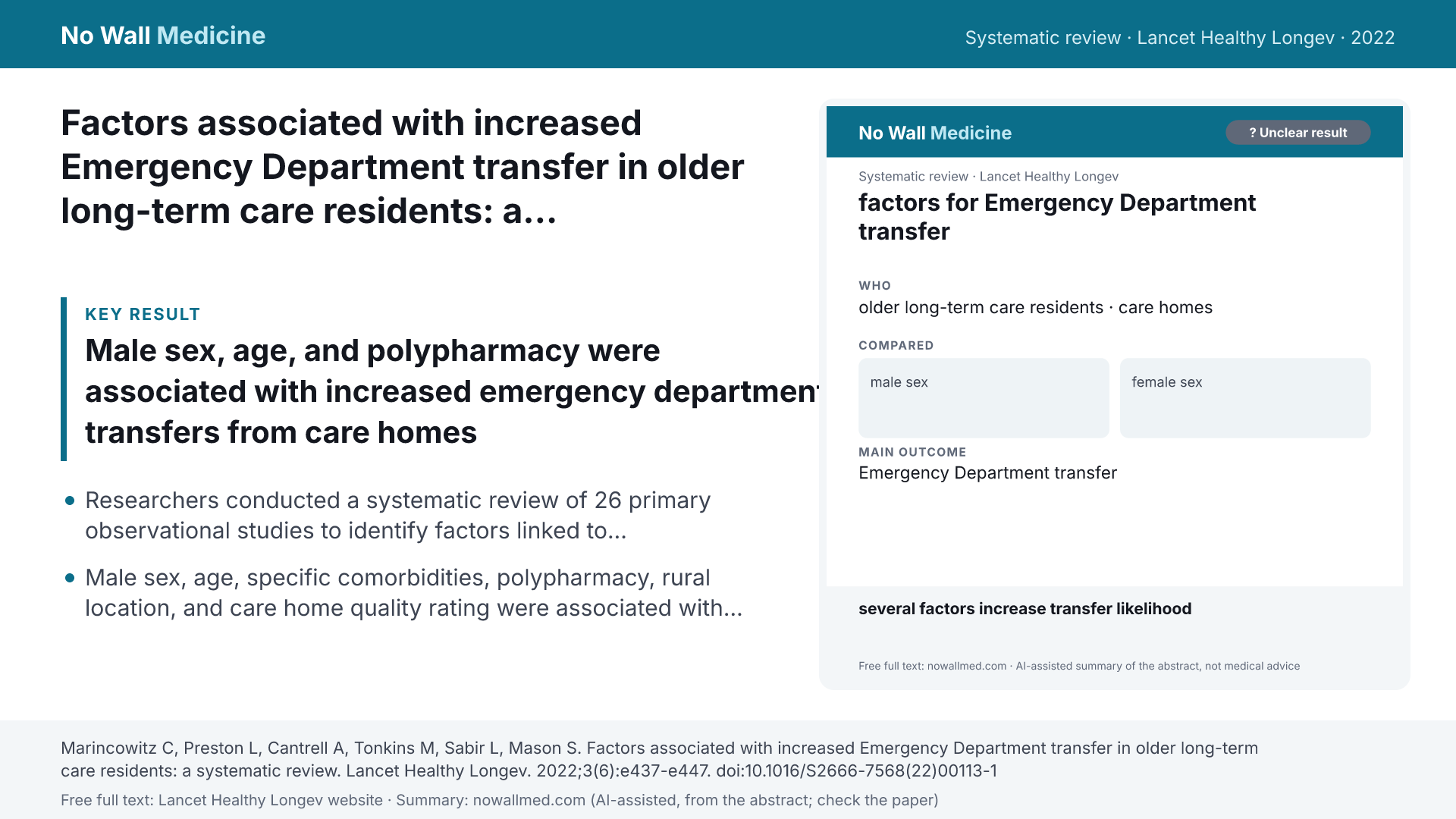
Factors associated with increased Emergency Department transfer in older long-term care residents: a systematic review
Key result: Male sex, age, and polypharmacy were associated with increased emergency department transfers from care homes
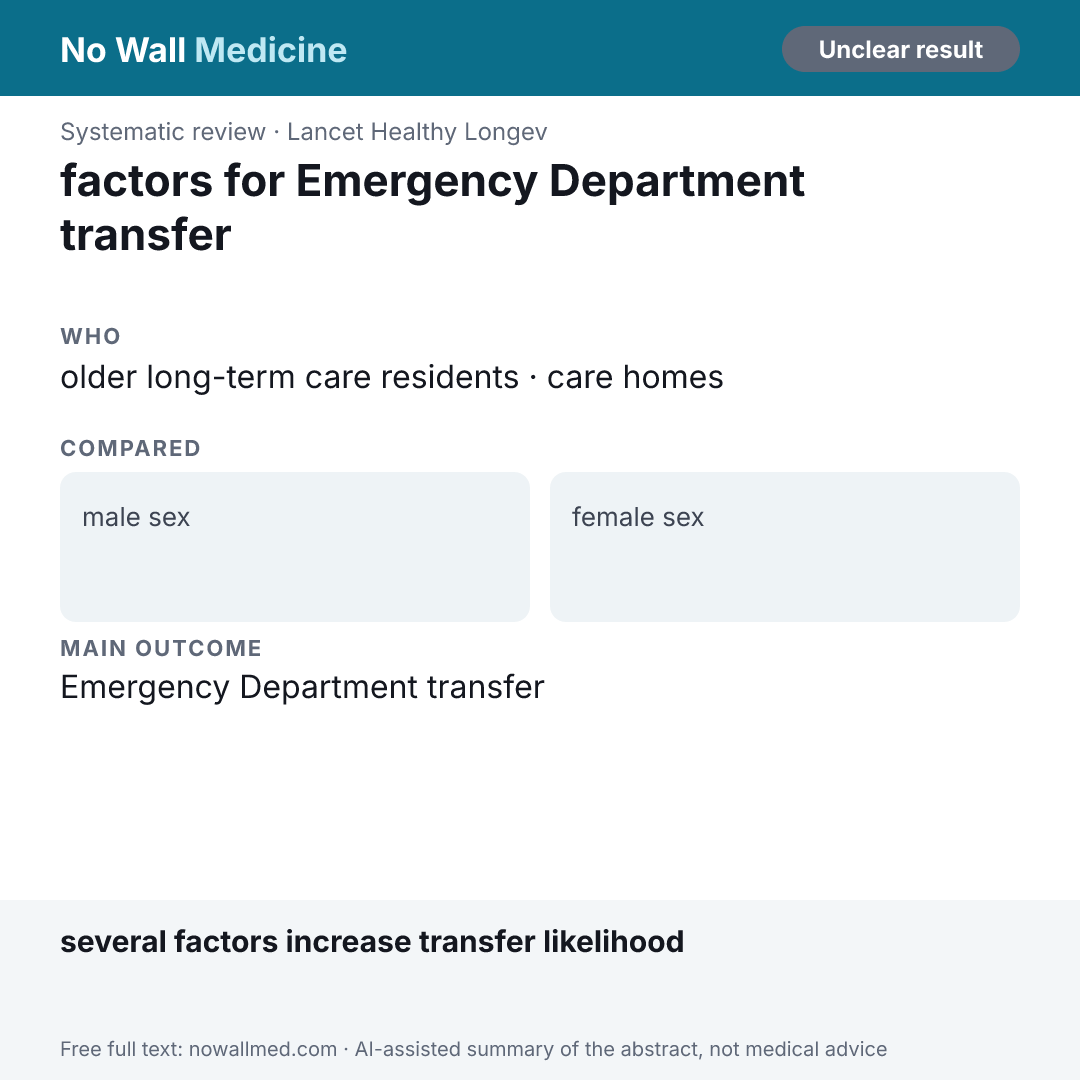
Systematic reviewUnclear result
factors for Emergency Department transfer
Who
older long-term care residents · care homes
Compared
male sex
female sex
Main outcome
Emergency Department transfer
Bottom line: several factors increase transfer likelihood
Lancet Healthy Longev · 2022-06-09 · Save PNG
Key points
- Researchers conducted a systematic review of 26 primary observational studies to identify factors linked to emergency department transfers among care home residents.
- Male sex, age, specific comorbidities, polypharmacy, rural location, and care home quality rating were associated with a higher likelihood of emergency department transfer.
- Around 40% of emergency department attendances for care home residents might be avoidable.
Discussion prompts
- Would these patients look like yours? Who was left out?
- Is the main outcome one that matters to patients?
- Is the difference large enough to change what you do?
Cite: Marincowitz C, Preston L, Cantrell A, Tonkins M, Sabir L, Mason S. Factors associated with increased Emergency Department transfer in older long-term care residents: a systematic review. Lancet Healthy Longev. 2022;3(6):e437-e447. doi:10.1016/S2666-7568(22)00113-1
Free full text: Lancet Healthy Longev website · Summary and visual abstract: nowallmed.com/a/factors-associated-with-increased-emergency-department-transfer-in-1r18ett/ (AI-assisted from the abstract; check the paper before relying on it).