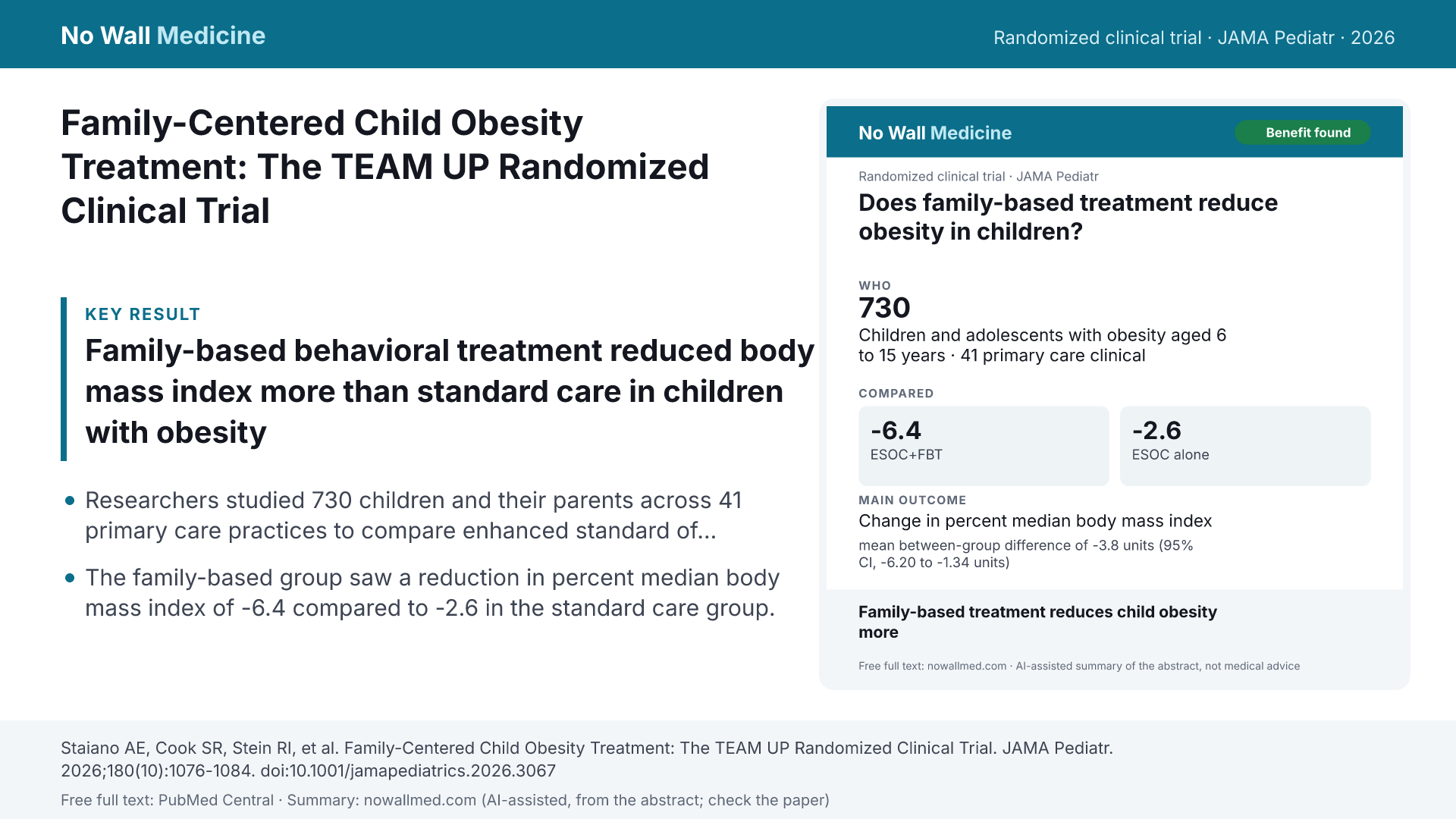
Family-based behavioral treatment reduced body mass index more than standard care in children with obesity
Family-Centered Child Obesity Treatment: The TEAM UP Randomized Clinical Trial
Randomized clinical trialBenefit found
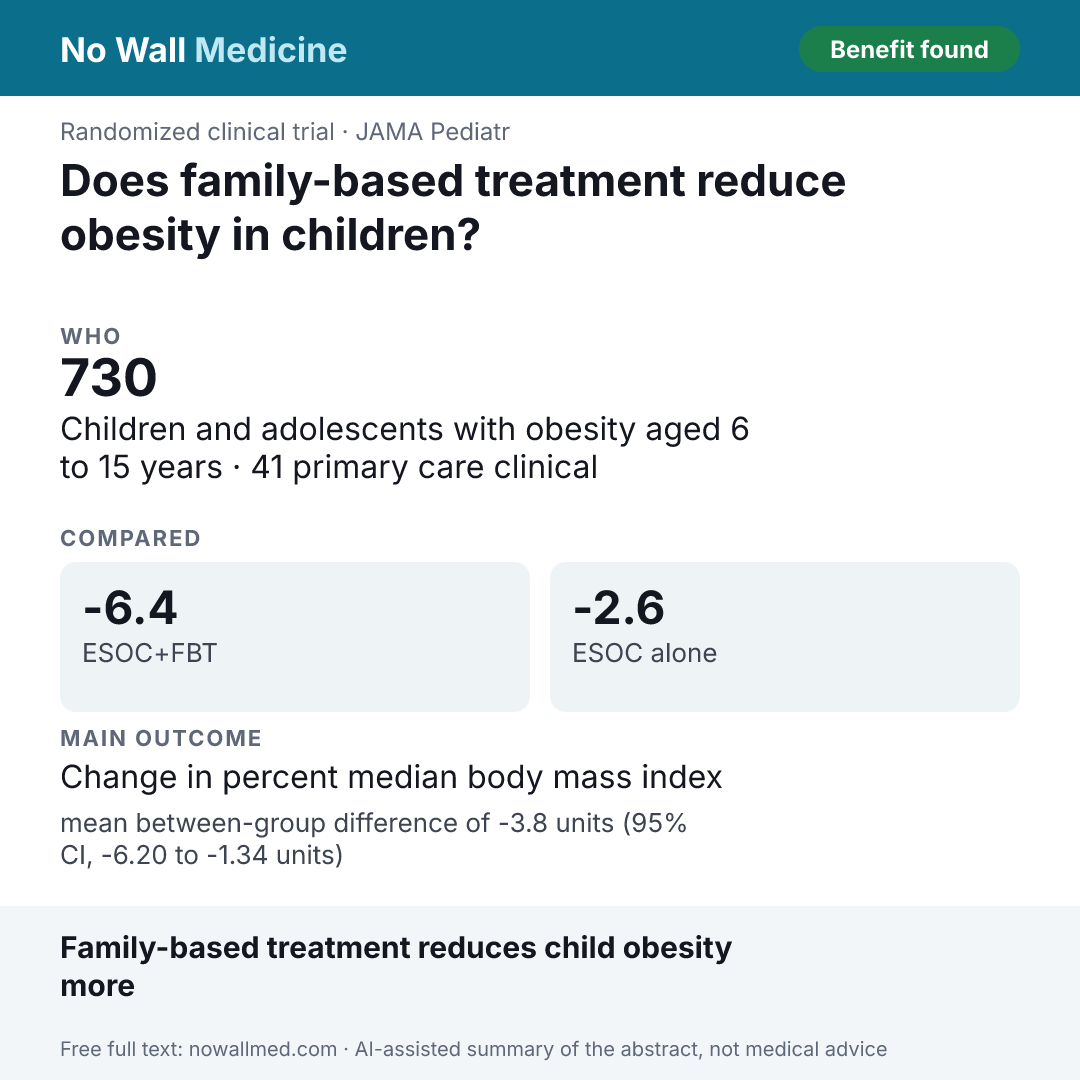
Does family-based treatment reduce obesity in children?
Who
730
Children and adolescents with obesity aged 6 to 15 years · 41 primary care clinical practices
Compared
-6.4ESOC+FBT
-2.6ESOC alone
Main outcome
Change in percent median body mass index
Result: mean between-group difference of -3.8 units (95% CI, -6.20 to -1.34 units)
Bottom line: Family-based treatment reduces child obesity more
JAMA Pediatr · 2026-07-27 · Save PNG
Clinical question: Does family-based treatment reduce obesity in children?
Why it matters: Families have limited access to pediatric weight management services.
Key points
- Researchers studied 730 children and their parents across 41 primary care practices to compare enhanced standard of care with added family-based behavioral treatment.
- The family-based group saw a reduction in percent median body mass index of -6.4 compared to -2.6 in the standard care group.
- Quality of life improved for children in both treatment groups at 12 and 18 months of follow-up.
Headline and key points written with AI from the paper’s abstract, with every number checked against it. Read the paper before relying on them.
Was this summary helpful?
Subject terms
Headline, design, result, key points, caveat and citation as plain text.
Cite this article
Staiano AE, Cook SR, Stein RI, et al. Family-Centered Child Obesity Treatment: The TEAM UP Randomized Clinical Trial. JAMA Pediatr. 2026;180(10):1076-1084. doi:10.1001/jamapediatrics.2026.3067
Spotted a mistake? Suggest a correction