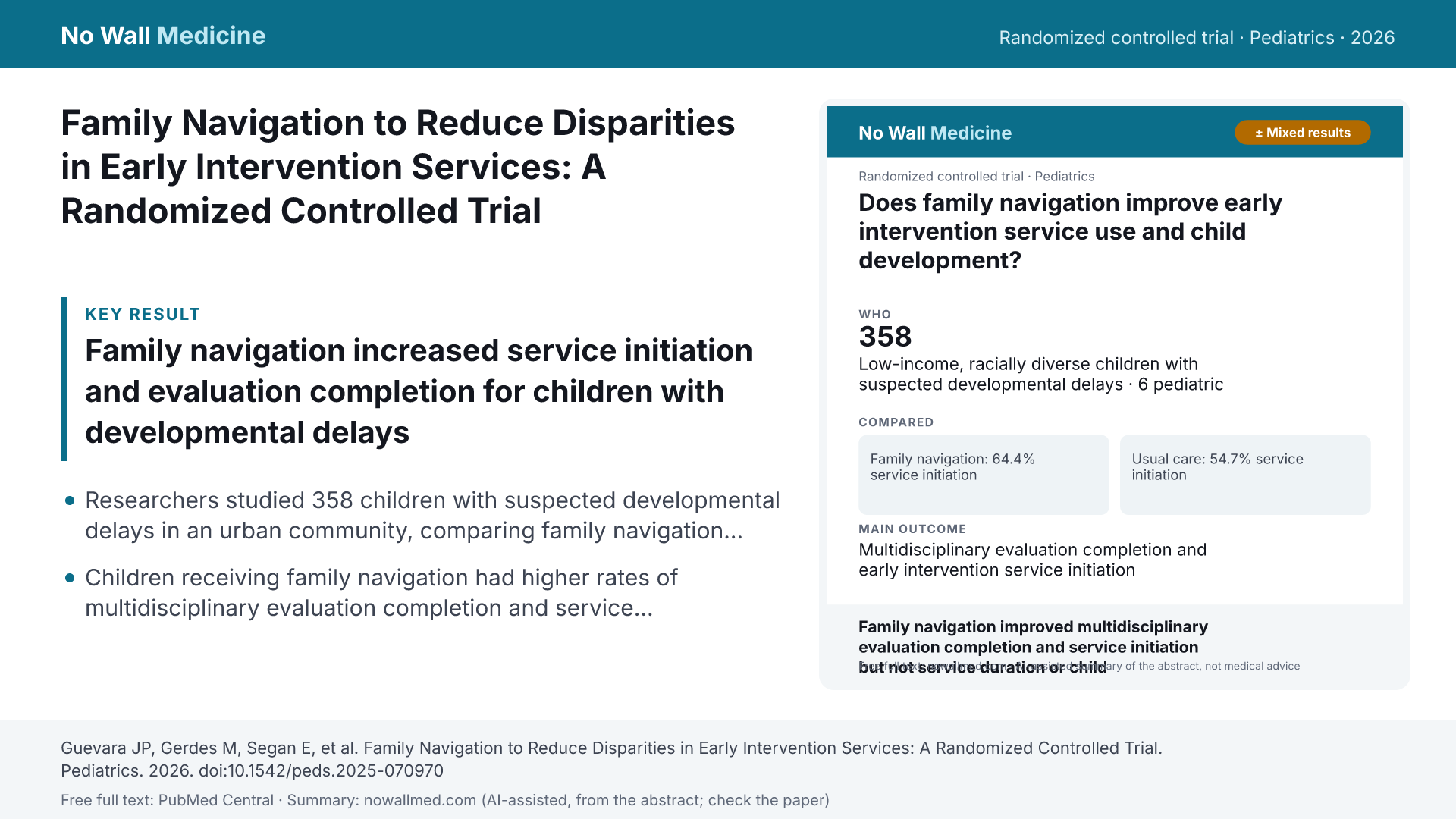
Family navigation increased service initiation and evaluation completion for children with developmental delays
Family Navigation to Reduce Disparities in Early Intervention Services: A Randomized Controlled Trial
Randomized controlled trialMixed results
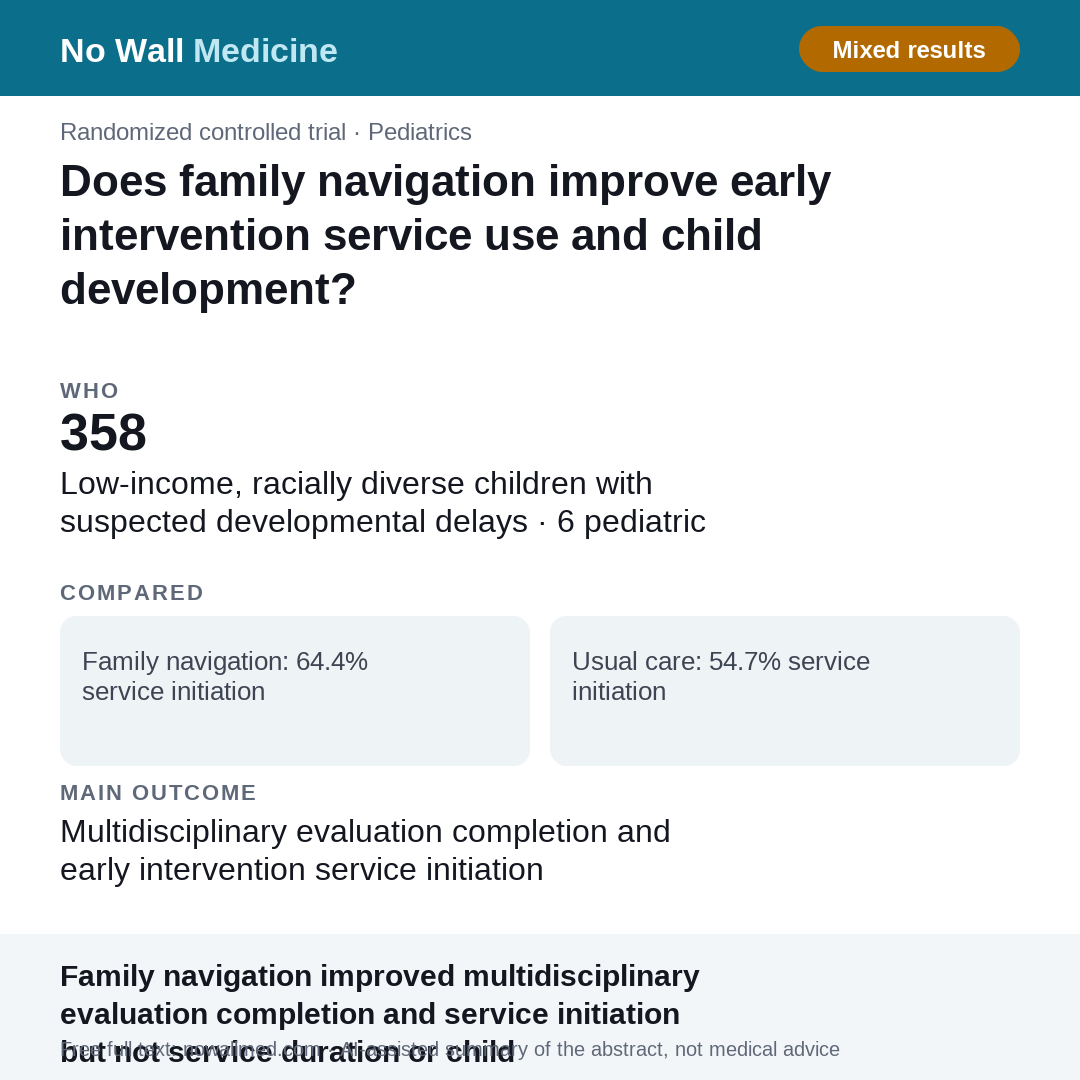
Does family navigation improve early intervention service use and child development?
Who
358
Low-income, racially diverse children with suspected developmental delays · 6 pediatric practices in a large urban community
Compared
Family navigation: 64.4% service initiation
Usual care: 54.7% service initiation
Main outcome
Multidisciplinary evaluation completion and early intervention service initiation
Result: adjusted odds ratio 2.1 (95% CI 1.2-3.5) for multidisciplinary evaluation completion
Bottom line: Family navigation improved multidisciplinary evaluation completion and service initiation but not service duration or child development.
Pediatrics · 2026-03-09Download image
Clinical question: Does family navigation improve early intervention service use and child development?
Why it matters: Disparities in the use of early intervention services are well documented among low-income and racially diverse populations.
Key points
- Researchers studied 358 children with suspected developmental delays in an urban community, comparing family navigation to usual care over 12 months.
- Children receiving family navigation had higher rates of multidisciplinary evaluation completion and service initiation compared to the usual care group.
- The average duration of early intervention services and child developmental scores did not differ between the two groups.
Headline and key points written with AI from the paper’s abstract, with every number checked against it. Read the paper before relying on them.
Was this summary helpful?
Cite this article
Guevara JP, Gerdes M, Segan E, et al. Family Navigation to Reduce Disparities in Early Intervention Services: A Randomized Controlled Trial. Pediatrics. 2026. doi:10.1542/peds.2025-070970
Spotted a mistake? Suggest a correction