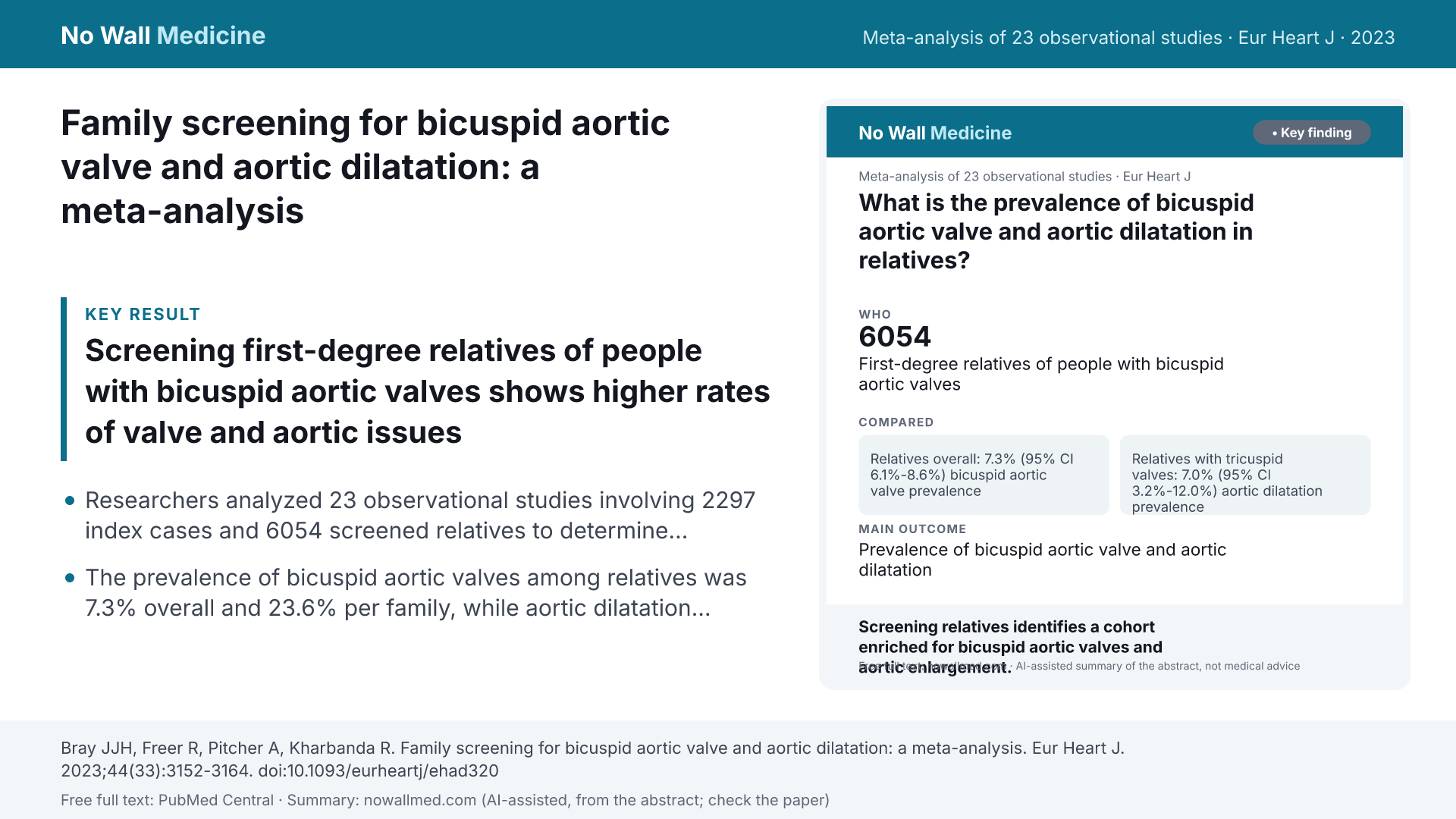
Screening first-degree relatives of people with bicuspid aortic valves shows higher rates of valve and aortic issues
Family screening for bicuspid aortic valve and aortic dilatation: a meta-analysis
Meta-analysis of 23 observational studiesBenefit found
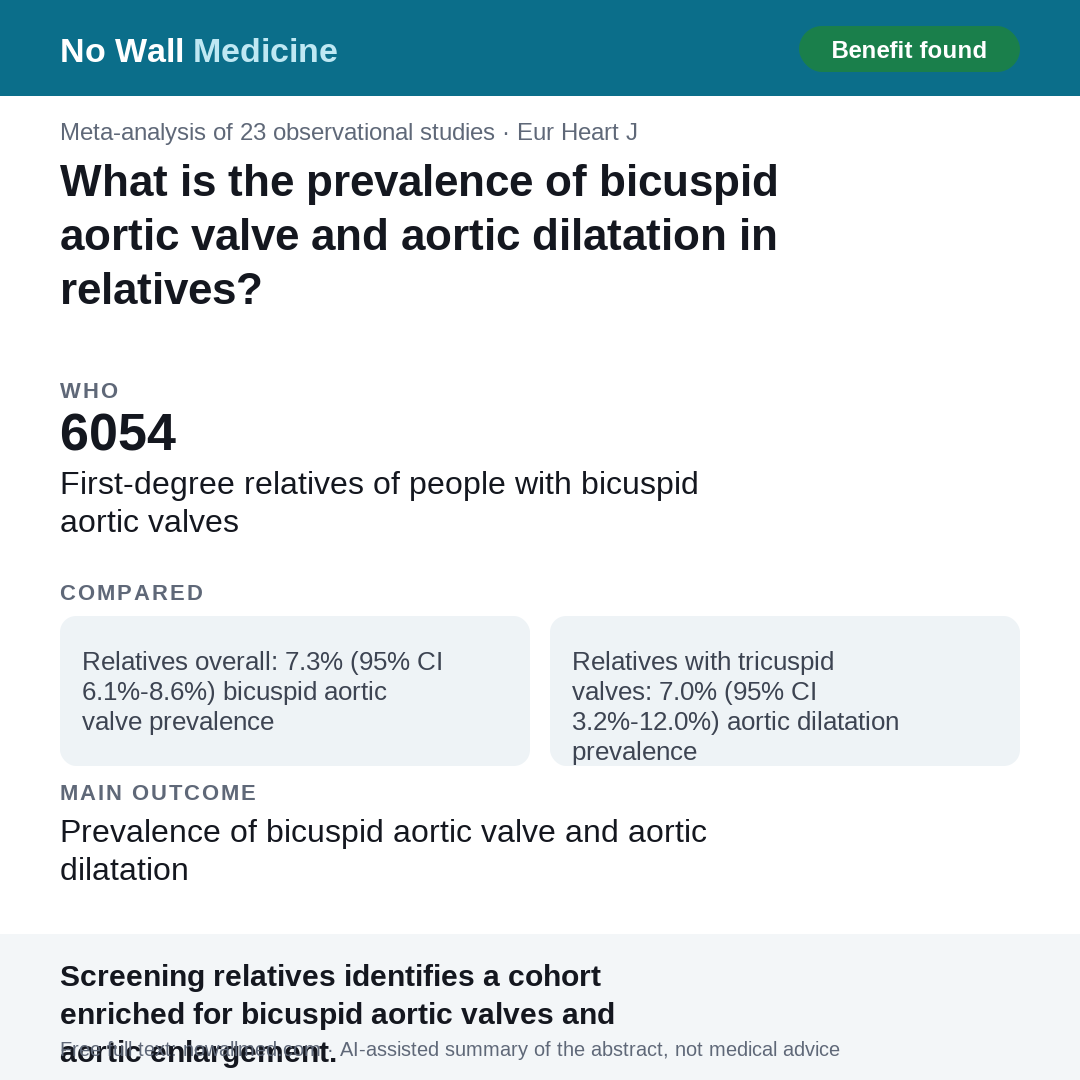
What is the prevalence of bicuspid aortic valve and aortic dilatation in relatives?
Who
6054
First-degree relatives of people with bicuspid aortic valves
Compared
Relatives overall: 7.3% (95% CI 6.1%-8.6%) bicuspid aortic valve prevalence
Relatives with tricuspid valves: 7.0% (95% CI 3.2%-12.0%) aortic dilatation prevalence
Main outcome
Prevalence of bicuspid aortic valve and aortic dilatation
Bottom line: Screening relatives identifies a cohort enriched for bicuspid aortic valves and aortic enlargement.
Limitation: Substantial current uncertainties regarding the clinical implications of aortic findings.
Eur Heart J · 2023-06-08Download image
Clinical question: What is the prevalence of bicuspid aortic valve and aortic dilatation in relatives?
Why it matters: The prevalence of bicuspid aortic valves and aortic dilatation among first-degree relatives of affected individuals is currently uncertain.
Key points
- Researchers analyzed 23 observational studies involving 2297 index cases and 6054 screened relatives to determine the prevalence of bicuspid aortic valves and aortic dilatation.
- The prevalence of bicuspid aortic valves among relatives was 7.3% overall and 23.6% per family, while aortic dilatation was found in 9.4% of relatives.
- Aortic dilatation was found in 29.2% of relatives with bicuspid aortic valves, but was also found in 7.0% of relatives with normal tricuspid aortic valves.
Headline and key points written with AI from the paper’s abstract, with every number checked against it. Read the paper before relying on them.
Was this summary helpful?
Subject terms
Cite this article
Bray JJH, Freer R, Pitcher A, Kharbanda R. Family screening for bicuspid aortic valve and aortic dilatation: a meta-analysis. Eur Heart J. 2023. doi:10.1093/eurheartj/ehad320
Spotted a mistake? Suggest a correction