Genetic variation may predict how eicosapentaenoic acid affects colorectal polyp risk
Fatty acid desaturase insertion-deletion polymorphism rs66698963 predicts colorectal polyp prevention by the n-3 fatty acid eicosapentaenoic acid: a secondary analysis of the seAFOod polyp prevention trial
Randomized, placebo-controlled, 2x2 factorial trialBenefit found
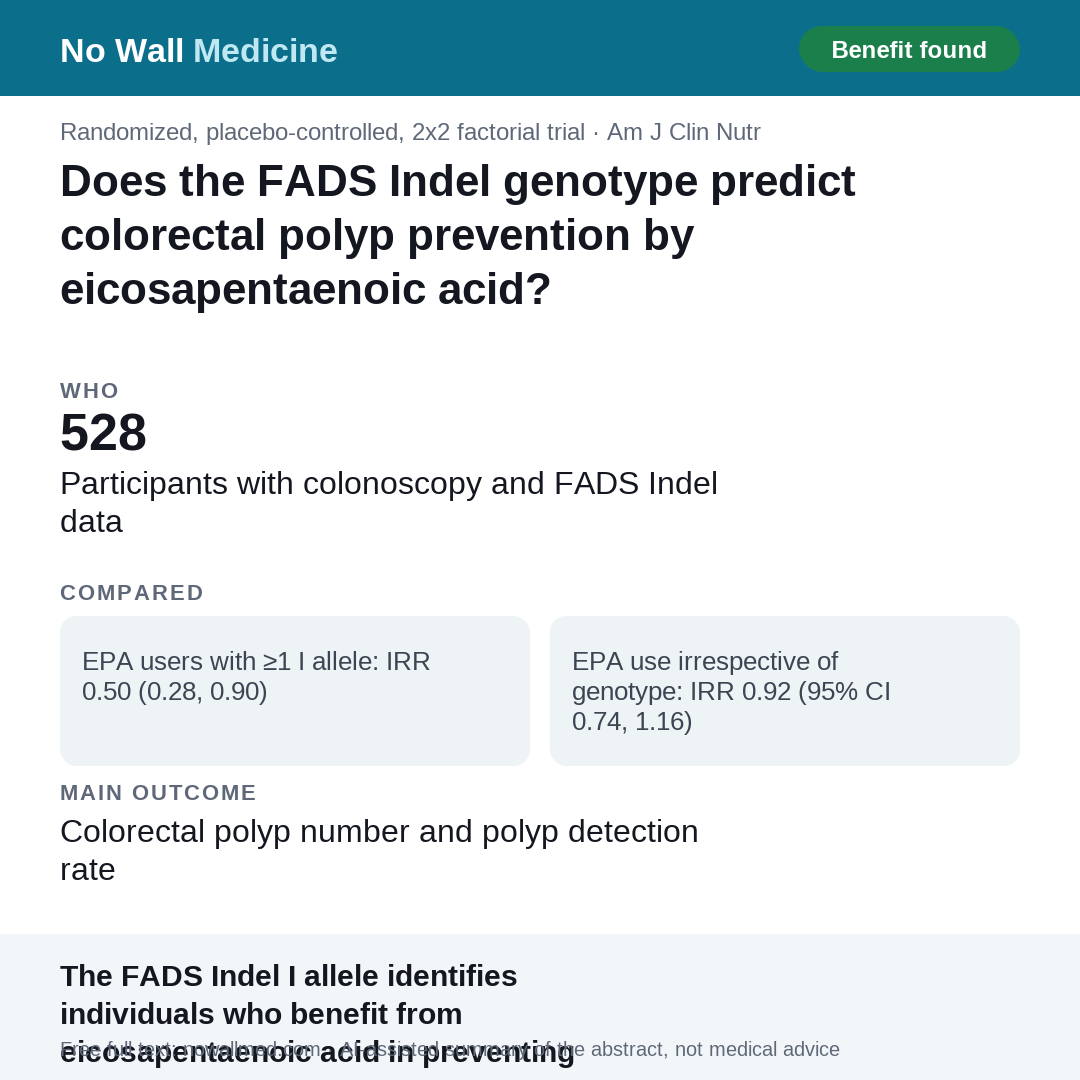
Does the FADS Indel genotype predict colorectal polyp prevention by eicosapentaenoic acid?
Who
528
Participants with colonoscopy and FADS Indel data
Compared
EPA users with ≥1 I allele: IRR 0.50 (0.28, 0.90)
EPA use irrespective of genotype: IRR 0.92 (95% CI 0.74, 1.16)
Main outcome
Colorectal polyp number and polyp detection rate
Result: IRR 0.50 (95% CI 0.28, 0.90) for I allele carriers
Bottom line: The FADS Indel I allele identifies individuals who benefit from eicosapentaenoic acid in preventing colorectal polyps.
Limitation: Assessment in other populations and healthcare settings is warranted.
Am J Clin Nutr · 2024-06-13Download image
Clinical question: Does the FADS Indel genotype predict colorectal polyp prevention by eicosapentaenoic acid?
Why it matters: It is unknown if a precision medicine approach using genetic markers can identify which individuals benefit from eicosapentaenoic acid for colorectal polyp prevention.
Key points
- Researchers analyzed 528 participants from a randomized trial to see if a specific gene variant influenced the effect of eicosapentaenoic acid on colorectal polyps.
- In participants with at least one insertion allele, eicosapentaenoic acid use was associated with a lower polyp number (incidence rate ratio: 0.50; 95% confidence interval: 0.28, 0.90).
- Eicosapentaenoic acid use was not associated with a reduced polyp number in the total group regardless of genotype (incidence rate ratio: 0.92; 95% confidence interval: 0.74, 1.16).
Headline and key points written with AI from the paper’s abstract, with every number checked against it. Read the paper before relying on them.
Was this summary helpful?
Subject terms
Cite this article
Sun G, Li YN, Davies JR, Block RC, Kothapalli KS, Brenna JT. Fatty acid desaturase insertion-deletion polymorphism rs66698963 predicts colorectal polyp prevention by the n-3 fatty acid eicosapentaenoic acid: a secondary analysis of the seAFOod polyp prevention trial. Am J Clin Nutr. 2024. doi:10.1016/j.ajcnut.2024.06.004
Spotted a mistake? Suggest a correction
Top studies every Monday
The week’s key trials and guidelines in your specialties, plus any topics you follow. By email, free.
Get the weekly digest