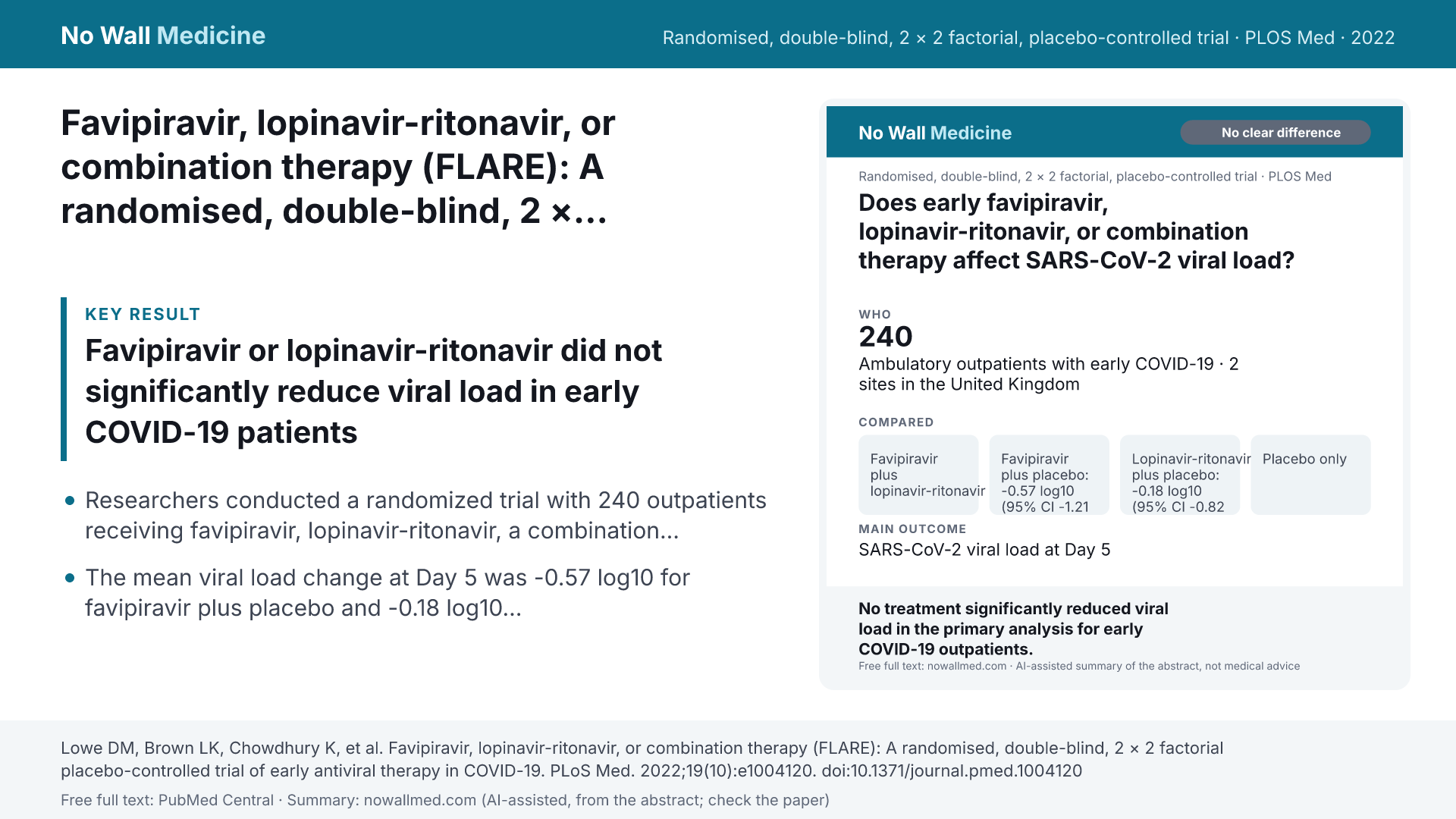
Favipiravir or lopinavir-ritonavir did not significantly reduce viral load in early COVID-19 patients
Favipiravir, lopinavir-ritonavir, or combination therapy (FLARE): A randomised, double-blind, 2 × 2 factorial placebo-controlled trial of early antiviral therapy in COVID-19
Randomised, double-blind, 2 × 2 factorial, placebo-controlled trialNo clear difference
Does early favipiravir, lopinavir-ritonavir, or combination therapy affect SARS-CoV-2 viral load?
Who
240
Ambulatory outpatients with early COVID-19 · 2 sites in the United Kingdom
Compared
Favipiravir plus lopinavir-ritonavir
Favipiravir plus placebo: -0.57 log10 (95% CI -1.21 to 0.07)
Lopinavir-ritonavir plus placebo: -0.18 log10 (95% CI -0.82 to 0.46)
Placebo only
Main outcome
SARS-CoV-2 viral load at Day 5
Result: no significant interaction (interaction coefficient term: 0.59 log10, 95% CI -0.32 to 1.50)
Bottom line: No treatment significantly reduced viral load in the primary analysis for early COVID-19 outpatients.
Limitation: The study population was relatively young and healthy compared to those most affected by the pandemic.
PLOS Med · 2022-10-19Download image
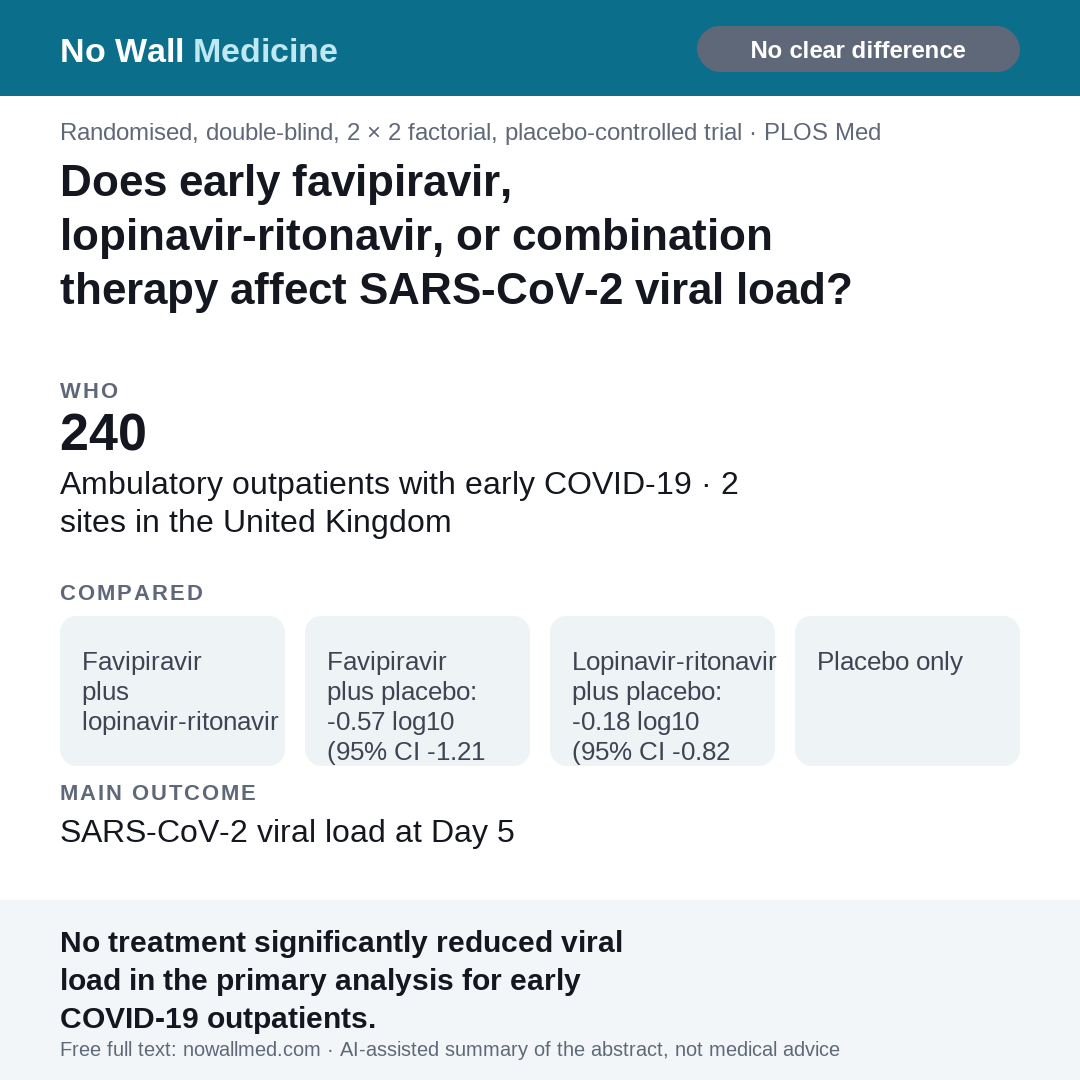
Clinical question: Does early favipiravir, lopinavir-ritonavir, or combination therapy affect SARS-CoV-2 viral load?
Why it matters: It was unknown if favipiravir, lopinavir-ritonavir, or a combination of these drugs could affect the SARS-CoV-2 viral load trajectory when given early in the infection.
Key points
- Researchers conducted a randomized trial with 240 outpatients receiving favipiravir, lopinavir-ritonavir, a combination of both, or a placebo.
- The mean viral load change at Day 5 was -0.57 log10 for favipiravir plus placebo and -0.18 log10 for lopinavir-ritonavir plus placebo compared to placebo.
- While 46.3% had undetectable virus in the favipiravir plus placebo group versus 26.9% in the placebo group, the primary analysis showed no significant reduction.
Limitation the authors note: The study population was relatively young and healthy compared to those most affected by the COVID-19 pandemic.
Headline and key points written with AI from the paper’s abstract, with every number checked against it. Read the paper before relying on them.
Was this summary helpful?
Subject terms
Cite this article
Lowe DM, Brown LK, Chowdhury K, Davey S, Yee P, Ikeji F. Favipiravir, lopinavir-ritonavir, or combination therapy (FLARE): A randomised, double-blind, 2 × 2 factorial placebo-controlled trial of early antiviral therapy in COVID-19. PLOS Med. 2022. doi:10.1371/journal.pmed.1004120
Spotted a mistake? Suggest a correction