Favourable effect of a 'second hit' after 13 weeks in early RA non-responders: the Amsterdam COBRA treat-to-target randomized trial
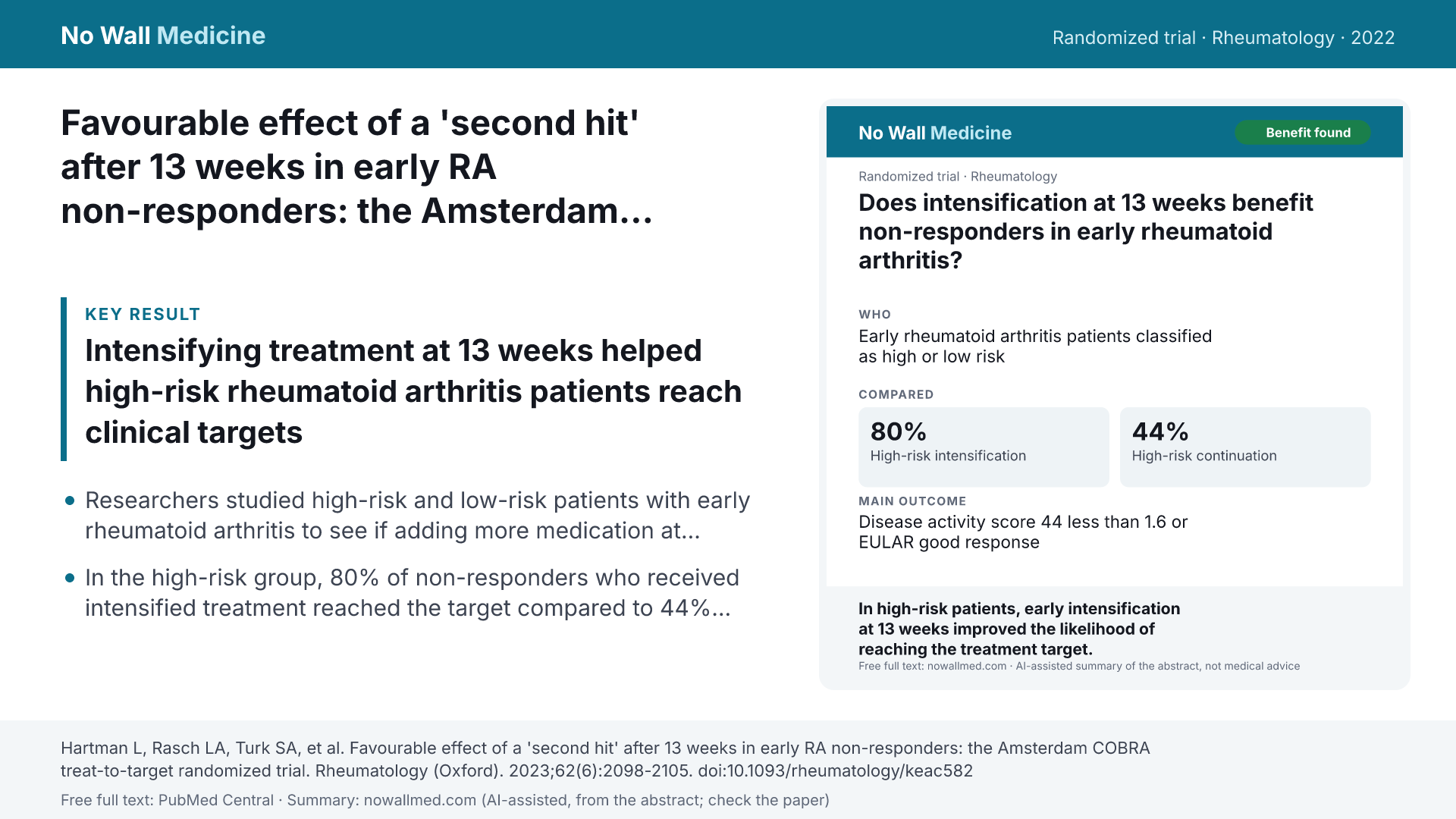
Key result: Intensifying treatment at 13 weeks helped high-risk rheumatoid arthritis patients reach clinical targets
Randomized trialBenefit found
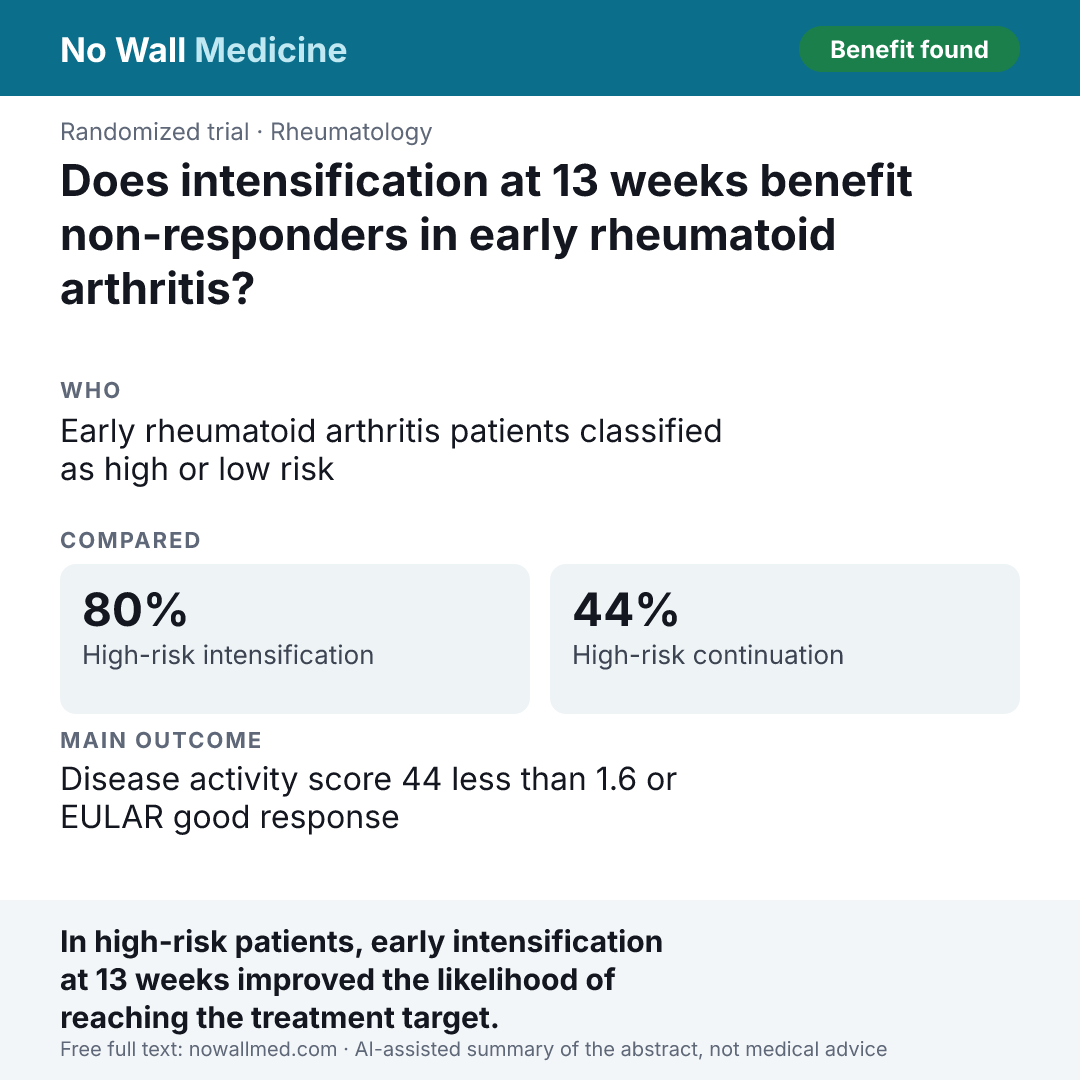
Does intensification at 13 weeks benefit non-responders in early rheumatoid arthritis?
Who
Early rheumatoid arthritis patients classified as high or low risk
Compared
80%High-risk intensification
44%High-risk continuation
Main outcome
Disease activity score 44 less than 1.6 or EULAR good response
Result: difference: 36%, (95% CI 2%, 71%)
Bottom line: In high-risk patients, early intensification at 13 weeks improved the likelihood of reaching the treatment target.
Rheumatology · 2022-10-08 · Save PNG
Key points
- Researchers studied high-risk and low-risk patients with early rheumatoid arthritis to see if adding more medication at 13 weeks improved outcomes.
- In the high-risk group, 80% of non-responders who received intensified treatment reached the target compared to 44% of those who continued standard therapy.
- Adverse event rates were higher in the high-risk group and specifically within the subgroup receiving intensified treatment.
Limitation the authors note: The low-risk group was too small for drawing conclusions and protocol violations were frequent.
Discussion prompts
- Would these patients look like yours? Who was left out?
- Is the main outcome one that matters to patients?
- Is the difference large enough to change what you do?
Cite: Hartman L, Rasch LA, Turk SA, et al. Favourable effect of a 'second hit' after 13 weeks in early RA non-responders: the Amsterdam COBRA treat-to-target randomized trial. Rheumatology (Oxford). 2023;62(6):2098-2105. doi:10.1093/rheumatology/keac582
Free full text: PubMed Central · Summary and visual abstract: nowallmed.com/a/favourable-effect-of-a-second-hit-after-13-weeks-in-early-ra-non-rricf8/ (AI-assisted from the abstract; check the paper before relying on it).