Mind-body walking program and health education program both met feasibility benchmarks for chronic pain
Feasibility of a Mind-Body Program for Chronic Pain: A Randomized Clinical Trial
Single-blind, 2-arm, feasibility randomized clinical trialBenefit found
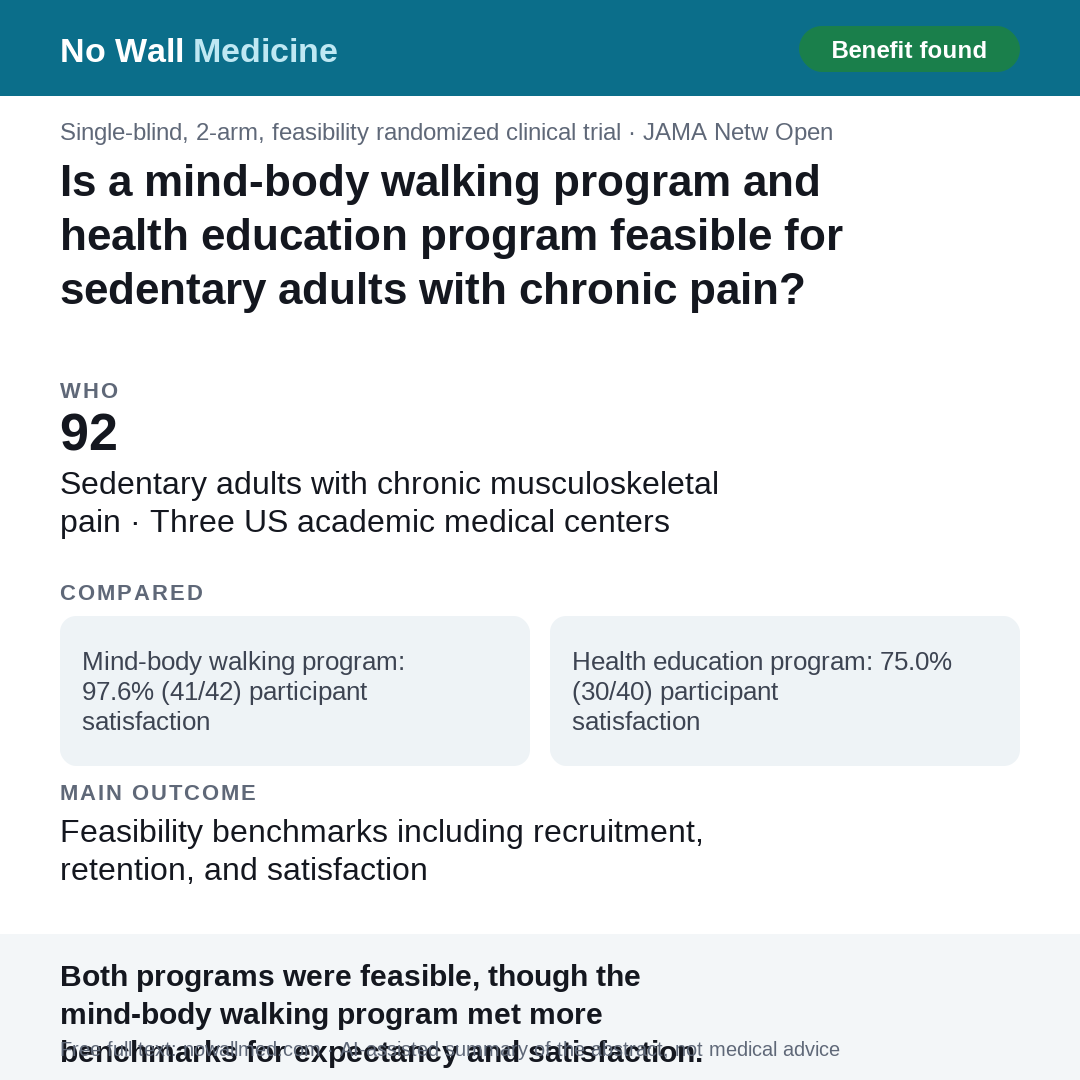
Is a mind-body walking program and health education program feasible for sedentary adults with chronic pain?
Who
92
Sedentary adults with chronic musculoskeletal pain · Three US academic medical centers
Compared
Mind-body walking program: 97.6% (41/42) participant satisfaction
Health education program: 75.0% (30/40) participant satisfaction
Main outcome
Feasibility benchmarks including recruitment, retention, and satisfaction
Bottom line: Both programs were feasible, though the mind-body walking program met more benchmarks for expectancy and satisfaction.
Limitation: Analyses were conducted on observed data rather than following intent-to-treat principles.
JAMA Netw Open · 2025-06-02Download image
Clinical question: Is a mind-body walking program and health education program feasible for sedentary adults with chronic pain?
Why it matters: Most chronic pain trials have limited racial and ethnic diversity and have not comprehensively assessed multimodal physical function.
Key points
- The study randomized 92 sedentary adults with chronic musculoskeletal pain to either a mind-body walking program or a health education program.
- Both programs met benchmarks for treatment credibility, treatment fidelity, assessment accuracy, and participant retention.
- The mind-body walking program met benchmarks for treatment expectancy and satisfaction, while the health education program did not.
Limitation the authors note: Because this was a pilot trial, all analyses were conducted on the observed data rather than following intent-to-treat principles.
Headline and key points written with AI from the paper’s abstract, with every number checked against it. Read the paper before relying on them.
Topics
Cite this article
Greenberg J, Hooker JE, McDermott KA, La Camera DE, Brewer JR, Szapary CL. Feasibility of a Mind-Body Program for Chronic Pain: A Randomized Clinical Trial. JAMA Netw Open. 2025. doi:10.1001/jamanetworkopen.2025.15685
Spotted a mistake? Suggest a correction