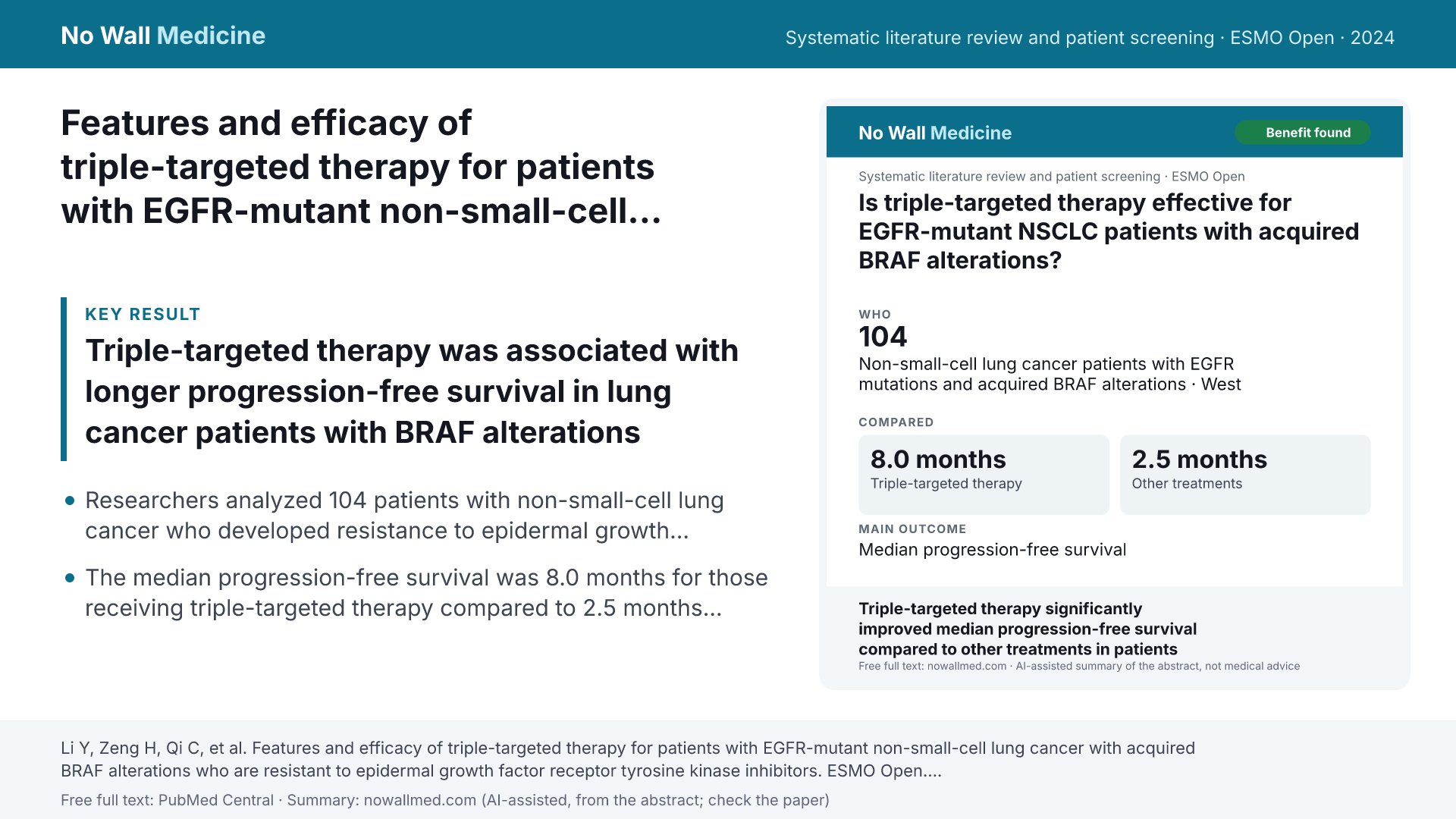
Triple-targeted therapy was associated with longer progression-free survival in lung cancer patients with BRAF alterations
Features and efficacy of triple-targeted therapy for patients with EGFR-mutant non-small-cell lung cancer with acquired BRAF alterations who are resistant to epidermal growth factor receptor tyrosine kinase inhibitors
Systematic literature review and patient screeningBenefit found
Is triple-targeted therapy effective for EGFR-mutant NSCLC patients with acquired BRAF alterations?
Who
104
Non-small-cell lung cancer patients with EGFR mutations and acquired BRAF alterations · West China Hospital of Sichuan University and literature
Compared
8.0 monthsTriple-targeted therapy
2.5 monthsOther treatments
Main outcome
Median progression-free survival
Bottom line: Triple-targeted therapy significantly improved median progression-free survival compared to other treatments in patients with acquired BRAF alterations.
ESMO Open · 2024-10-09 · Save PNG
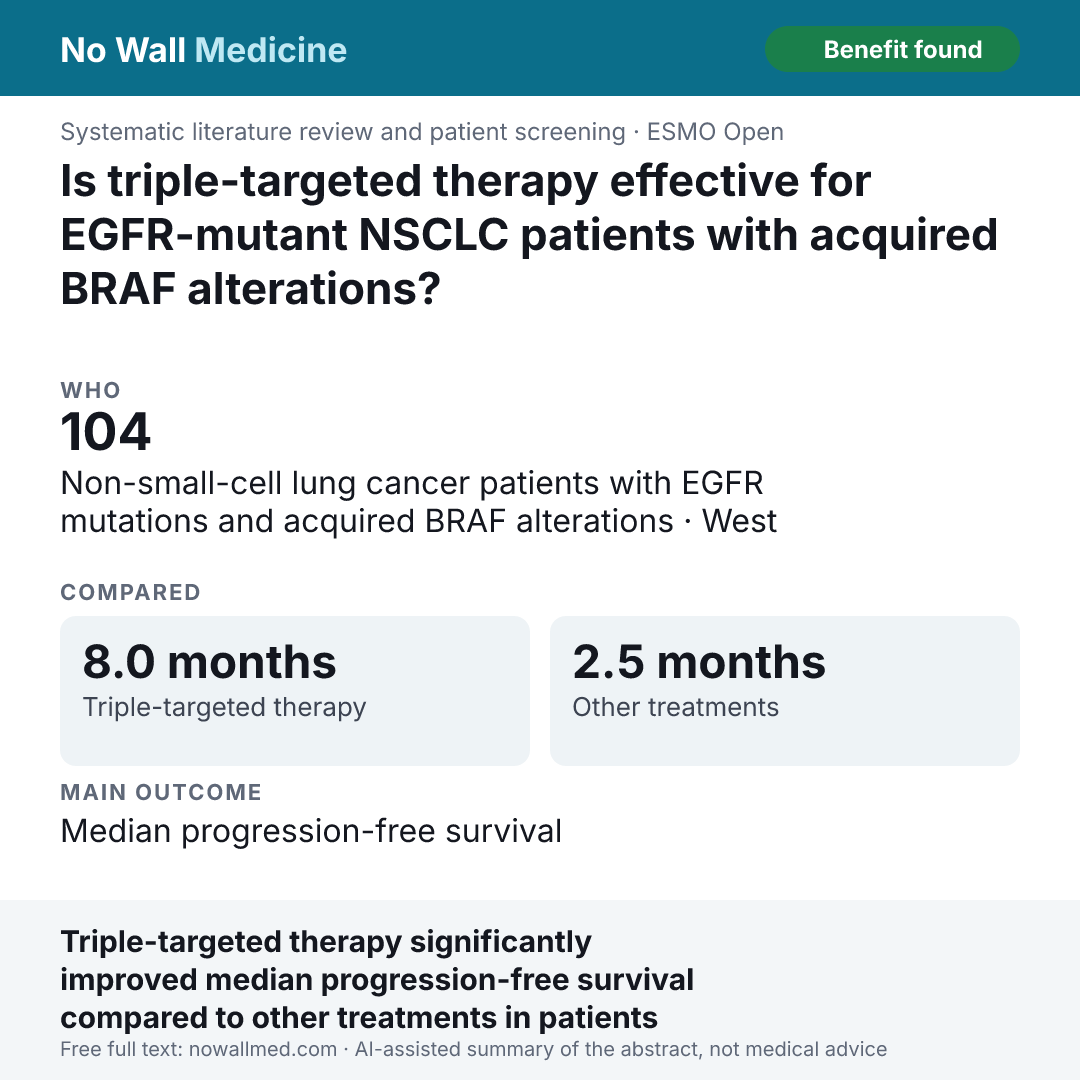
Clinical question: Is triple-targeted therapy effective for EGFR-mutant NSCLC patients with acquired BRAF alterations?
Key points
- Researchers analyzed 104 patients with non-small-cell lung cancer who developed resistance to epidermal growth factor receptor tyrosine kinase inhibitors due to BRAF alterations.
- The median progression-free survival was 8.0 months for those receiving triple-targeted therapy compared to 2.5 months for those receiving other treatments.
- Adverse events occurred in 48.8% of patients, and 12.2% required a dose reduction of the RAF or MEK inhibitor.
Headline and key points written with AI from the paper’s abstract, with every number checked against it. Read the paper before relying on them.
Was this summary helpful?
Subject terms
Headline, design, result, key points, caveat and citation as plain text.
Cite this article
Li Y, Zeng H, Qi C, et al. Features and efficacy of triple-targeted therapy for patients with EGFR-mutant non-small-cell lung cancer with acquired BRAF alterations who are resistant to epidermal growth factor receptor tyrosine kinase inhibitors. ESMO Open. 2024;9(10):103935. doi:10.1016/j.esmoop.2024.103935
Spotted a mistake? Suggest a correction