Fecal transplant from vaginally seeded infants decreases intraabdominal adiposity in mice
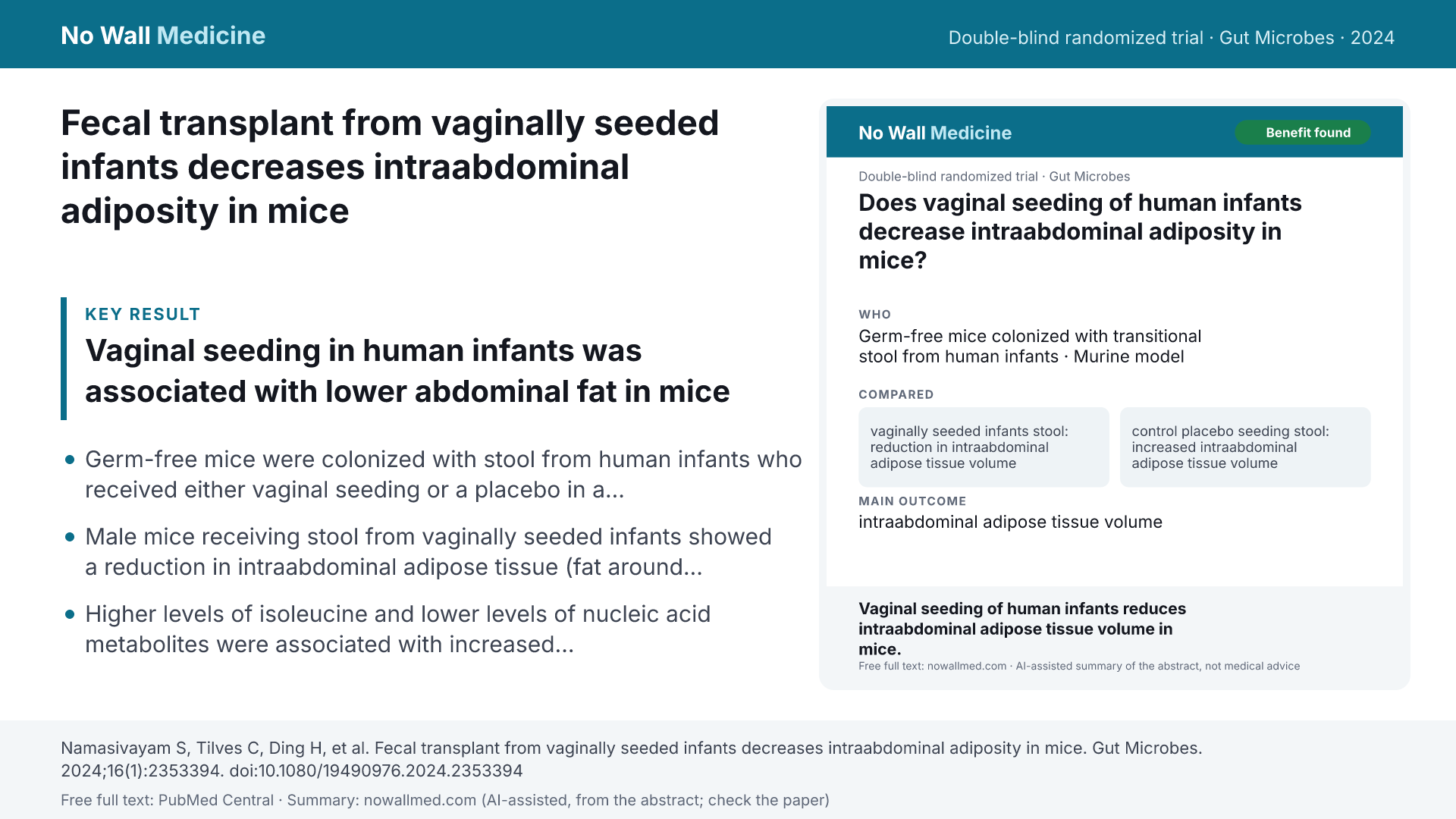
Key result: Vaginal seeding in human infants was associated with lower abdominal fat in mice
Double-blind randomized trialBenefit found
Does vaginal seeding of human infants decrease intraabdominal adiposity in mice?
Who
Germ-free mice colonized with transitional stool from human infants · Murine model
Compared
vaginally seeded infants stool: reduction in intraabdominal adipose tissue volume
control placebo seeding stool: increased intraabdominal adipose tissue volume
Main outcome
intraabdominal adipose tissue volume
Bottom line: Vaginal seeding of human infants reduces intraabdominal adipose tissue volume in mice.
Gut Microbes · 2024-05-14
Key points
- Germ-free mice were colonized with stool from human infants who received either vaginal seeding or a placebo in a double-blind randomized trial.
- Male mice receiving stool from vaginally seeded infants showed a reduction in intraabdominal adipose tissue (fat around the organs) volume compared to the control group.
- Higher levels of isoleucine and lower levels of nucleic acid metabolites were associated with increased intraabdominal adipose tissue volume in the control group.
Discussion prompts
- Would these patients look like yours? Who was left out?
- Is the main outcome one that matters to patients?
- Is the difference large enough to change what you do?
Cite: Namasivayam S, Tilves C, Ding H, et al. Fecal transplant from vaginally seeded infants decreases intraabdominal adiposity in mice. Gut Microbes. 2024;16(1):2353394. doi:10.1080/19490976.2024.2353394
Free full text: PubMed Central · Summary and visual abstract: nowallmed.com/a/fecal-transplant-from-vaginally-seeded-infants-decreases-1o5x278/ (AI-assisted from the abstract; check the paper before relying on it).