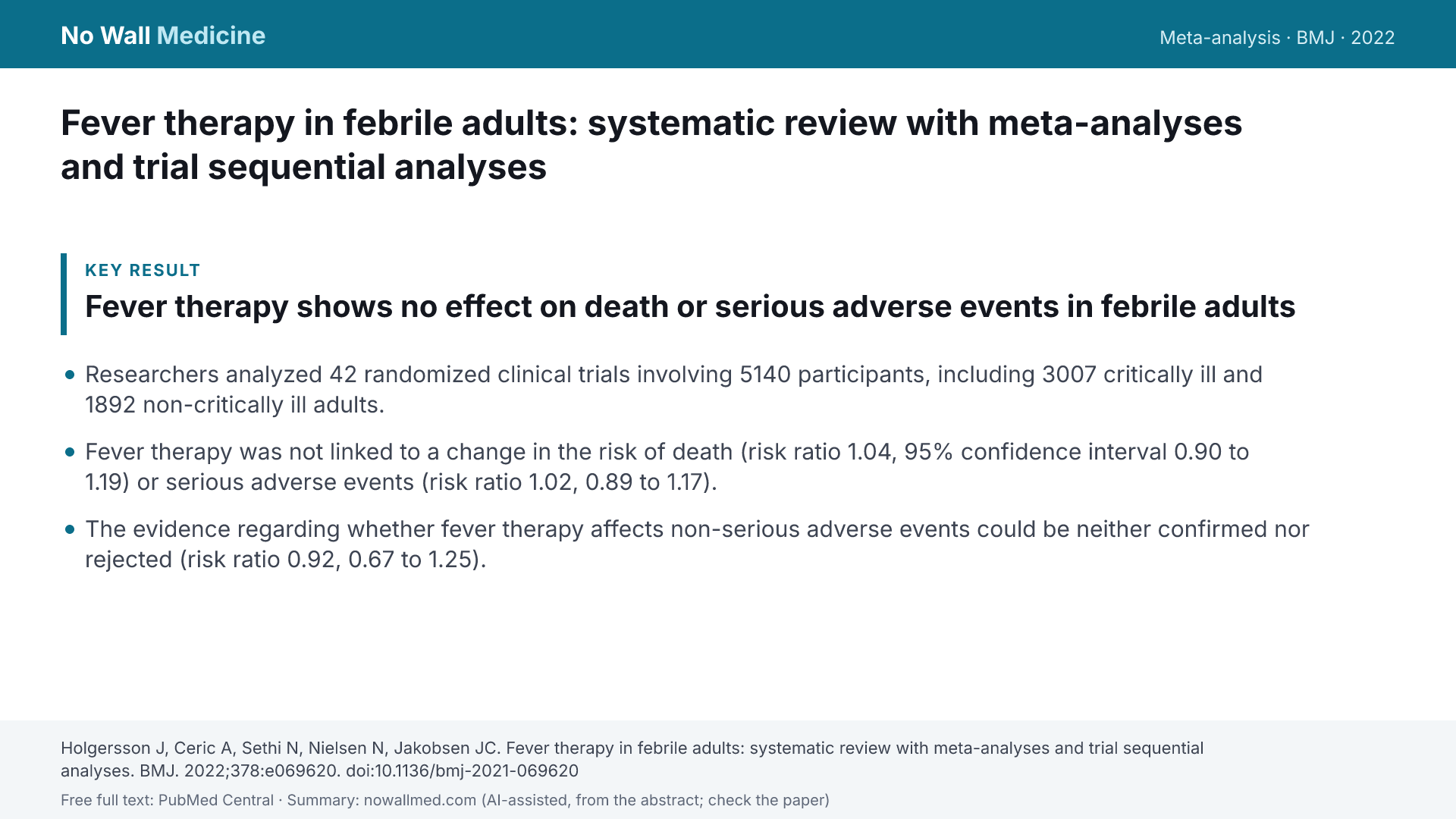
Fever therapy shows no effect on death or serious adverse events in febrile adults
Fever therapy in febrile adults: systematic review with meta-analyses and trial sequential analyses
Systematic review and meta-analysesNo clear difference
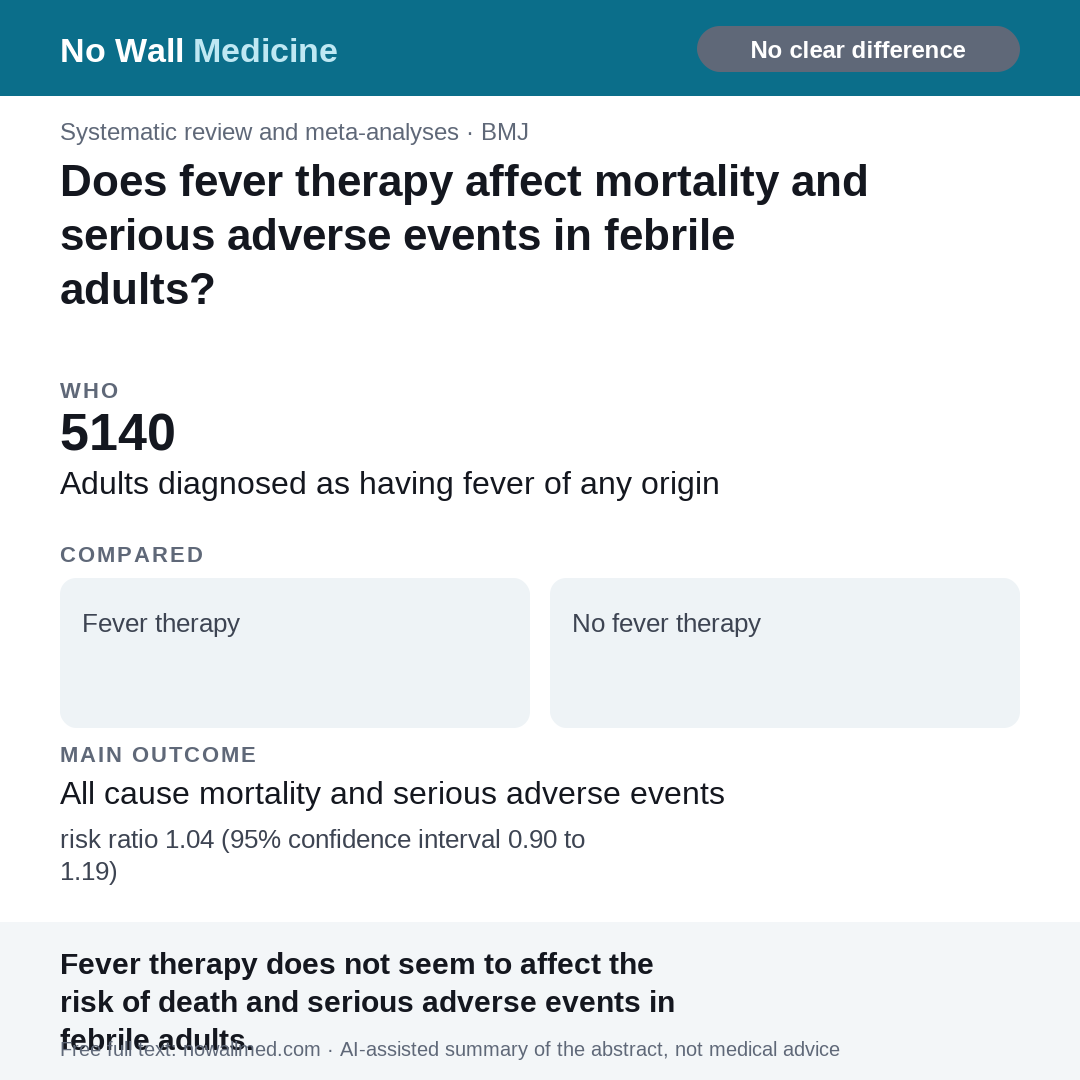
Does fever therapy affect mortality and serious adverse events in febrile adults?
Who
5140
Adults diagnosed as having fever of any origin
Compared
Fever therapy
No fever therapy
Main outcome
All cause mortality and serious adverse events
Result: risk ratio 1.04 (95% confidence interval 0.90 to 1.19)
Bottom line: Fever therapy does not seem to affect the risk of death and serious adverse events in febrile adults.
Limitation: All trials were assessed as being at high risk of bias.
BMJ · 2022-07-12Download image
Clinical question: Does fever therapy affect mortality and serious adverse events in febrile adults?
Why it matters: It was unknown if treating fever with drugs or physical cooling affects mortality or safety in adults with fever of any origin.
Key points
- Researchers analyzed 42 randomized clinical trials involving 5140 participants, including 3007 critically ill and 1892 non-critically ill adults.
- Fever therapy was not linked to a change in the risk of death (risk ratio 1.04, 95% confidence interval 0.90 to 1.19) or serious adverse events (risk ratio 1.02, 0.89 to 1.17).
- The evidence regarding whether fever therapy affects non-serious adverse events could be neither confirmed nor rejected (risk ratio 0.92, 0.67 to 1.25).
Limitation the authors note: All included trials were assessed as being at high risk of bias.
Headline and key points written with AI from the paper’s abstract, with every number checked against it. Read the paper before relying on them.
Was this summary helpful?
Abstract
Objective
To investigate the effects of fever therapy compared with no fever therapy in a wide population of febrile adults. Design
Systematic review with meta-analyses and trial sequential analyses of randomised clinical trials. Data sources
CENTRAL, BIOSIS, CINAHL, MEDLINE, Embase, LILACS, Scopus, and Web of Science Core Collection, searched from their inception to 2 July 2021. Eligibility criteria
Randomised clinical trials in adults diagnosed as having fever of any origin. Included experimental interventions were any fever therapy, and the control intervention had to be no fever therapy (with or without placebo/sham). Data extraction and synthesis
Two authors independently selected studies, extracted data, and assessed the risk of bias. Primary outcomes were all cause mortality and serious adverse events. Secondary outcomes were quality of life and non-serious adverse events. Aggregate data were synthesised with meta-analyses, subgroup analyses, and trial sequential analyses, and the evidence was assessed using the Grading of Recommendations, Assessment, Development and Evaluation (GRADE) approach. Results
Forty two trials assessing 5140 participants were included. Twenty three trials assessed 11 different antipyretic drugs, 11 trials assessed physical cooling, and eight trials assessed a combination of antipyretic drugs and physical cooling. Of the participants, 3007 were critically ill, 1892 were non-critically ill, 3277 had infectious fever, and 1139 had non-infectious fever. All trials were assessed as being at high risk of bias. Meta-analysis and trial sequential analysis showed that the hypothesis that fever therapy reduces the risk of death (risk ratio 1.04, 95% confidence interval 0.90 to 1.19; I2=0%; P=0.62; 16 trials; high certainty evidence) and the risk of serious adverse events (risk ratio 1.02, 0.89 to 1.17; I2=0%; P=0.78; 16 trials; high certainty evidence) could be rejected. One trial assessing quality of life was included, showing no difference between fever therapy and control. Meta-analysis and trial sequential analysis showed that the hypothesis that fever therapy reduces the risk of non-serious adverse events could be neither confirmed nor rejected (risk ratio 0.92, 0.67 to 1.25; I2=66.5%; P=0.58; four trials; very low certainty evidence). Conclusions
Fever therapy does not seem to affect the risk of death and serious adverse events. Systematic review registration
PROSPERO CRD42019134006.
Abstract reproduced under the article’s CC BY NC licence.
Subject terms
Cite this article
Holgersson J, Ceric A, Sethi N, Nielsen N, Jakobsen JC. Fever therapy in febrile adults: systematic review with meta-analyses and trial sequential analyses. BMJ. 2022. doi:10.1136/bmj-2021-069620
Spotted a mistake? Suggest a correction