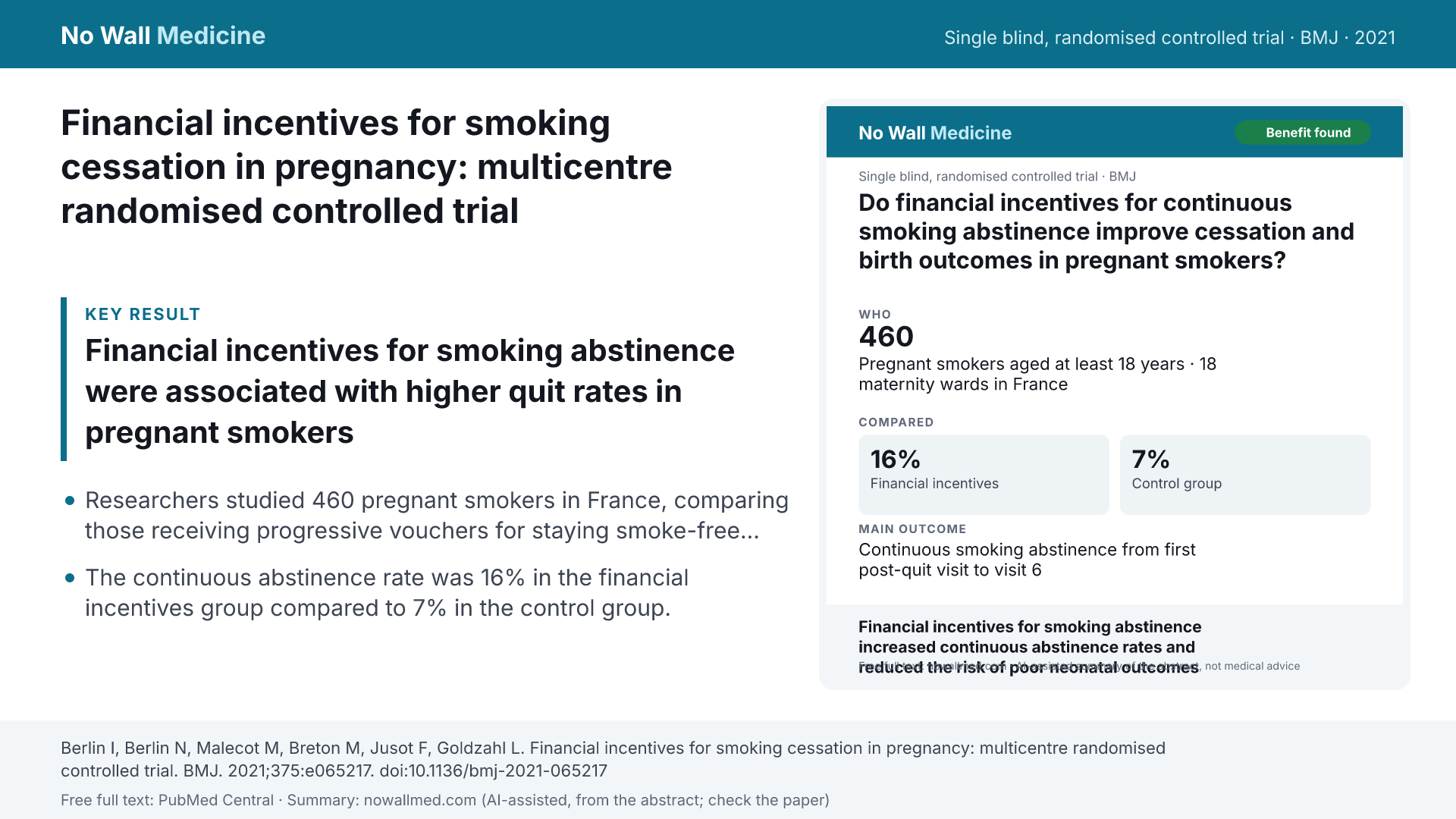
Financial incentives for smoking abstinence were associated with higher quit rates in pregnant smokers
Financial incentives for smoking cessation in pregnancy: multicentre randomised controlled trial
Single blind, randomised controlled trialBenefit found
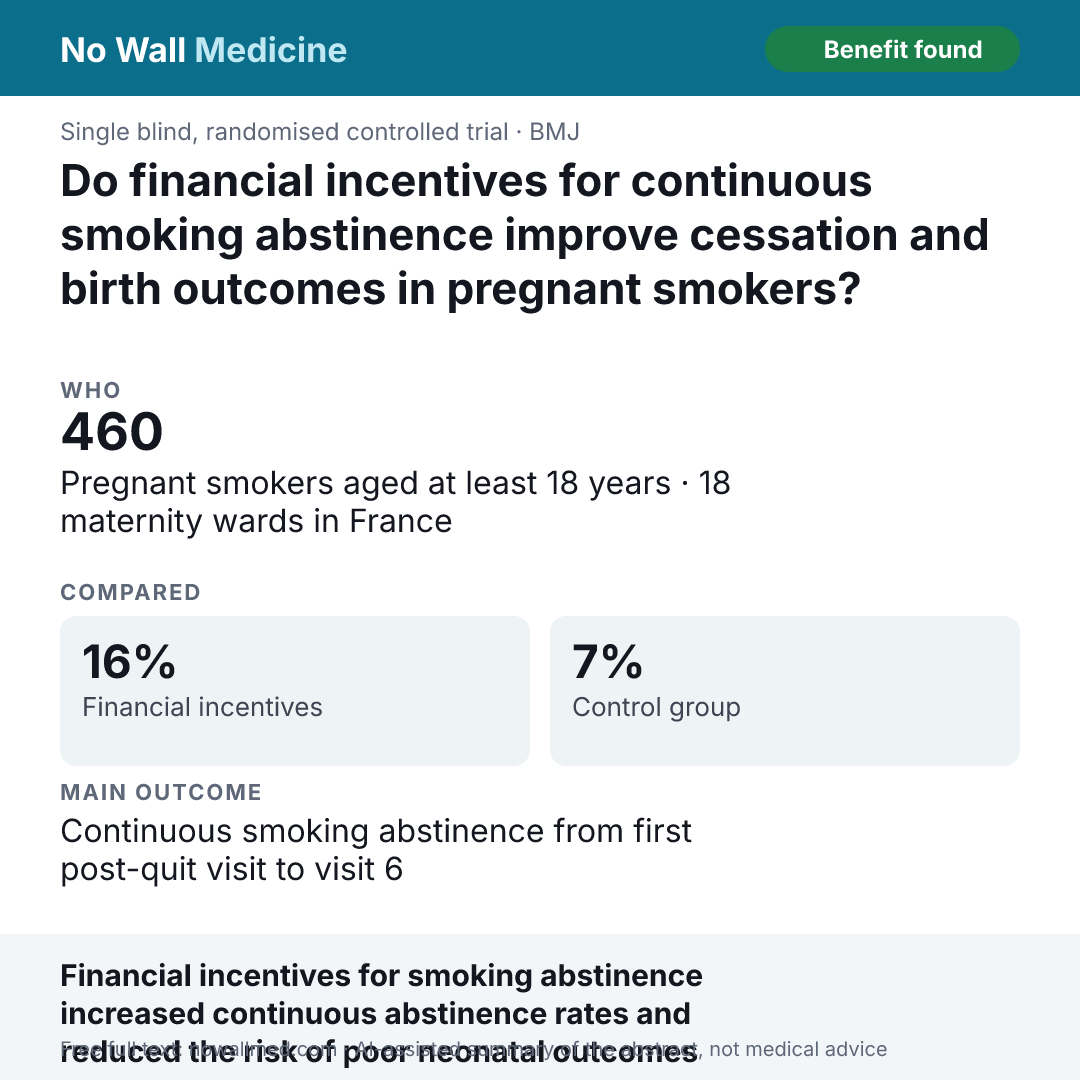
Do financial incentives for continuous smoking abstinence improve cessation and birth outcomes in pregnant smokers?
Who
460
Pregnant smokers aged at least 18 years · 18 maternity wards in France
Compared
16%Financial incentives (38/231)
7%Control group (17/229)
Main outcome
Continuous smoking abstinence from first post-quit visit to visit 6
Result: odds ratio 2.45 (95% confidence interval 1.34 to 4.49)
Bottom line: Financial incentives for smoking abstinence increased continuous abstinence rates and reduced the risk of poor neonatal outcomes in pregnant smokers.
Limitation: Post hoc analyses regarding birth weights should be interpreted with caution.
BMJ · 2021-12-01 · Save PNG
Clinical question: Do financial incentives for continuous smoking abstinence improve cessation and birth outcomes in pregnant smokers?
In absolute numbers
Financial incentives: 16% · Control group: 7% → a difference of 9 percentage points, so about 12 people would need the treatment for 1 more to benefit (number needed to treat) over the trial’s follow-up.
Worked out by us from the two group results above, not reported by the authors. Check the paper for the exact outcome and timing.
Key points
- Researchers studied 460 pregnant smokers in France, comparing those receiving progressive vouchers for staying smoke-free to a control group receiving no abstinence incentives.
- The continuous abstinence rate was 16% in the financial incentives group compared to 7% in the control group.
- Financial incentives were associated with a lower risk of poor neonatal outcomes, occurring in 2% of the incentive group versus 9% in the control group.
Limitation the authors note: The authors noted that results from post hoc analyses, including those regarding birth weights, should be interpreted with caution.
Headline and key points written with AI from the paper’s abstract, with every number checked against it. Read the paper before relying on them.
Was this summary helpful?
Abstract
Objective
To evaluate the efficacy of financial incentives dependent on continuous smoking abstinence on smoking cessation and birth outcomes among pregnant smokers. Design
Single blind, randomised controlled trial. Setting
Financial Incentive for Smoking Cessation in Pregnancy (FISCP) trial in 18 maternity wards in France. Participants
460 pregnant smokers aged at least 18 years who smoked ≤5 cigarettes/day or ≤3 roll-your-own cigarettes/day and had a pregnancy gestation of <18 weeks were randomised to a financial incentives group (n=231) or a control group (n=229). Interventions
Participants in the financial incentives group received a voucher equivalent to €20 (£17; $23), and further progressively increasing vouchers at each study visit if they remained abstinent. Participants in the control group received no financial incentive for abstinence. All participants received a €20 show-up fee at each of six visits. Main outcome measures
The main outcome measure was continuous smoking abstinence from the first post-quit date visit to visit 6, before delivery. Secondary outcomes in the mothers were point prevalence abstinence, time to smoking relapse, withdrawal symptoms, blood pressure, and alcohol and cannabis use in past 30 days. Secondary outcomes in the babies were gestational age at birth, birth characteristics (birth weight, length, head circumference, Apgar score), and a poor neonatal outcome-a composite measure of transfer to the neonatal unit, congenital malformation, convulsions, or perinatal death. Results
Mean age was 29 years. In the financial incentives and control groups, respectively, 137 (59%) and 148 (65%) were employed, 163 (71%) and 171 (75%) were in a relationship, and 41 (18%) and 31 (13%) were married. The participants had smoked a median of 60 cigarettes in the past seven days. The continuous abstinence rate was significantly higher in the financial incentives group (16%, 38/231) than control group (7%, 17/229): odds ratio 2.45 (95% confidence interval 1.34 to 4.49), P=0.004). The point prevalence abstinence rate was higher (4.61, 1.41 to 15.01, P=0.011), the median time to relapse was longer (visit 5 (interquartile range 3-6) and visit 4 (3-6), P<0.001)), and craving for tobacco was lower (β=-1.81, 95% confidence interval -3.55 to -0.08, P=0.04) in the financial incentives group than control group. Financial incentives were associated with a 7% reduction in the risk of a poor neonatal outcome: 4 babies (2%) in the financial incentives group and 18 babies (9%) in the control group: mean difference 14 (95% confidence interval 5 to 23), P=0.003. Post hoc analyses suggested that more babies in the financial incentives group had birth weights ≥2500 g than in the control group: unadjusted odds ratio 1.95 (95% confidence interval 0.99 to 3.85), P=0.055; sex adjusted odds ratio 2.05 (1.03 to 4.10), P=0.041; and sex and prematurity adjusted odds ratio 2.06 (0.90 to 4.71), P=0.086. As these are post hoc analyses, the results should be interpreted with caution. Conclusions
Financial incentives to reward smoking abstinence compared with no financial incentives were associated with an increased abstinence rate in pregnant smokers. Financial incentives dependent on smoking abstinence could be implemented as a safe and effective intervention to help pregnant smokers quit smoking. Trial registration
ClinicalTrials.gov NCT02606227.
Abstract reproduced under the article’s CC BY NC licence.
Subject terms
Headline, design, result, key points, caveat and citation as plain text.
Cite this article
Berlin I, Berlin N, Malecot M, Breton M, Jusot F, Goldzahl L. Financial incentives for smoking cessation in pregnancy: multicentre randomised controlled trial. BMJ. 2021;375:e065217. doi:10.1136/bmj-2021-065217
Spotted a mistake? Suggest a correction