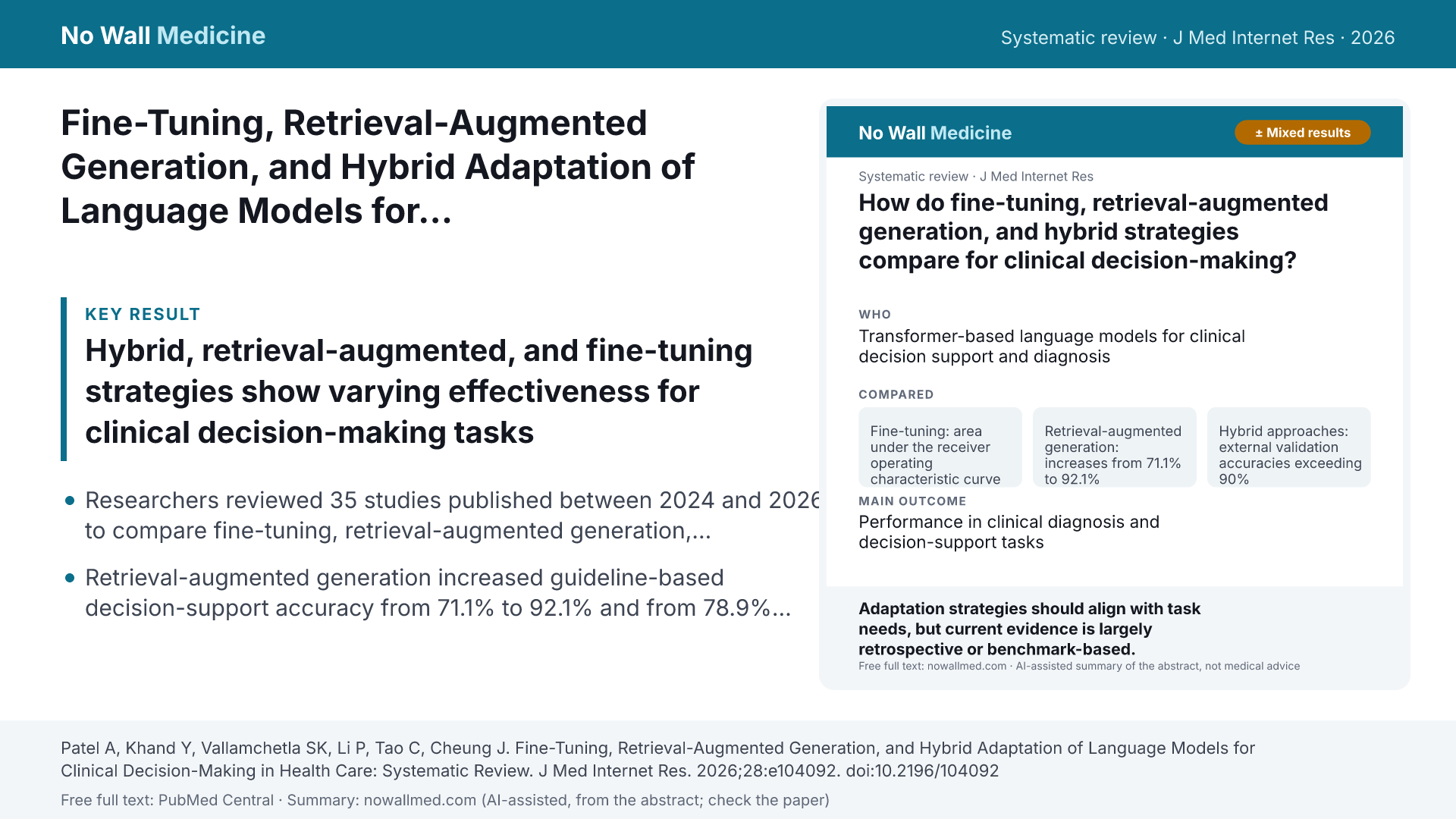
Fine-Tuning, Retrieval-Augmented Generation, and Hybrid Adaptation of Language Models for Clinical Decision-Making in Health Care: Systematic Review
Key result: Hybrid, retrieval-augmented, and fine-tuning strategies show varying effectiveness for clinical decision-making tasks
Key points
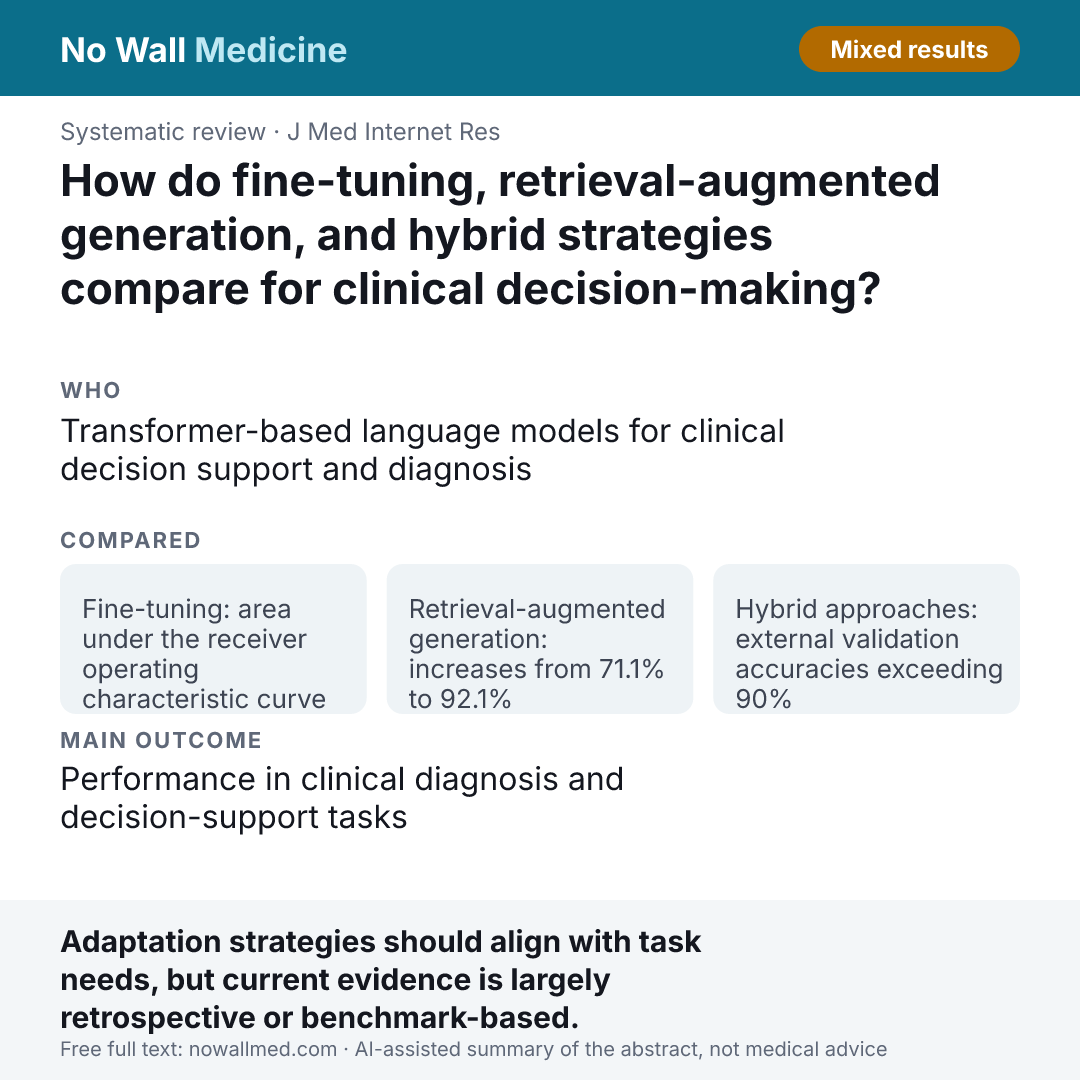
- Researchers reviewed 35 studies published between 2024 and 2026 to compare fine-tuning, retrieval-augmented generation, and hybrid adaptation strategies for medical tasks.
- Retrieval-augmented generation increased guideline-based decision-support accuracy from 71.1% to 92.1% and from 78.9% to 94.7%, while hybrid systems achieved accuracies exceeding 90% in certain applications.
- Fine-tuning achieved area under the receiver operating characteristic curve values up to 0.912 for cancer detection and 0.892 for major depressive disorder prediction.
Limitation the authors note: The authors state that the evidence base remains largely retrospective or benchmark-based and identified substantial methodological limitations in most studies.
Discussion prompts
- Would these patients look like yours? Who was left out?
- Is the main outcome one that matters to patients?
- Is the difference large enough to change what you do?
Cite: Patel A, Khand Y, Vallamchetla SK, Li P, Tao C, Cheung J. Fine-Tuning, Retrieval-Augmented Generation, and Hybrid Adaptation of Language Models for Clinical Decision-Making in Health Care: Systematic Review. J Med Internet Res. 2026;28:e104092. doi:10.2196/104092
Free full text: PubMed Central · Summary and visual abstract: nowallmed.com/a/fine-tuning-retrieval-augmented-generation-and-hybrid-adaptation-of-30m96v/ (AI-assisted from the abstract; check the paper before relying on it).