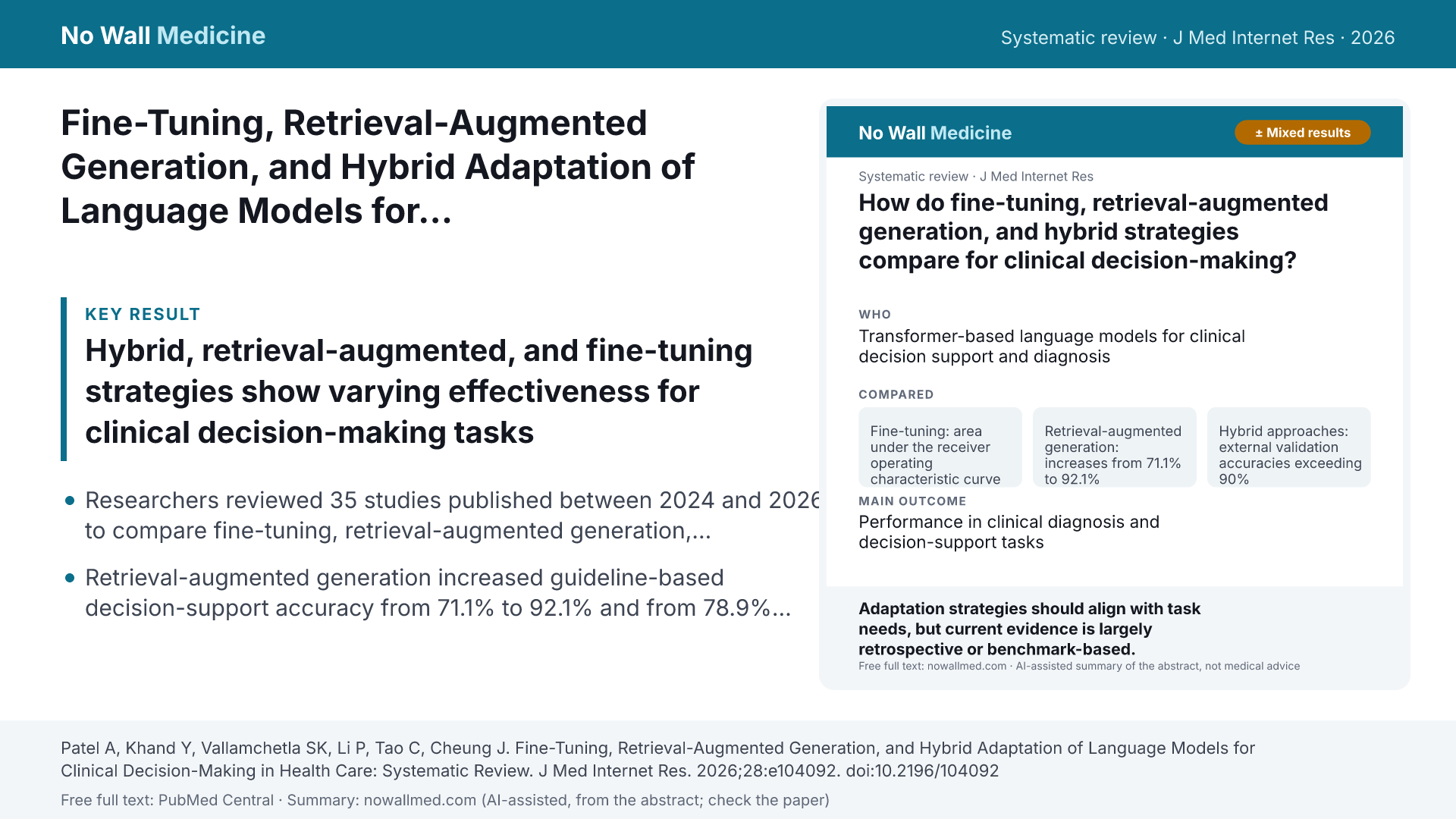
Hybrid, retrieval-augmented, and fine-tuning strategies show varying effectiveness for clinical decision-making tasks
Fine-Tuning, Retrieval-Augmented Generation, and Hybrid Adaptation of Language Models for Clinical Decision-Making in Health Care: Systematic Review
Systematic reviewMixed results
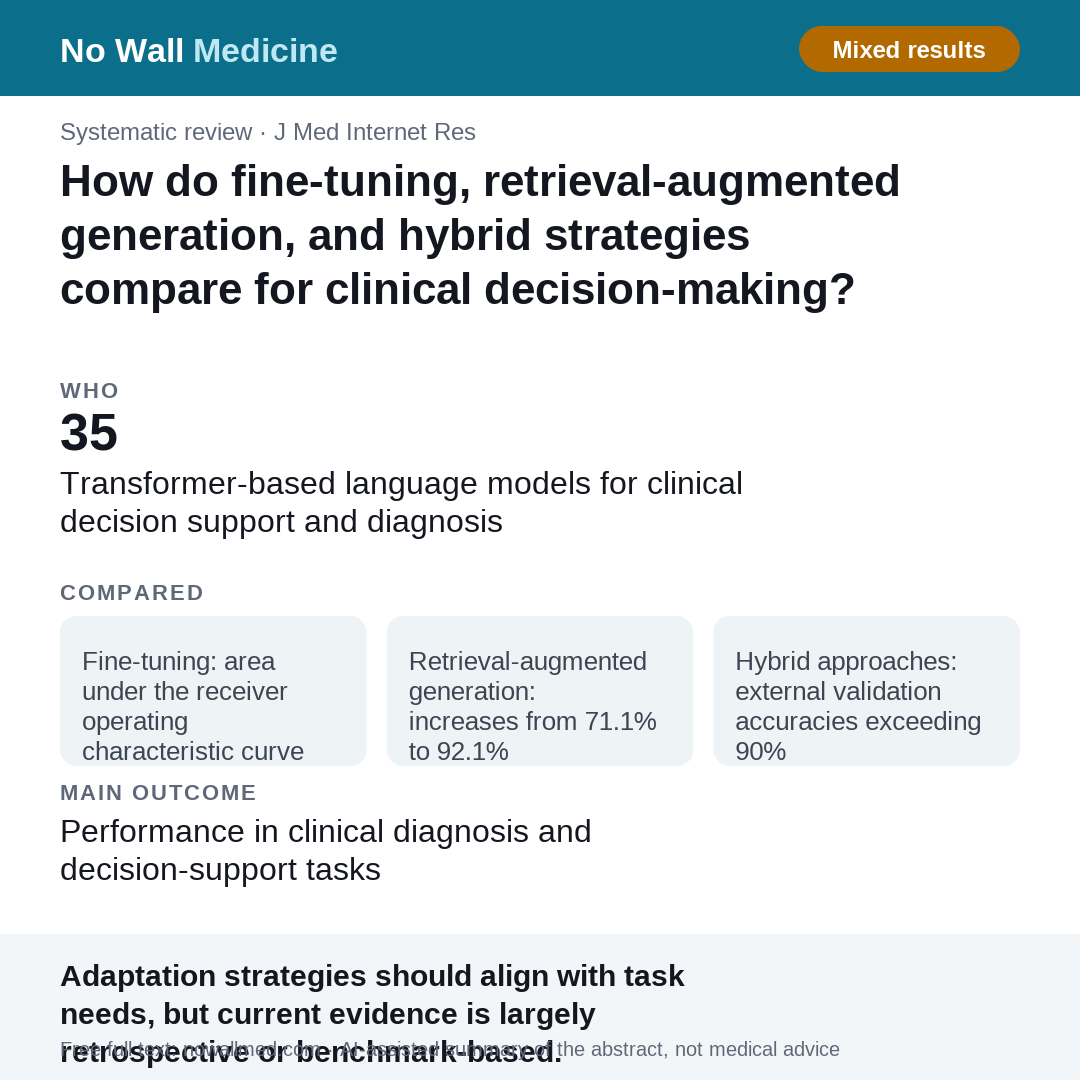
How do fine-tuning, retrieval-augmented generation, and hybrid strategies compare for clinical decision-making?
Who
35
Transformer-based language models for clinical decision support and diagnosis
Compared
Fine-tuning: area under the receiver operating characteristic curve up to 0.912
Retrieval-augmented generation: increases from 71.1% to 92.1%
Hybrid approaches: external validation accuracies exceeding 90%
Main outcome
Performance in clinical diagnosis and decision-support tasks
Bottom line: Adaptation strategies should align with task needs, but current evidence is largely retrospective or benchmark-based.
Limitation: Substantial methodological limitations including inadequate external validation and lack of calibration assessment.
J Med Internet Res · 2026-09-17Download image
Clinical question: How do fine-tuning, retrieval-augmented generation, and hybrid strategies compare for clinical decision-making?
Why it matters: The comparative effectiveness of different posttraining adaptation strategies for grounding language models in clinical evidence remains unclear.
Key points
- Researchers reviewed 35 studies published between 2024 and 2026 to compare fine-tuning, retrieval-augmented generation, and hybrid adaptation strategies for medical tasks.
- Retrieval-augmented generation increased guideline-based decision-support accuracy from 71.1% to 92.1% and from 78.9% to 94.7%, while hybrid systems achieved accuracies exceeding 90% in certain applications.
- Fine-tuning achieved area under the receiver operating characteristic curve values up to 0.912 for cancer detection and 0.892 for major depressive disorder prediction.
Limitation the authors note: The authors state that the evidence base remains largely retrospective or benchmark-based and identified substantial methodological limitations in most studies.
Headline and key points written with AI from the paper’s abstract, with every number checked against it. Read the paper before relying on them.
Was this summary helpful?
Subject terms
Cite this article
Patel A, Khand Y, Vallamchetla SK, Li P, Tao C, Cheung J. Fine-Tuning, Retrieval-Augmented Generation, and Hybrid Adaptation of Language Models for Clinical Decision-Making in Health Care: Systematic Review. J Med Internet Res. 2026. doi:10.2196/104092
Spotted a mistake? Suggest a correction