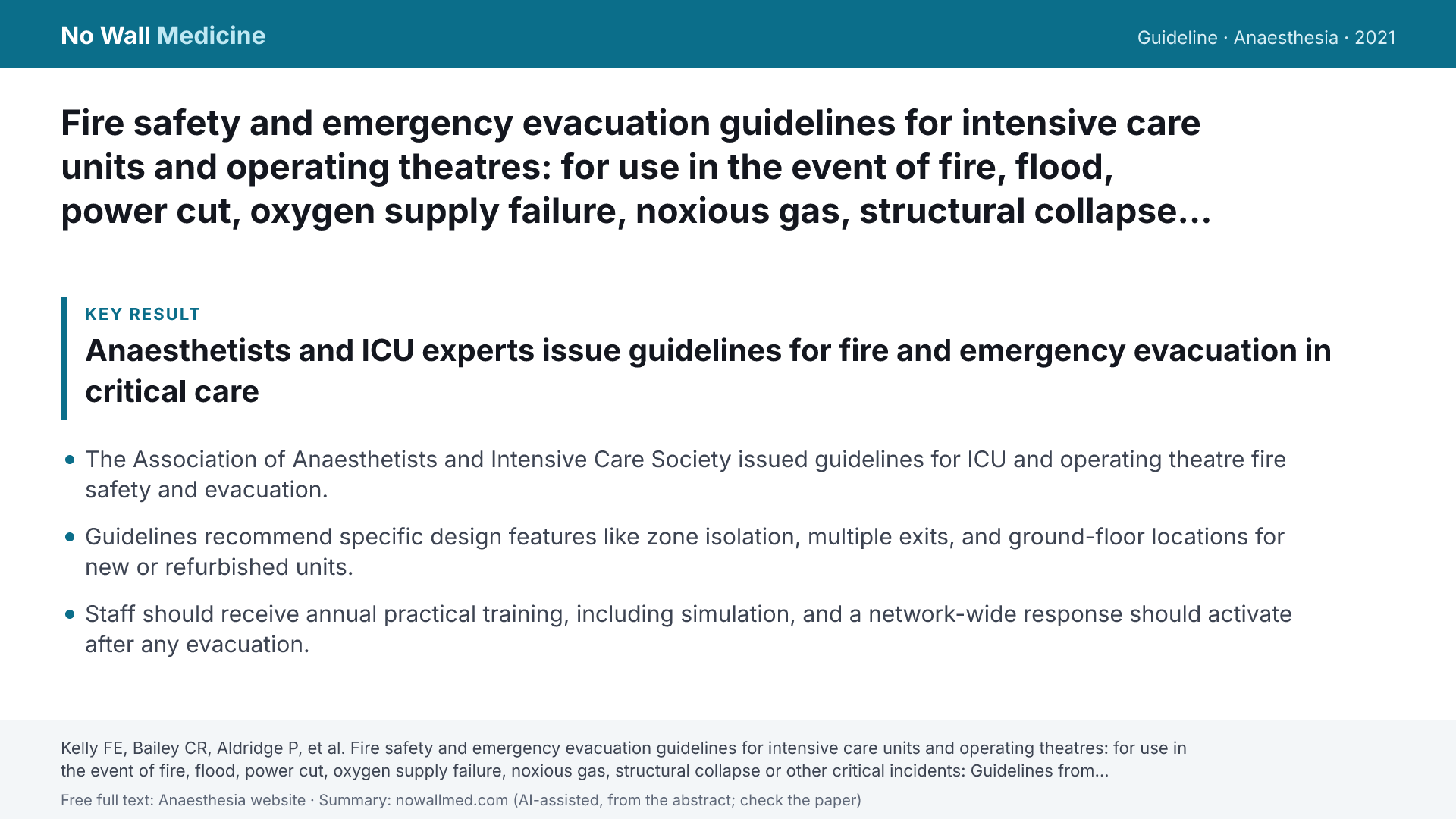
Fire safety and emergency evacuation guidelines for intensive care units and operating theatres: for use in the event of fire, flood, power cut, oxygen supply failure, noxious gas, structural collapse or other critical incidents: Guidelines from the Association of Anaesthetists and the Intensive Care Society
Key result: Anaesthetists and ICU experts issue guidelines for fire and emergency evacuation in critical care
Key points
- The Association of Anaesthetists and Intensive Care Society issued guidelines for ICU and operating theatre fire safety and evacuation.
- Guidelines recommend specific design features like zone isolation, multiple exits, and ground-floor locations for new or refurbished units.
- Staff should receive annual practical training, including simulation, and a network-wide response should activate after any evacuation.
Why it matters: Evacuating critical care units during emergencies is rare but difficult, posing risks to patients and staff that require standardized safety measures.
Discussion prompts
- Would these patients look like yours? Who was left out?
- Is the main outcome one that matters to patients?
- Is the difference large enough to change what you do?
Cite: Kelly FE, Bailey CR, Aldridge P, et al. Fire safety and emergency evacuation guidelines for intensive care units and operating theatres: for use in the event of fire, flood, power cut, oxygen supply failure, noxious gas, structural collapse or other critical incidents: Guidelines from the Association of Anaesthetists and the Intensive Care Society. Anaesthesia. 2021;76(10):1377-1391. doi:10.1111/anae.15511
Free full text: Anaesthesia website · Summary and visual abstract: nowallmed.com/a/fire-safety-and-emergency-evacuation-guidelines-for-intensive-care-18zp3rz/ (AI-assisted from the abstract; check the paper before relying on it).